
On this page
Less manual Timeline Brief preparation time, subject to matter complexity, document quality and review protocol.
Relevant clauses surfaced from a 400+ page contract, with surrounding context preserved.
Modes available: CreateOS cloud, firm environment, or fully on-premise.
Free beta on one live matter under NDA, no commitment.
The Challenge
Before any litigation strategy begins, someone has to understand the matter file. Litigation runs on matter files: contracts, notices, emails, handwritten notes, photographs, and scanned evidence that arrive as a folder, across multiple emails, or sometimes dropped in as hard copies. The record has to be read before anyone can think.
Existing legal AI tools focus on research, drafting, contract review, and discovery. The work that happens before all of that, turning raw matter files into a case-ready workspace, has remained manual. Paperbooks contain typed pages, handwritten notes, photographs, site maps, emails, screenshots, and annexures bundled together. Images, maps, charts, signatures, stamps, and scanned exhibits get lost when ordinary extraction tools squeeze the record into plain text.
The record, in the form it arrives
- Contracts and notices400+ pages, of which a dozen clauses bear on the dispute.
- Email threadsWhere half the chronology actually lives.
- Handwritten notesNever typed up, and often the only account of a conversation.
One matter file
Messy, visual, incomplete and format-fragile.
- Photographs and exhibitsFlattened or missed entirely by tools built for text.
- Scanned annexuresPaperbooks and scans, arriving as images of documents.
- And what is not thereGaps that surface late, once strategy already depends on them.
The workflow is not broken.
The missing layer is between the raw matter file and the legal mind. That is where CreateOS Timeline Brief sits.
The Impact: What Changes
CreateOS adds three intelligence layers that make each stage of the existing litigation workflow faster, more complete, and auditable, plus a security posture built for legal records.
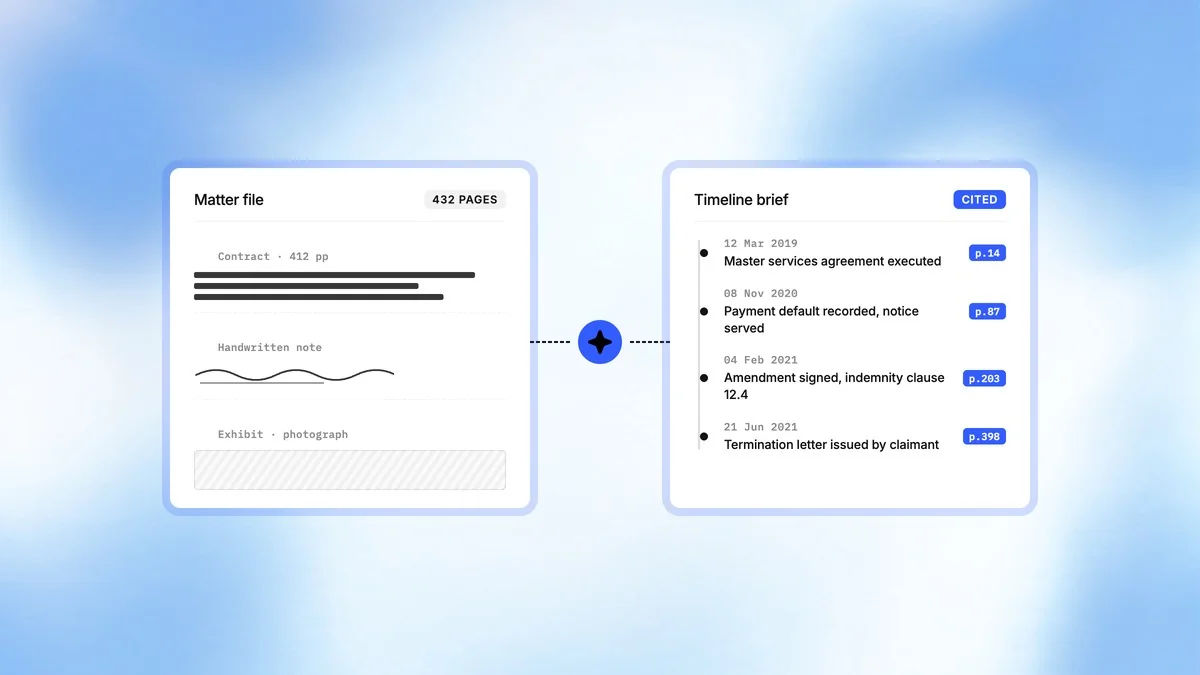
- Narrative Intelligence. Every document type ingested: contracts, notices, emails, handwritten notes, photographs, scanned evidence. Structured case narrative with every fact cited. Page-level context and original layout retained, not flattened. Visual exhibits, maps, diagrams, charts, and tables preserved and interpreted.
- Timeline Intelligence. Chronology built automatically across hundreds of pages. Every entry linked to its source document and page. Undated documents, broken sequences, and missing replies flagged before filing. Gaps surface in the Brief, not in court.
- Clause Intelligence. 400+ page contracts reduced to a focused brief of the dozen relevant clauses. Surrounding context and obligations identified for each. Cross-referencing across multiple documents in a single matter. Partners read the Brief first and the files second.
- Security and Trust. Mutual NDA before any document is shared. Zero data retention by default; documents processed in-session. On-premise or firm-environment deployment available. Unique login per user with a full audit log of every document accessed.
Before & After
Before CreateOS
- Matter files reviewed manually
- Chronology built date by date
- Relevant clauses searched manually
- Missing documents found late
- New lawyers rebuild case history
- Partners spend time on fact-finding
With CreateOS
- Matter files converted into a structured Timeline Brief
- Timeline generated with source-linked entries
- Key clauses surfaced with surrounding context
- Gaps flagged early
- Matter workspace becomes reusable
- Partners start closer to strategy
CreateOS prepares the record.
Lawyers remain in control of judgment, strategy and final use.
The Approach: How CreateOS Solves It
Three intelligence layers, one Brief
Narrative reads every document type the team has and produces a structured case narrative. Timeline builds the chronology automatically and flags what is missing. Clause turns a 400+ page contract into a focused brief of the dozen clauses that bear on the live question. The hero output is a single Timeline Brief per matter, where every line cites its source.
Handles the record the way legal teams receive it
Messy, visual, incomplete, and format-fragile. Ingests PDFs, scans, paperbooks, annexures, emails, screenshots, and mixed-format documents. Preserves and interprets images, maps, diagrams, charts, and tables rather than treating them as blank space. Every output links back to the source page.
Deployed for legal operations, not engineering teams
Sits on top of the matter files the firm already has, on infrastructure the firm chooses. No rebuild of core systems, no engineering team to staff, no DevOps work. The complexity of ingestion, extraction, cross-referencing, and gap analysis still exists; it is just no longer the firm's problem.
Engagement structured with a stop point at every stage
Two weeks of free beta on a real matter under NDA. A 4 to 6 week pilot on 2 to 3 active matters with baseline metrics agreed in writing. Then production rollout (cloud, hosted, or fully on-premise) with either a monthly subscription or annual licence.
Capacity, not cost.
Not fewer billable hours, but more matters handled by the same team, with baselines captured during beta and targets signed off before the pilot begins.
What's Next
The Timeline Brief is the entry point, not the end state. As litigation teams operate the intelligence layer across more matters, the data accumulates: which document patterns predict gaps, which clause configurations recur across a practice area, which workflows compound the most associate time savings. That data feeds back into the engines, making each matter faster and more complete than the last.
Future capabilities being explored include a client-facing legal dashboard where clients can securely upload documents and facts, preferred-channel notifications, and document request workflows across email, messaging, and client portals. The roadmap also includes auto-generated draft emails for missing-document requests, calendar integration for notice dates and hearing reminders, and deeper workflow consolidation so lawyers can reduce switching between email, drives, and document folders.
Get Started
Two ways to start without committing budget or engineering time.
The Broader Lesson
The largest practices compound by closing the gap between the record they receive and the workspace they can act on. Litigation practices have proven they can carry enormous matter volume on a workflow built around partner judgement and associate diligence. The competitive advantage now lies in what sits between document intake and strategy. When narrative, timeline, and clause intelligence all run reliably on the firm's own matter files, the team is no longer doing anything technically remarkable. It is simply opening every matter with the Brief partners would have wanted on day one.
“Litigation teams don't have a fact problem. They have a fact-finding problem. The workflow is right. What's missing is the intelligence layer that sits between the documents and the strategy meeting. CreateOS exists to put that layer in place, on the firm's own infrastructure, with every fact cited and every gap flagged before the first hearing.”
Sheena Kohli · Legal and Investor Relations Lead, CreateOS
Highlights
- Designed to reduce manual Timeline Brief preparation time by up to 40%, depending on matter complexity and document quality.
- Reads mixed matter files in full: contracts, notices, emails, handwritten notes, scanned annexures, photographs, screenshots, and evidence.
- Surfaces a 400+ page contract as the dozen clauses that bear on the live litigation question, each with surrounding context.
- Zero data retention by default; CreateOS cloud, firm environment, or fully on-premise deployment.
About the Partner
Built for litigation teams handling matters across commercial disputes, regulatory proceedings, arbitration, constitutional matters, and complex advisory work. The CreateOS partnership expands what these teams can do before the first strategy meeting by adding an intelligence layer on top of the workflow they already run, with no engineering required and full source traceability embedded in. Target users include partners, associates, and litigation operations leads at law firms; deployment is CreateOS cloud, firm environment, or on-premise, with zero data retention by default.