On this page
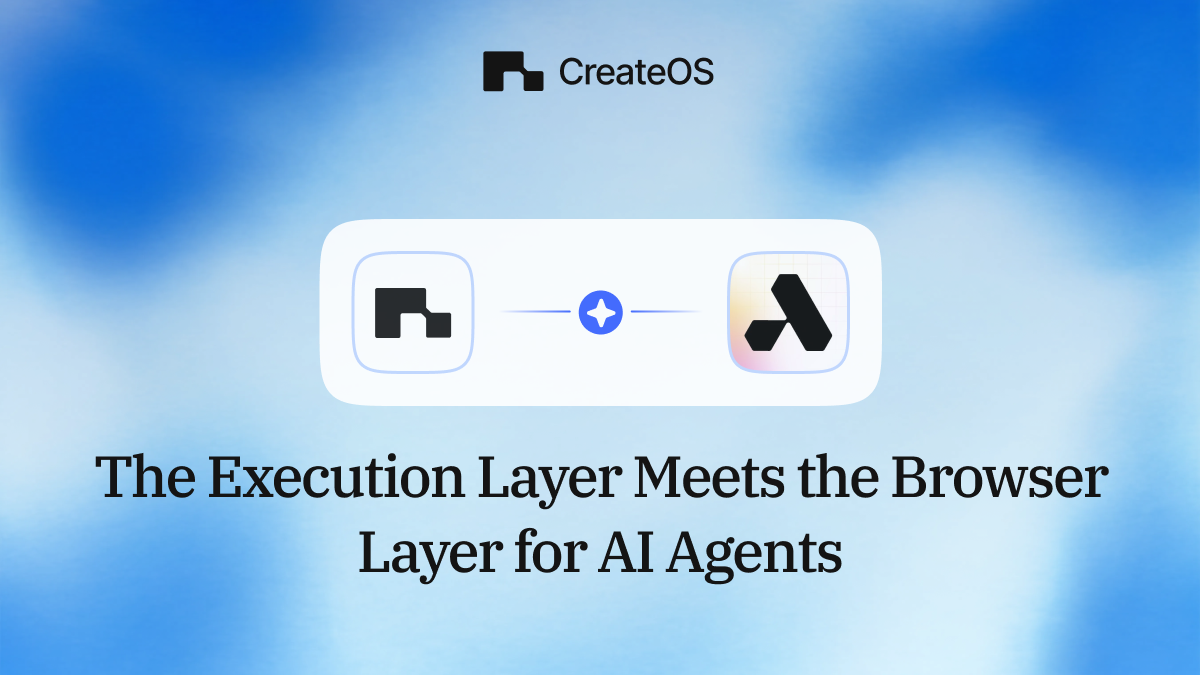
CreateOS and Anchor: The Execution Layer Meets the Browser Layer for AI Agents
CreateOS Sandbox now ships with Anchor browser built in. Bring your own Anchor key, and every agent in Sandbox, whether it is Claude, Codex, or any other framework, gets browser access automatically with no separate setup.
AI agents today can reason, plan, and execute. But the moment an agent needs to log into a real account, click through a web flow, or hold a session without getting flagged as a bot, most infrastructure falls short. Model improvements do not change the fact that the web was built for humans, not agents.
CreateOS handles the execution layer. Anchor solves the other half: giving the agent a browser it can actually trust in production. Together, they cover what an enterprise agent needs to operate reliably.
What Breaks Browser Agents in Production
Before getting into the integration, it is worth naming what actually goes wrong when browser agents leave the demo and hit production.
- Bot detection. Most SaaS applications sit behind services like Cloudflare, Akamai, DataDome, reCAPTCHA, and Fingerprint, designed specifically to keep automated browsers out.
- Authentication at scale. MFA, session management, and identity flows assume a human at a keyboard. They break when hundreds of agents need to authenticate concurrently.
- Security and isolation. Agents can take unintended actions if they are not properly sandboxed. A browser session with access to a production system needs the same isolation as any other workload.
- Speed and reliability. Dynamic pages, fragile selectors, and timeouts make browser tasks slow and prone to failure.
- Cost efficiency. Retries, token usage, and browser infrastructure add up fast at enterprise scale.
None of these are model problems. They are browser infrastructure problems.
What the CreateOS and Anchor Partnership Changes
CreateOS handles the execution layer. Every agent runs in its own Firecracker microVM with its own kernel, eBPF egress controls, and full audit logging. The Sandbox provides the isolated environment for agents to operate.
Anchor provides the browser layer inside that environment. This includes Anchor Chromium for humanized fingerprinting, Anchor VPN for clean network identity, and Anchor Authentication for managed credentials and persistent sessions.
How It Works
- Get an Anchor key.
- Use it with your CreateOS Sandbox.
- Every agent running in Sandbox automatically gets access to the Anchor browser.
- Anchor runs as a container inside the Sandbox, handling Chromium, VPN, and Authentication.
- The agent reaches target web applications as a trusted, authenticated session.
No additional infrastructure. No separate setup.
Why This Matters
Most AI agent infrastructure stops at code execution. Agents can generate, run, and test code, but many real-world tasks live inside web applications. This partnership extends the Sandbox beyond code execution into browser-based interaction, with the same isolation, audit controls, and lifecycle management applying to browser sessions.
Get Started
If you are already using CreateOS Sandbox, bring your Anchor key and your agents will have browser access immediately. If you are new to Sandbox, start at createos.sh and add Anchor to your workflow.