On this page
Annual saving on case-handling cost.
Cost per case falling from $10 to roughly $7 ($6.00 to $7.50).
Capacity returned as FTE-equivalents (redeployed, not removed).
Regulation E resolution within the ten-day clock.
Challenge
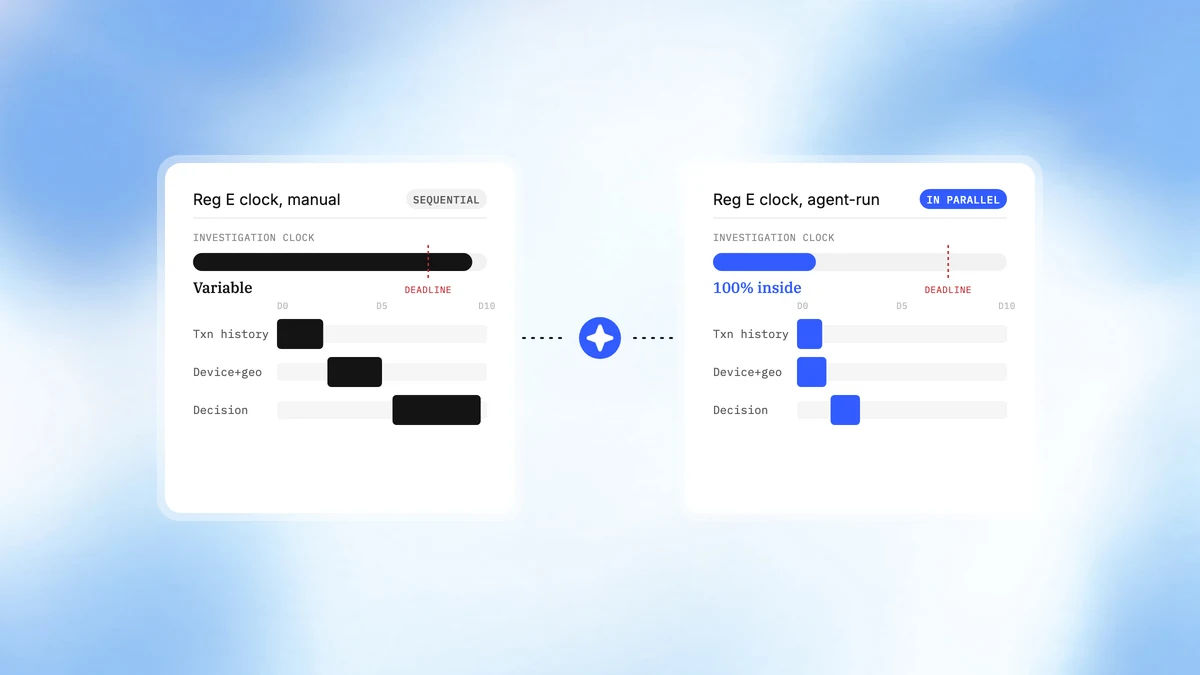
Regulation E gives the bank ten business days to investigate a customer's fraud claim (12 CFR 1005.11(c)(1), eCFR), and the bank absorbs the loss unless it can affirmatively evidence first-party fraud. The investigation can run to 45 days, but only if the account is provisionally credited inside the ten.
- Miss the deadline and the decision is taken away. Provisional credit is issued automatically, whether the claim was valid or not.
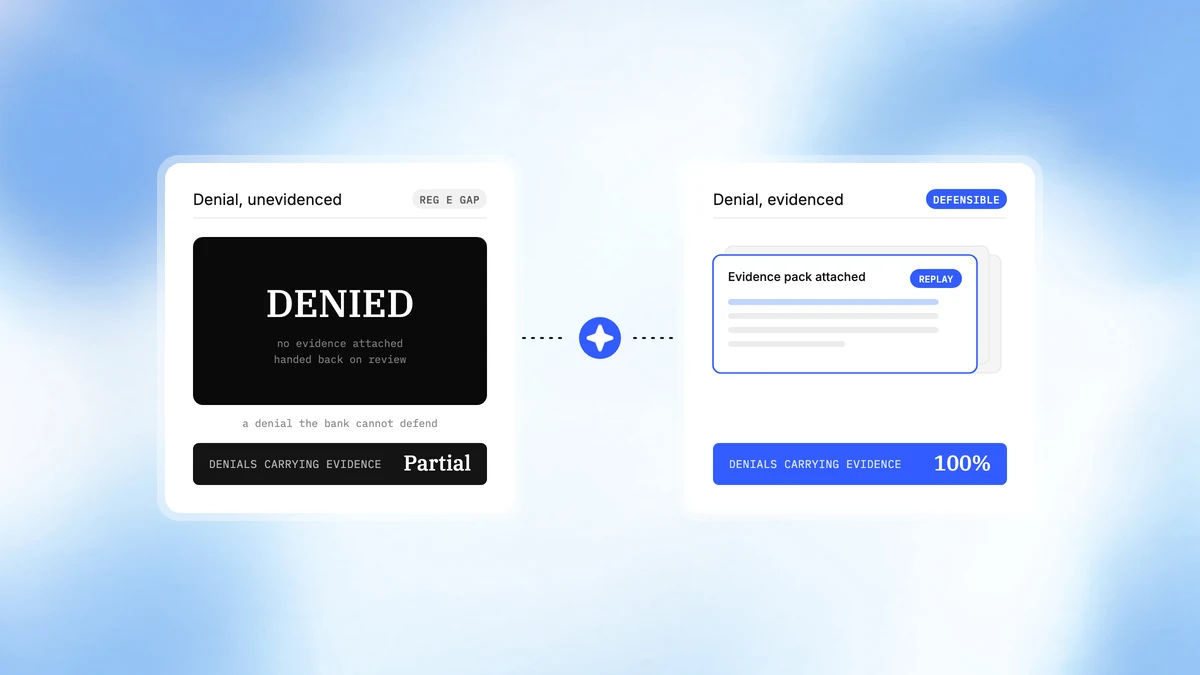
- Resolve it fast but without evidence and you buy a different problem. A wrongful denial becomes a complaint and a regulatory exposure.
- $9.08 to $10.32 per disputed transaction, before any loss is written off. US chargeback volume is projected at 146 million cases worth $15.3B in 2026, and global chargeback value climbs from $33.79B in 2025 toward $41.69B by 2028.
- Volume is rising faster than headcount can. Dispute rates jumped 78% year over year in one recent quarter, against back offices of hundreds of investigators.
- The day is spent assembling, not deciding. Pulling transaction history, checking device and counterparty signals, and building a case file by hand, against a clock, for a decision that must survive an examiner's review years later.
- Why disputes lagged behind other fraud work. It touches live payment data and can move money, and most agent vendors cannot tell a bank's security function where any of it runs.
Solution
CreateOS deploys a dispute investigation crew inside the bank's own environment, running each case end to end under the Regulation E clock.
- The clock is tracked from intake, per case. Every dispute opens its own isolated case environment with the deadline running from the moment of intake.
- Built not to falsely accuse a legitimate customer. A wrong first-party-fraud finding is a complaint and a reputational event, so the claim is captured cleanly rather than pre-judged.
- Evidence is gathered in parallel, not in sequence. Transaction history, device signals, counterparty patterns, and prior behaviour arrive as one evidenced case instead of a day of tab-switching.
- The bank's own loss policy decides the outcome. Applied consistently, with a defensible accept-or-deny rationale prepared inside the deadline and every step logged as it happens.
- Clear cases resolve in minutes, exceptions reach a person prepared. A human gets the case already assembled with the open questions surfaced, rather than a raw claim and an empty folder.
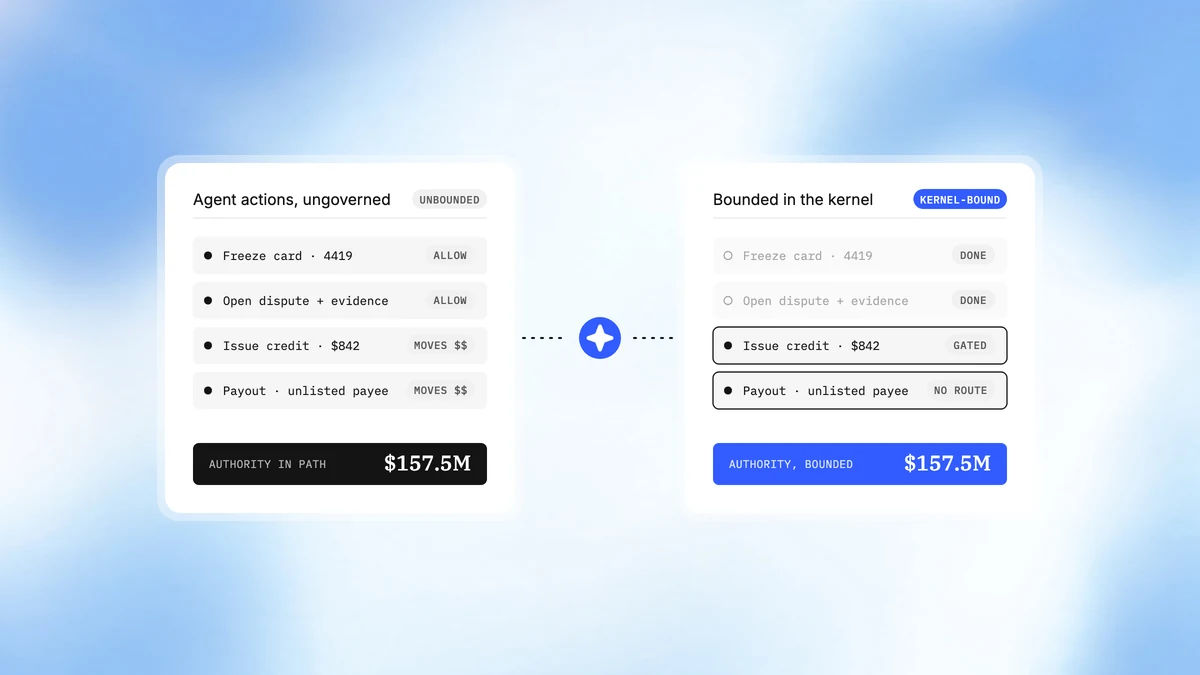
- An agent that can issue credit is bounded in the kernel. Egress is allowlisted to sanctioned payment-system paths, so an agent that is wrong or manipulated cannot move money to an unapproved destination. VM suspension is the kill switch.
- Payment data never leaves the boundary. Control plane and storage sit inside the bank's own infrastructure and region. CreateOS is SOC 2 Type II and ISO 27001 certified.
One case, against the ten-day clock
- 01
Intake opens the case and starts the clock
Reads The customer's claim, captured without presuming fraud
Emits An isolated case environment, deadline running
- 02
Evidence gathered in parallel
Reads Transaction history, device and counterparty signals, prior behaviour
Emits One assembled case file, not four sequential lookups
- 03
The bank's own loss policy decides
Reads The assembled file, against the bank's stated policy
Emits An accept or deny rationale, every step logged
- 04
Credit moves, or a person picks it up
Reads Clear cases resolve; exceptions route to an investigator
Held Money movement, on kernel-allowlisted payment paths only
Outcome Derived
The committed number here is an operational one, and that is deliberate: a 25% to 40% reduction in case-handling cost is a process gain that travels between banks, which makes it safe to put in a contract.
- $3.75M to $6.0M a year. Cost per case falling from $10 to roughly $7, on the committed 25% to 40% reduction.
- 50 to 80 FTE-equivalents of capacity returned. Redeployed onto judgment work, not removed from the organization.
- 100% Regulation E resolution inside the ten-day clock. With full audit coverage, so provisional credit is never forced by a missed deadline.
- Modelled, not borrowed. The range is our own, built from the bank's cost per case rather than from a third-party automation benchmark, and it is the figure we expect to be measured against.
Modelled on a Representative Mid-Size Bank
| Assumption | Figure |
|---|---|
| Fraud and dispute cases per year | 1,500,000 |
| Fully loaded handling cost per case | $10 (research range: $9.08 to $10.32) |
| Resulting dispute operation | ~200 FTE, consistent with the "hundreds of staff" industry norm |
| Average dispute value | ~$105 (derived from 146M US cases at $15.3B) |
The cost base every saving comes out of
1,500,000
Fraud and dispute cases a year
$10
Fully loaded handling cost per case
$15.0M
Spent a year assembling evidence, before any loss is written off
What the bank spends today
- Case-handling cost: 1,500,000 x $10 = $15.0M per year
- Roughly 200 back-office investigators, the majority of whose time goes to evidence assembly rather than judgement
- Provisional-credit exposure on every case that runs past the ten-day clock
- A cost base that grows with dispute volume, which is rising, not falling
What the agent delivers
| Metric | Before | After |
|---|---|---|
| Cost per case | $10 | $6.00 to $7.50 |
| Annual case-handling cost | $15.0M | $9.0M to $11.25M |
| Annual saving | , | $3.75M to $6.0M |
| Capacity returned | , | 50 to 80 FTE-equivalents |
| Time to action on reported fraud | Hours to days | Near-real-time; minutes on clear cases |
| Regulation E resolution | Variable | 100% within the ten-day clock |
| Unauthorized money movement | Risk | Zero, enforced in-kernel |
| Audit coverage of decisions and actions | Partial | 100% |
Headline: $3.75M to $6.0M per year, with cost per case falling from $10 to roughly $7.
Two points that matter more than the headline.
The capacity is redeployed, not removed. Fifty to eighty FTE-equivalents of freed time is not a headcount cut, and we will not sell it as one. It is the evidence-assembly half of the job coming off the team so investigators spend their day on judgement calls and genuine fraud. Any vendor promising a bank it can eliminate its dispute function is losing the room in the first meeting.
The saving compounds, because it is unit economics rather than a fixed cut. Dispute volume is growing. Chargeback value rises 23% between 2025 and 2028, and one recent quarter saw dispute rates climb 78% year over year. A bank that holds its cost per case at $10 watches its dispute budget grow in lockstep with the problem. A bank at $7 per case has bent the curve, and the gap widens every year the volume climbs.
Regulation E exposure, presented as loss avoidance rather than a headline number. Every dispute resolved inside the ten-day clock with defensible evidence avoids two distinct costs: the automatic provisional-credit absorption that comes with running late, and the wrongful-denial complaints that come with thin evidence. We deliberately do not attach a dollar figure to this, because it depends entirely on the bank's current miss rate and denial-overturn rate. We measure both in Phase 0 and let the bank's own numbers size it.
What We Would Prove, and How
| We commit to | We validate on your data |
|---|---|
| 25% to 40% case-handling cost reduction | Current Regulation E miss rate and provisional-credit absorption |
| 100% Regulation E resolution within the clock | Wrongful-denial and complaint-overturn rates |
| 100% audit coverage of every decision and action | True fully loaded cost per case |
| Zero unauthorized money movement | Case-mix split between clear-cut and genuinely contested |
The first deliverable of the engagement is not the agent. It is the bank's measured baseline: actual cost per case, dispute volume, current Regulation E performance. Everything above is re-run against those real numbers, and that baseline becomes the yardstick in the contract. It protects both sides, and it is the reason a procurement team can sign it.
Highlights
- $3.75M to $6.0M per year, with cost per case falling from $10 to roughly $7.
- 25% to 40% reduction in case-handling cost, the committed operational number.
- 50 to 80 FTE-equivalents of capacity returned (redeployed, not removed).
- 100% Regulation E resolution within the ten-day clock; 100% audit coverage.