On this page
Annual money-movement authority an action agent sits in the path of.
Unauthorized money movement, enforced in-kernel.
Of decisions and actions logged, step by step.
Time to halt a misbehaving agent: VM suspension.
Challenge
90% of financial institutions already use AI somewhere in fraud detection. The models work. The projects die on how the agent's authority is bounded.
- A useful fraud agent has to act, not advise. Block a transaction, freeze a card, issue provisional credit, raise a chargeback. An agent that can only recommend has moved the work to a human queue and saved nobody anything.
- Every one of those actions is irreversible. Taken in seconds, at volume, against live money, by software, and not undone with a rollback.
- The industry's usual answer fails on its own logic. Guardrails in the prompt, policy in the application layer, alignment in the system card. All of it places the control inside the thing that might malfunction.
- A compromised agent is the one whose instructions you cannot trust. Asking it to respect its own guardrails is asking the suspect to guard the evidence.
- The inputs are adversarial by design. Fraud data is hostile by nature and attackers know a machine is reading it, and the agent runs against the payment stack, the highest-value target in the bank.
- Most vendors cannot fix this, structurally. They own the model and rent the runtime. When the agent can freeze cards and issue credits, that is backwards: you cannot make a hard promise about a layer you do not control.
Why the projects die
- It has to act, not adviseFreeze a card, issue credit, raise a chargeback.
- Every action is irreversibleLive money, in seconds, at volume.
- The usual answer is self-referentialThe control sits inside the thing it governs.
Control inside the agent
Guardrails, policy and app checks all sit in the layer that might malfunction.
- A compromised agent cannot vouch for itselfThe suspect is asked to guard the evidence.
- The inputs are adversarial by designAttackers know a machine is reading.
- Most vendors cannot fix itThey own the model and rent the runtime.
Solution
CreateOS owns both the agents and the infrastructure they run on. That is what makes the following promises enforceable rather than aspirational.
Where each control actually lives
Model and rented runtime
CreateOS
Payment destinations
Payment destinations
Policy in the prompt
eBPF allowlist in the kernel
Adversarial payload lands
Adversarial payload lands
Shared container, shared host
Its own micro-VM, disposable
Agent misbehaves
Agent misbehaves
Revoke, redeploy, escalate
Suspend the VM
Card and payment data
Card and payment data
Vendor cloud, vendor region
The bank's own region
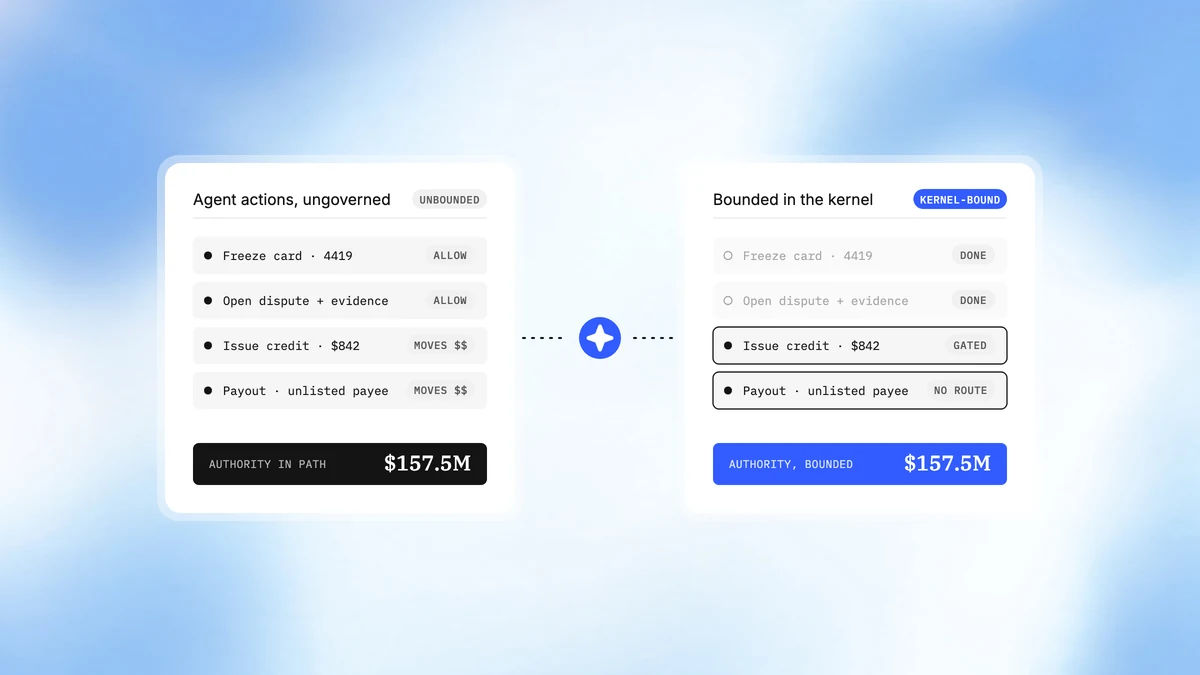
- Sanctioned payment paths are the only paths that exist. Egress is allowlisted in the kernel. This is not a rule the agent is asked to follow, it is a route absent from the kernel's networking, so a manipulated or simply wrong agent cannot exfiltrate payment data or move money to an unapproved destination. There is no wire to do it on.
- Every agent runs in its own kernel. Each scoring job and investigation executes in its own micro-VM rather than a shared container on a shared host, so a malicious payload in a transaction record or merchant field is contained to a disposable machine.
- The kill switch is the VM lifecycle, not a support ticket. A misbehaving agent is suspended instantly. No credential to revoke, no deployment to roll back, no window in which it keeps acting while somebody finds the right runbook.
- Latency is designed for, not hoped for. Scoring stays warm so decisions land inside the authorization window; investigation forks per case so a backlog processes in parallel. Latency-critical work stays warm, bursty work scales by forking.
- The fraud model stays the bank's to own and document. Control plane and storage run inside the bank's own infrastructure and region, so payment data never leaves. CreateOS is SOC 2 Type II and ISO 27001 certified.
- The crew coordinates privately. Agents communicate over an overlay network with private DNS, behaving as one system inside a private mesh rather than as services exposed to anything.
Outcome Derived
The value here is not a line in the P&L. It is that the fraud programme ships at all. Pilots in banking die in procurement far more often than in proof of concept, and the sentence that kills them is always a variant of we cannot allow that system to take that action.
- Zero unauthorized money movement, enforced in-kernel. The control on irreversible financial action sits below the agent, where the agent cannot reach it.
- $157.5M of annual money-movement authority, bounded. That is the exposure an action agent sits in the path of, and the reason the boundary has to be structural rather than instructed.
- Immediate halt, and a full record. A misbehaving agent stops on VM suspension, with 100% of decisions and actions logged step by step.
The Control Questions a Second Line of Defence Actually Asks
| Metric | Before | After |
|---|---|---|
| What stops the agent moving money somewhere unapproved? | Prompt guardrails, model policy, application-layer checks | eBPF kernel egress allowlist. The route does not exist. |
| Where does an adversarial payload execute? | Shared container, shared host kernel | Firecracker micro-VM with its own guest kernel, disposable per job |
| How fast can you stop a misbehaving agent? | Revoke credentials, redeploy, escalate | Suspend the VM. The lifecycle is the kill switch. |
| Where does payment and card data live? | Vendor cloud, vendor region | The bank's infrastructure, the bank's region. It never leaves. |
| Who owns the runtime the agent acts from? | Rented from a third party | We own the agents and the runtime both. |
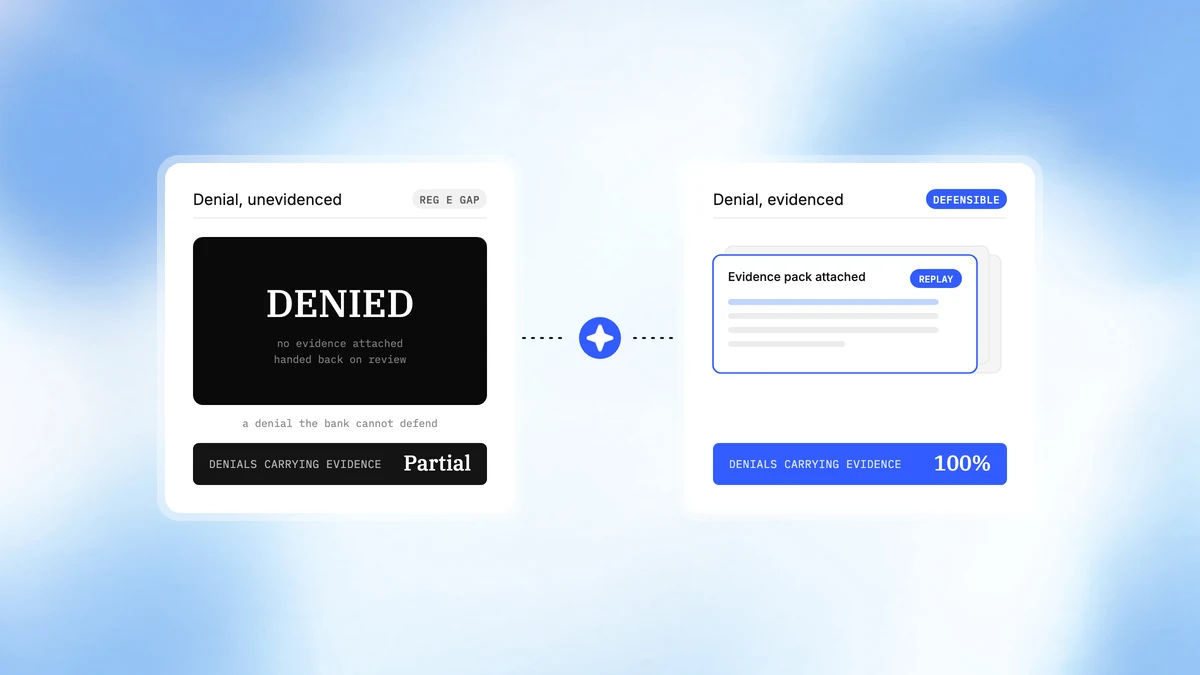
| Can a denial or a freeze be replayed for an examiner? | Partial application logs | 100% of decisions and actions logged, step by step |
| Can the agent act without a human on high-risk cases? | Configurable, enforced in software | Irreversible actions gated by confirmation and, at the bank's choice, a human |
The Exposure This Bounds
On a representative mid-size bank processing 1,500,000 fraud and dispute cases a year at an average disputed value of roughly $105, an action agent sits in the path of approximately $157.5M of annual money movement authority: card freezes, provisional credits, chargebacks.
Annual money-movement authority
1,500,000
Fraud and dispute cases a year
~$105
Average disputed value
$157.5M
Authority the agent sits in the path of
That is the number to hold in mind when evaluating where the control lives. An advisory guardrail at the model layer is a request applied to $157.5M of authority. A kernel egress allowlist is a physical property of the network the agent runs on.
| Metric | Before | After |
|---|---|---|
| Unauthorized money movement | Bounded by policy and model behaviour | Zero, enforced in-kernel |
| Blast radius of a compromised agent | Shared host, lateral movement possible | Single disposable micro-VM |
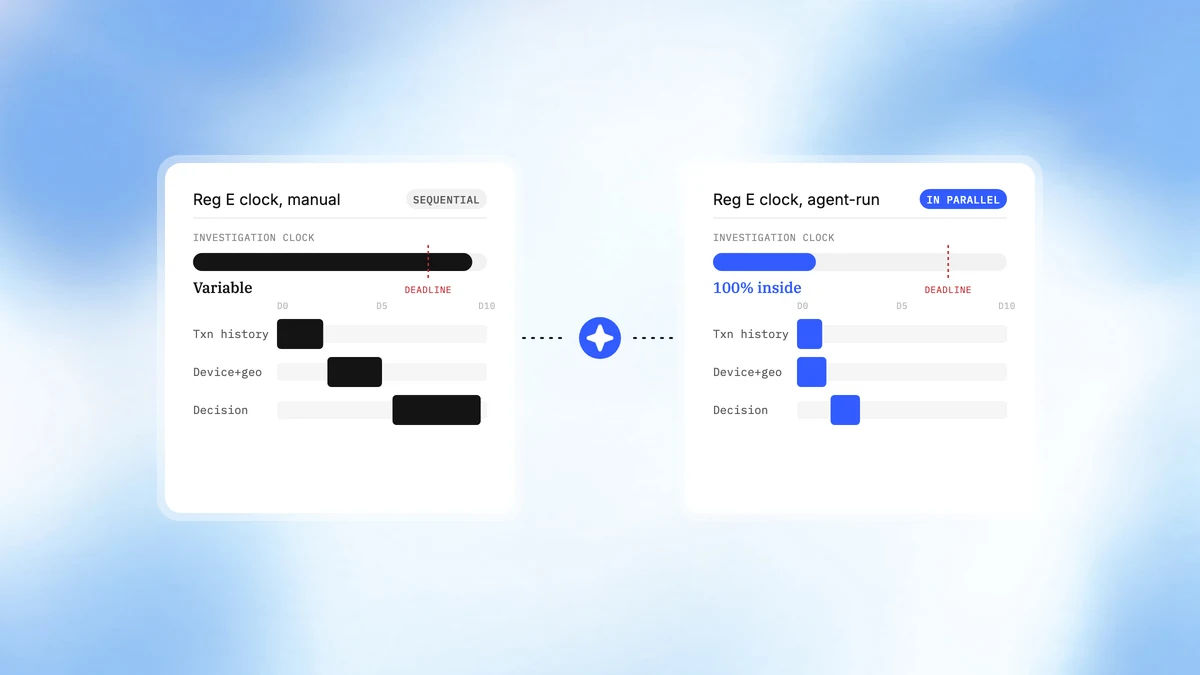
| Time to halt a misbehaving agent | Minutes to hours, process-dependent | Immediate, VM suspension |
| Payment data egress | Vendor-dependent | Kernel-allowlisted paths only |
| Data residency | Vendor region | Bank's region, self-hosted |
| Audit coverage of scores and actions | Partial | 100%, replayable |
What This is Worth Commercially
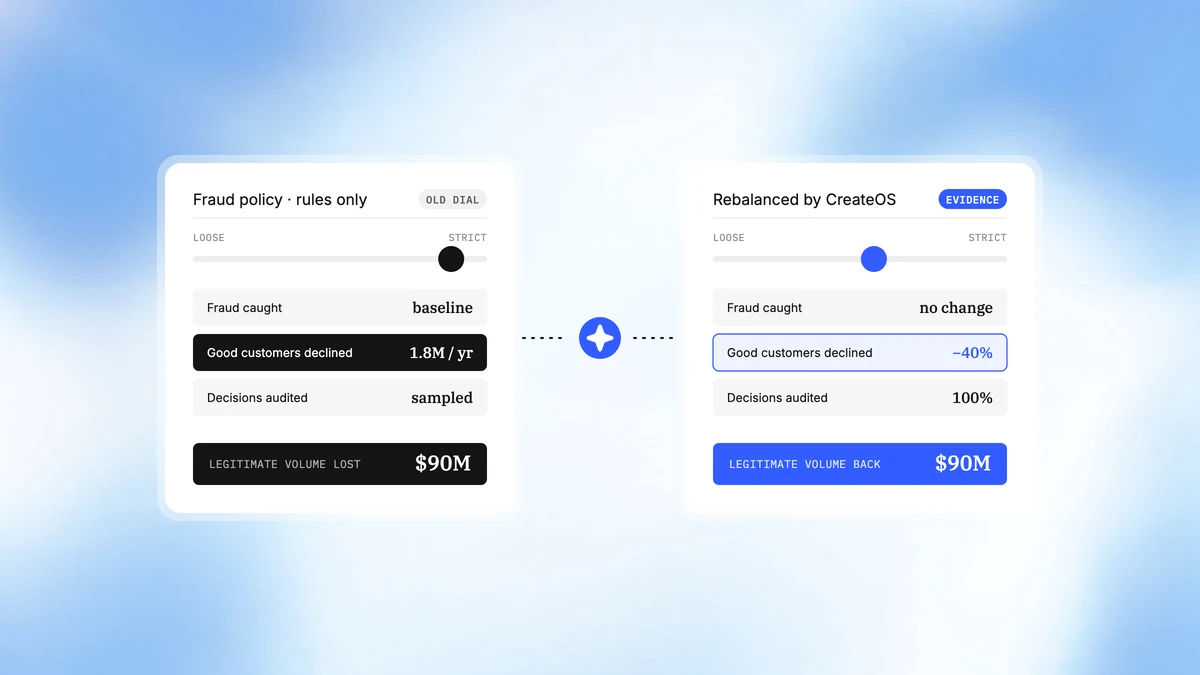
The security review becomes a formality instead of a fight. This is the difference between a fraud program that reaches production in a quarter and one that spends a year in review and quietly dies. Every dollar modelled in the other three fraud use cases, the recovered false declines, the $3.75M to $6.0M in dispute cost-out, the $9M in first-party fraud losses no longer absorbed, is contingent on this one clearing.
What the security review decides
Control argued in review
- A year in reviewThe programme quietly dies in procurement.
- Nothing downstream startsThe other three fraud cases wait on this one.
Control enforced below the model
- Production in a quarterThe review is a formality, not a fight.
- $12.75M to $15M unblocked$9M first-party fraud, $3.75M to $6.0M dispute cost-out, plus recovered false declines.
The bank keeps the model and the liability sits where it belongs. The bank owns the loss policy, the fraud model, and the risk appetite. We own the containment. Neither party is asked to trust the other on something they cannot inspect.
Irreversible actions stay gated. Money-movement actions are confirmation-gated, and the bank chooses which ones require a human. We do not argue for more autonomy than the bank's risk committee is ready to grant, and the controls do not depend on that argument being won.
Nothing Goes Live Blind
The agents run in shadow mode against the current program first, scoring and investigating real cases without binding authority, until the evidence supports the switch. The go-live sequence enables automated action on the clearest, lowest-risk case types first, with money movement gated by the egress allowlist and by confirmation controls, expanding only as the audit record builds confidence.
How the agent reaches live
- 01
Shadow mode
Reads Real cases, alongside the current programme
Held Scores and investigations, binding nothing
- 02
Automated action on the clearest cases
Reads The lowest-risk case types only
Held Money movement, behind the egress allowlist and confirmation
- 03
Scope widens
Reads The audit record built in the stages above
Emits More case types, never ahead of the evidence
Scoring latency is measured against the bank's own peak transaction concurrency during baselining, rather than assumed. Warm services are the design answer to the authorization window, and we would rather find any ceiling in shadow mode than in production.
Highlights
- Zero unauthorized money movement, enforced in-kernel, the control on irreversible financial action.
- $157.5M of annual money-movement authority bounded by kernel egress allowlist.
- 100% of decisions and actions logged, step by step.
- Immediate halt of a misbehaving agent via VM suspension.