Data lineage and traceability: 100% source-to-report.
Annual cost reduction on a $30M reporting and audit-preparation base.
Operational cost reduction, reporting and audit prep.
Unauthorized data egress, enforced in-kernel and self-hosted.
Challenge
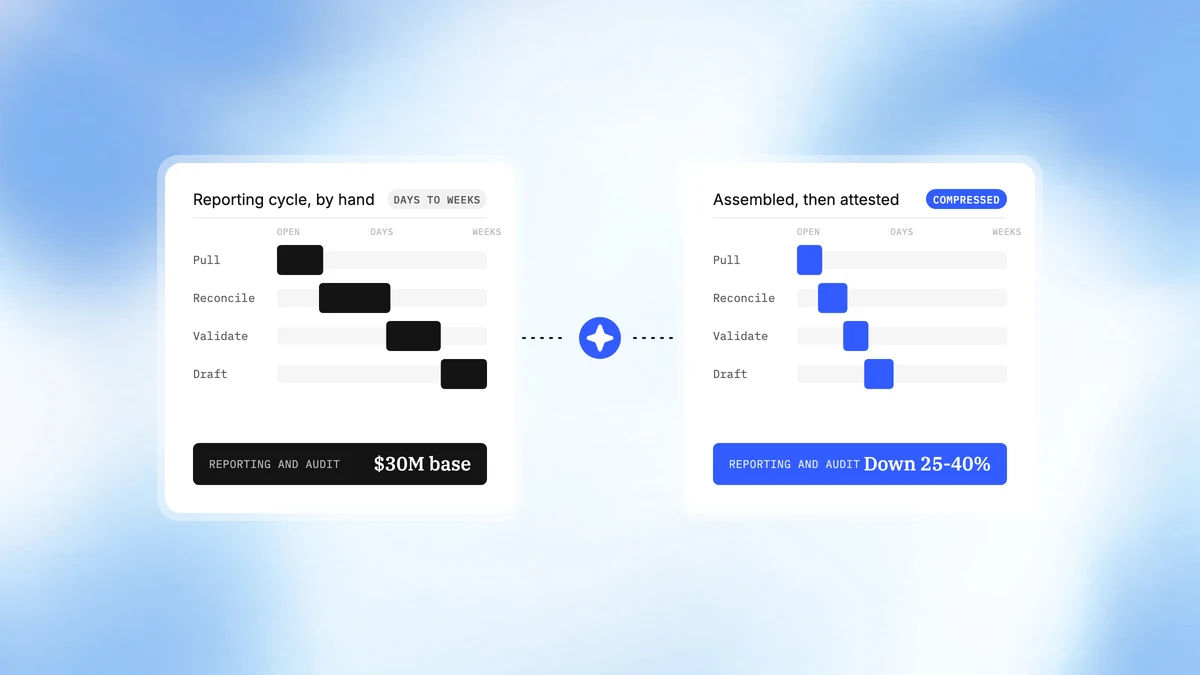
Every reporting cycle looks the same. Data is pulled from dozens of systems that do not agree with each other, reconciled by hand in spreadsheets by people senior enough to know what a break means, then formatted to a regulator's specification and pushed to a human who has to put their name against the number.
- That is one regime, and the institution runs many. Call reports, capital and liquidity returns, transaction reporting, incident reporting, and disclosure. Each pulls the same senior people back into assembly work.
- The accuracy bar is absolute. A misreported figure is not an internal mistake to fix next cycle. It is a supervisory finding, a potential fine, and at worst a restatement.
- The cost is rising and was met by hiring. Employee hours spent complying with financial regulation and examiner mandates rose 61% between 2016 and 2023, while aggregate employee hours rose 20% (Bank Policy Institute, 2024). The response almost everywhere was to add people.
- The regulators have acknowledged the weight of it. The Federal Reserve, OCC, and FDIC issued a joint request for information on streamlining the Call Report, published in the Federal Register on 1 December 2025 with comments due 30 January 2026 (OCC Bulletin 2025-42).
- Every proposal stalled in the same place. The tooling wanted reporting data in a vendor cloud, and lineage assembled outside the boundary is lineage the controllership cannot defend to an examiner.
- Not short of RegTech vendors, short of somewhere to run them. Which is why the function stayed manual.
One return, both ways
Dozens of systems
Built from source
Pull the figures
Pull the figures
From systems that do not agree
From source, on allowlisted paths
Reconcile the differences
Reconcile the differences
By hand, cycle after cycle
One templated run, identical each time
Produce the lineage
Produce the lineage
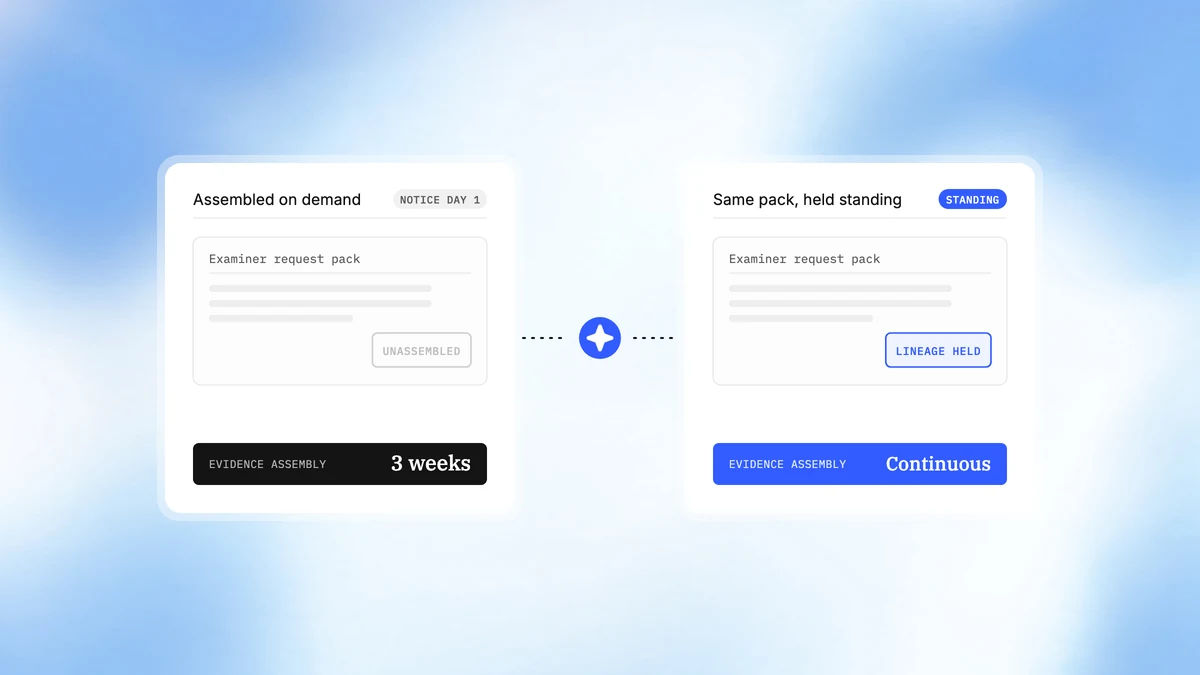
Reconstructed if an examiner asks
Written as each step runs, tamper-evident
Attest and file
Attest and file
A human signs it
A human signs it
Solution
CreateOS built and deployed a crew of specialized agents that take a reporting cycle from "cycle opens" to "regulator-ready return, with every figure traced to its source, waiting for a human to attest it."
Almost all labour, almost none judgment
Data pulled from dozens of systems that disagree, reconciled by hand.
$7.5M-$12.0Ma year on a $30M base
Assembled, validated, drafted
Breaks flagged before they reach a return, built in the regulator's own format.
Nothing is filed autonomously. Compliance responsibility is not delegated to a model.
Nothing is filed autonomously. That is a design constraint, not a limitation, and it reflects the regulatory expectation made explicit in 2025: compliance responsibility cannot be delegated to a model.
- The reporting corpus assembles itself. Required data pulled from source systems, ledgers, and the risk and finance platforms into one place, instead of reconciled by hand across systems that disagree.
- Breaks are flagged before they can reach a return. The corpus is checked for quality, consistency, and completeness against the reporting rules as the run happens.
- The return is drafted in the regulator's own format. Including the narrative where one is needed, so what reaches a human is a draft to review rather than a cycle to assemble.
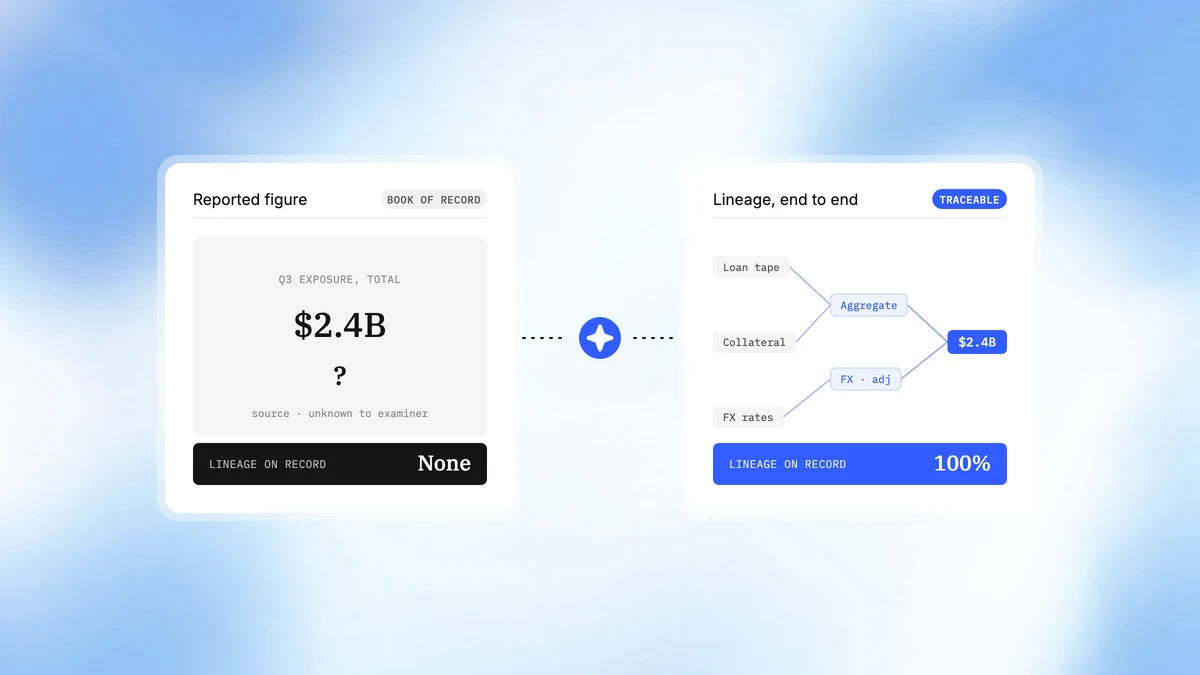
- Lineage is native to the runtime, not bolted on. Every reported figure traces back through a logged, sequenced, tamper-evident trail. In regulatory reporting the lineage is not a feature of the product, it is what the examiner and the auditor actually rely on.
- Separation is what keeps the trail clean. Gathering, validation, assembly, and lineage in distinct contained environments. A monolithic process that does all four is one an auditor has to take on faith.
- The data never leaves the jurisdiction. Control plane and storage run inside the institution's own infrastructure, with egress allowlisted in the kernel to approved internal systems and sanctioned regulator endpoints. That is why the pilot ran on real reporting data rather than a sanitised copy.
- Reproducibility is itself a control. One configured environment executes every cycle identically, so consistency is auditable and drift is a finding. That is what the controllership wanted before it wanted any of the speed.
- Cycles fork and run in parallel. Returns across entities, jurisdictions, and regimes are produced at the same time rather than queuing behind one another.
CreateOS is SOC 2 Type II and ISO 27001 certified. Most agent builders own the prompts and rent the runtime. We own both, which is the reason the internal audit review was a step in the process rather than the end of it.
Outcome Derived
The cycle compressed. The lineage got better than it was under the manual process. The senior people went back to oversight.
| Metric | Before | After |
|---|---|---|
| Reporting cycle time | Days to weeks | Sharply compressed |
| Operational cost, reporting and audit prep | $30M base | Down 25% to 40% |
| Data lineage and traceability | Partial | 100% source-to-report |
| Reporting error rate | Baseline | Reduced via automated validation |
| Reporting process consistency | Drifts cycle to cycle | Identical templated runs |
| Unauthorized data egress | Risk | Zero, enforced in-kernel and self-hosted |
| Human attestation on submissions | Manual | Preserved by design |
- $7.5M to $12.0M a year on a $30M base. 25% is the conservative floor we commit to in a pilot; 40% is the upper end of the general compliance-automation evidence. The saving comes from the three activities that consumed the most senior time and required the least senior judgment.
- The contract is written against the institution's baseline. Measured in the first two weeks of the engagement, not against this model.
- Senior capacity returns from assembly to oversight. 42% of C-suite time and 43% of board time goes to regulatory and supervisory compliance. When assembly moves to the agents, that attention returns to what the breaks mean and what to tell the regulator.
- Risk reduction is context, not a priced promise. Continuous validation catches breaks before they reach a return and lineage lets every figure be defended to source, which reduces both the probability and severity of a finding. We do not headline a dollar figure, because it depends on the institution's current finding rate.
- Where the evidence is thinner, we say so. Reporting savings are institution-specific and rarely disclosed cleanly, so this case has fewer hard published percentages than KYC or AML. A finance reviewer who tests these figures should find them dull and defensible, which is the intent.
What We Would Prove, and How
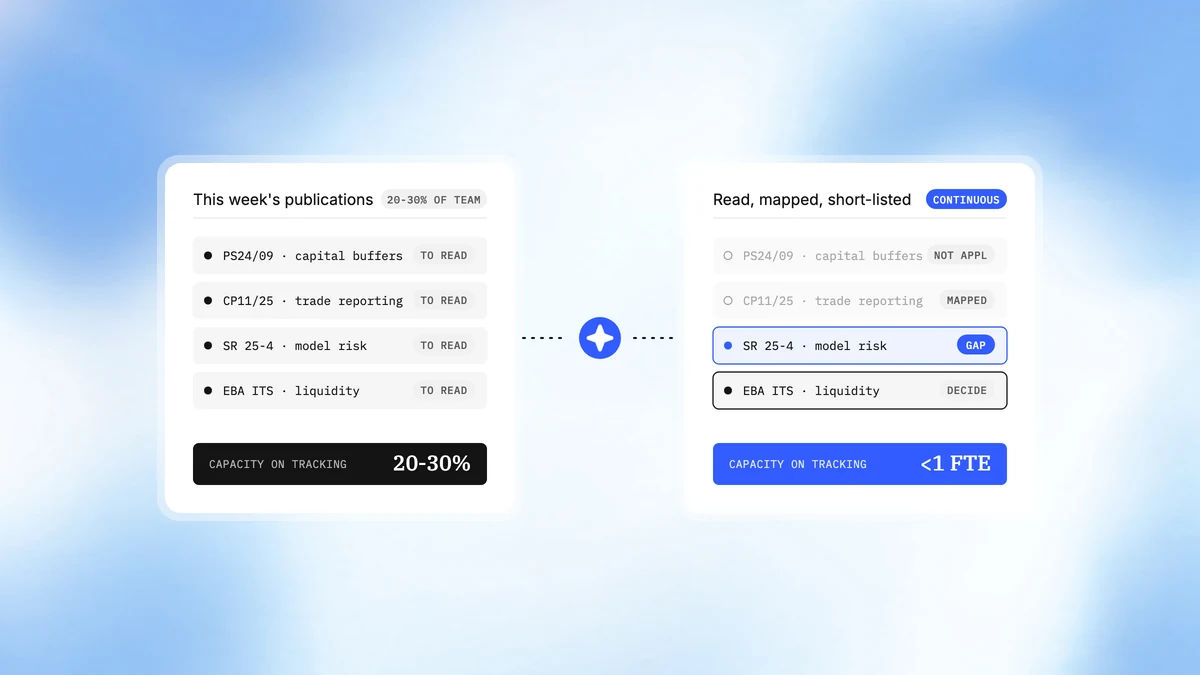
Weeks 1 to 2, baseline. Measure the institution's actual reporting cost and cycle time, its change-monitoring capacity, its error and finding history, and its audit-preparation effort. This becomes the contract's yardstick and protects both sides.
Weeks 2 to 6, build and integrate. Stand up the agent crew, integrate to source systems, ledgers, and reporting infrastructure along allowlisted paths, encode the institution's reporting rules and controls, deploy self-hosted inside the boundary. Scoped to a defined set of returns.
Weeks 6 to 9, parallel run. The agents produce returns alongside the current process without filing anything. Every figure and its lineage is compared against the institution's own filed reports. Proving the numbers and the trail are right is the whole game.
Week 9 onward, controlled adoption. The institution adopts agent-produced returns for the proven regimes, always with a human attesting before submission, expanding scope as the accuracy and lineage record builds.
Success criteria, agreed up front: reporting cost down at least 25%, cycle time materially compressed, reporting accuracy at or above the current process, full source-to-report lineage on every figure, human attestation preserved on every submission, and zero data-residency or leakage incidents.
Highlights
- Data lineage and traceability: Partial → 100% source-to-report.
- Annual cost reduction: $7.5M to $12.0M on a $30M reporting and audit-preparation base.
- Operational cost, reporting and audit prep: down 25% to 40%.
- Unauthorized data egress: Zero, enforced in-kernel and self-hosted.