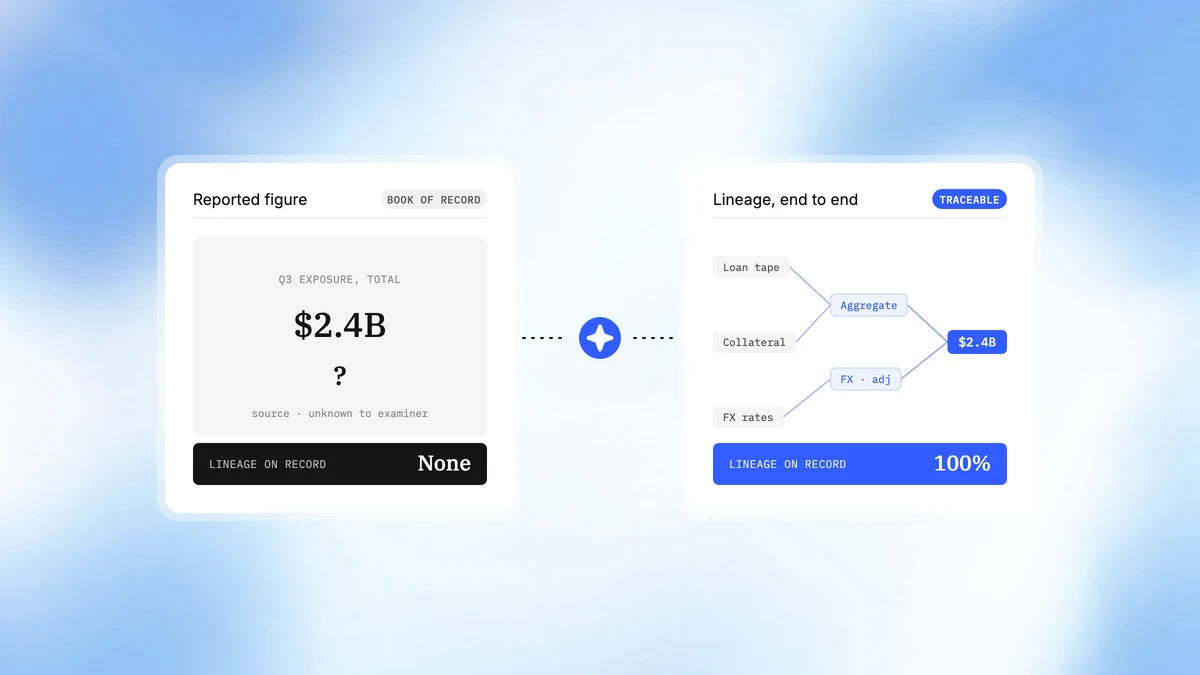
Data lineage behind evidence: 100% source-to-report, logged as it happens.
Cost taken out of audit preparation a year.
Audit preparation: continuous readiness vs per-cycle scramble.
Evidence assembly maintained continuously vs manual across fragmented systems.
Challenge
An examination notice arrives and the institution stops what it is doing. Weeks go into assembling evidence it should have had at hand: control documentation, transaction samples, policy versions as they stood on a given date, the reasoning behind a decision made eighteen months ago by someone who has since left.
- The evidence exists, which is what makes it galling. Scattered across ledgers, document stores, ticketing systems, email, and individual memories, and none of it assembled.
- Then it happens again, and again. For internal audit, then the external auditor, then the next examination cycle, because nothing assembled last time was kept in a form that could be reused.
- The assembly cost is the most expensive way to do it. Senior people, under deadline, at a premium, on the least judgment-heavy work in the compliance function.
- The disruption cost is larger and nobody measures it. A fire drill stops the reporting cycle, defers remediation, and pulls leadership into evidence review. With 42% of C-suite and 43% of board time already going to compliance, an examination takes the remainder.
- The finding you take for the absence of assembly. Not every finding is a control failure. Some are evidence failures: the control worked and the institution could not demonstrate it cleanly enough, fast enough, with a trail an examiner could follow. It is the most avoidable one on the list.
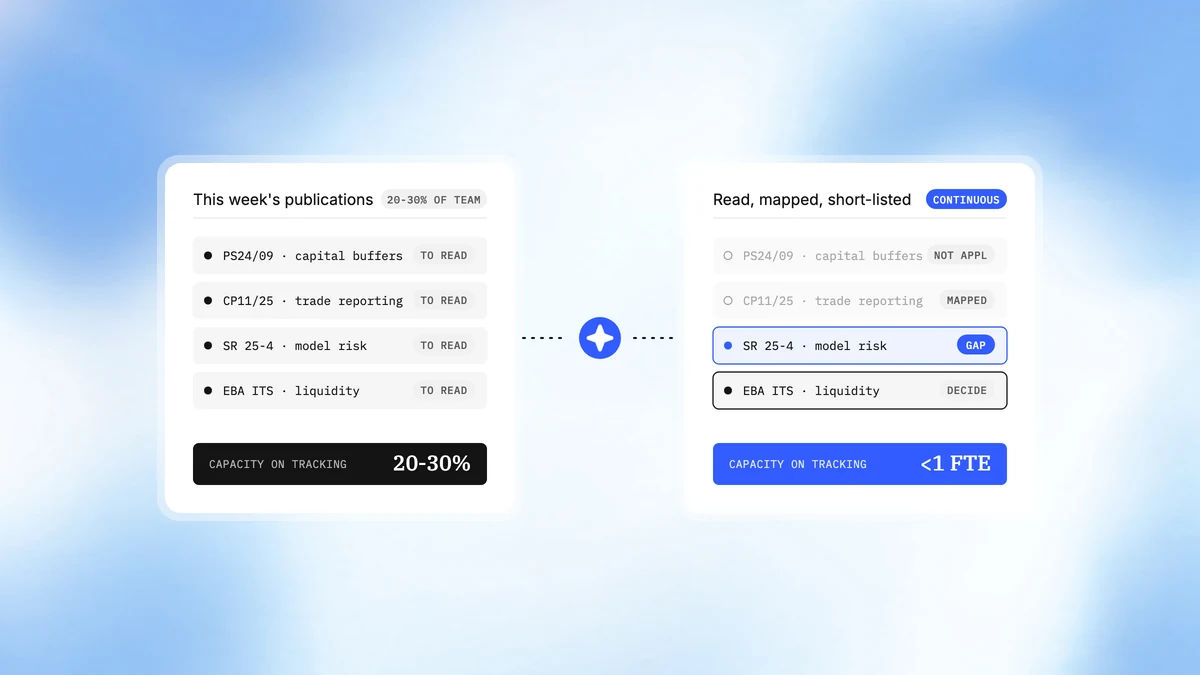
- The demand was not going to fall on its own. The Federal Reserve, OCC, and FDIC request for information on streamlining the Call Report, published 1 December 2025 (OCC Bulletin 2025-42), made that clear.
What scattered evidence costs
- Assembled by senior peopleAt a premium, under deadline, on the least judgement-heavy work there is.
- The fire drill stops everything elseThe reporting cycle pauses and remediation defers.
The evidence exists
Across ledgers, document stores, ticketing, email and memory.
- A finding for the absence of assemblyThe control worked. The institution could not show it in time.
- Then it happens againInternal audit, the external auditor, the next examination cycle.
Solution
CreateOS deployed an audit-evidence and examiner-response agent that keeps the institution continuously audit-ready rather than periodically audit-panicked.
The evidence existed and nobody could find it
Scattered across ledgers, document stores, ticketing systems and email.
Continuousnot per cycle
Held assembled, not excavated
A request list returns retrieval and review, with the lineage already attached.
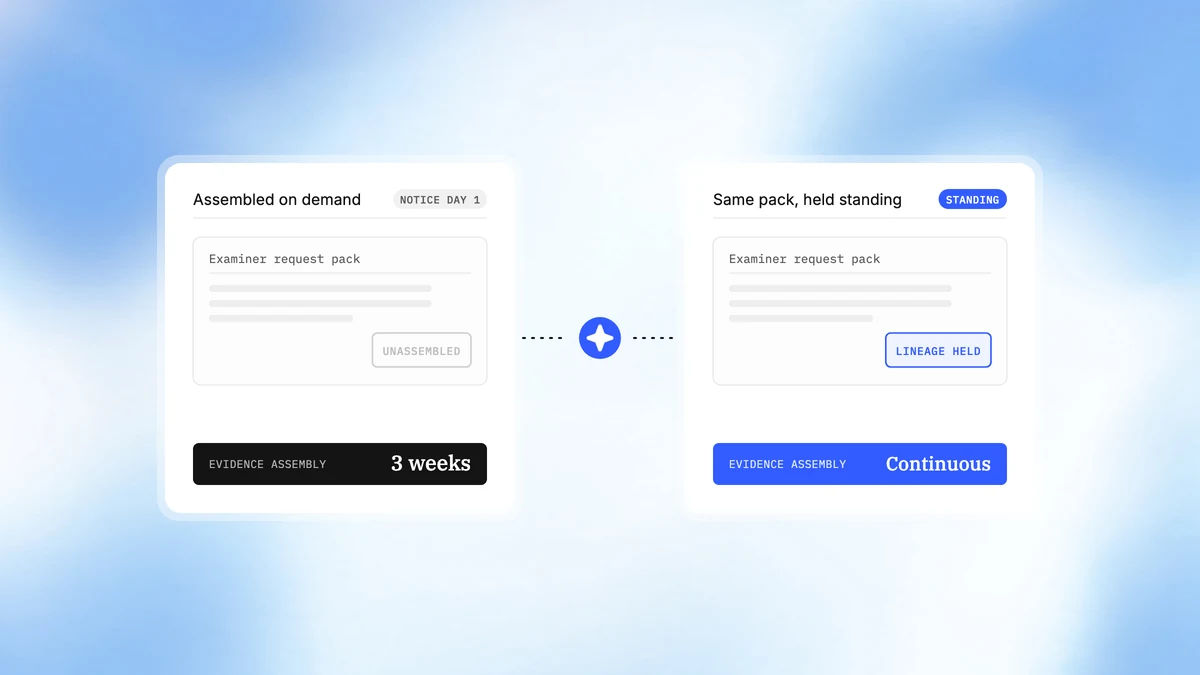
The shift is from assembling evidence when it is demanded to holding it assembled all the time. Evidence packages are maintained as a standing state. When a request list arrives, the response is retrieval and review rather than excavation and reconstruction.
- Evidence is held assembled, not assembled on demand. Packages are maintained as a standing state, so a request list returns retrieval and review rather than excavation and reconstruction.
- A three-week excavation becomes a package with lineage attached. Waiting for a human to review it and decide what goes to the examiner.
- The agent does not answer the regulator. It drafts, assembles, and evidences. A human reviews every response and owns the regulatory relationship, reflecting the 2025 expectation that compliance responsibility cannot be delegated to a model.
- Lineage is the deliverable, native to the runtime. A trail assembled after the fact is a reconstruction. A trail written as the work happens is evidence, and that is how the system records itself while it runs.
- Reproducibility is a control internal audit asked about first. One configured environment executes every cycle identically, so consistency is auditable and drift is a finding.
- Evidence never leaves the boundary. Control documentation, exception histories, and decision records stay inside the institution's own infrastructure and jurisdiction, with egress allowlisted to approved internal systems and sanctioned regulator endpoints.
- Every run is contained in its own guest kernel. Keeping sensitive finance, risk, and control data inside a hard boundary.
CreateOS is SOC 2 Type II and ISO 27001 certified, which means the institution's own controls evidence for the platform running its controls evidence is already in place.
Outcome Derived
Audit readiness stopped being an event.
| Metric | Before | After |
|---|---|---|
| Audit preparation | Per-cycle scramble | Continuous readiness |
| Examiner-response time | Weeks of assembly | Materially faster, retrieval not excavation |
| Evidence assembly | Manual, across fragmented systems | Standing, maintained continuously |
| Data lineage behind evidence | Partial, reconstructed | 100% source-to-report, logged as it happens |
| Process consistency | Drifts cycle to cycle | Identical templated runs, auditable |
| Reuse between audit cycles | None | Standing evidence base |
| Human ownership of the regulator relationship | Manual | Preserved by design |
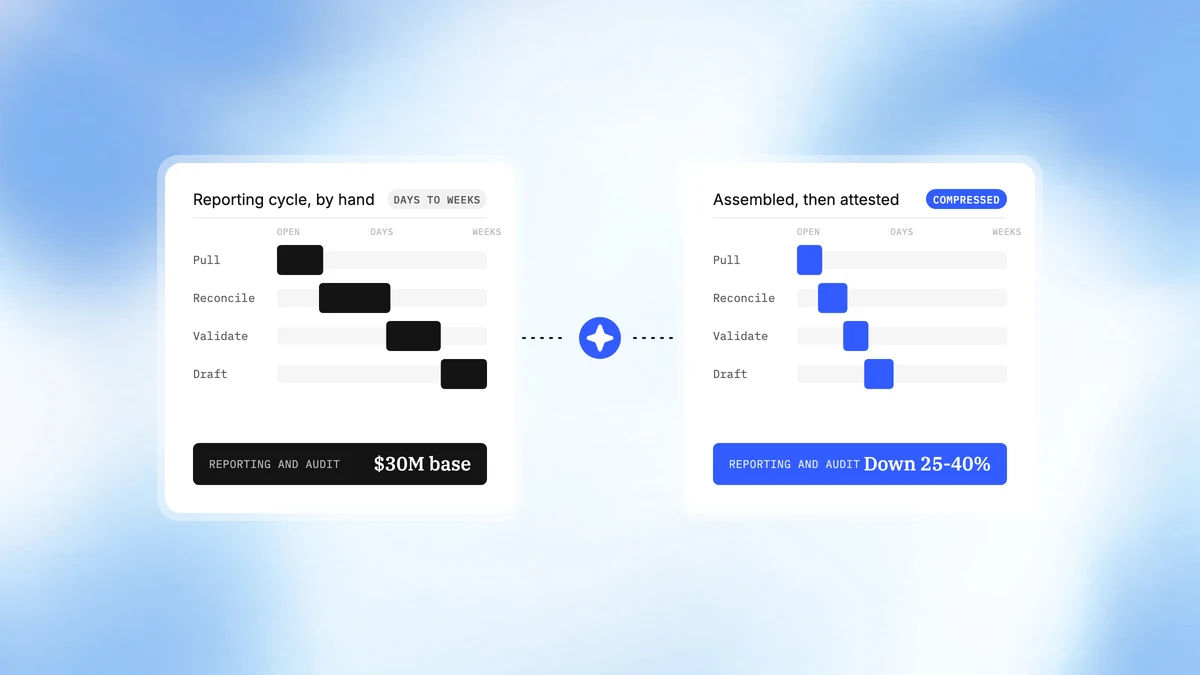
Audit readiness stopped being an event, and $1.5M to $2.4M a year came out of preparation.
- The smallest headline in this series, and the most defensible. Audit and examination prep is roughly 20% of a $30M base, or $6.0M a year. The conservative 25% to 40% reduction band applied to that slice gives the range.
- The disruption cost is bigger, and we do not price it. A fire drill halts the reporting cycle, defers remediation, and pulls the executive team and board into evidence review at exactly the moment they should be dealing with what the evidence shows.
- Continuous readiness removes the stoppage, not just the hours. Any dollar figure we attached to that would be invented. Every audit committee chair who has lived through an examination will price it themselves, and higher than we would.
- The finding taken for the absence of assembly goes away. Tamper-evident lineage written as the work happens, rather than reconstructed under deadline, is the direct answer to the most avoidable finding in an examination.
- It was never a compliance failure, it was an assembly failure. The controls worked. What was missing was the ability to demonstrate that on demand, in a form an examiner could follow, without stopping the business to do it.
What We Would Prove, and How
Weeks 1 to 2, baseline. Measure the institution's actual audit-preparation effort: hours per examination and per audit cycle, who is pulled in, what gets deferred while it runs, and the institution's finding history, with particular attention to findings taken on evidence rather than on control.
Weeks 2 to 6, build and integrate. Stand up the evidence and lineage agents, integrate to source systems, document stores, and control repositories along allowlisted paths, encode the institution's control framework, deploy self-hosted inside the boundary. Scoped to one examination or audit scope.
Weeks 6 to 9, parallel run. The agents assemble evidence packages alongside the current process. Every package is compared against what the team produced for the same request, on completeness, accuracy, and the strength of the lineage behind it. Nothing goes to an examiner from the agent during this phase.
Week 9 onward, controlled adoption. The institution works from agent-assembled evidence, with a human reviewing every package and owning every response to the regulator, expanding scope across audit and examination types as the record builds.
Success criteria, agreed up front: audit-preparation effort down at least 25% against the measured baseline, evidence packages complete and accurate at or above the current process, full source-to-report lineage behind every artifact, human review and human ownership of the regulator relationship preserved on every response, and zero data-residency or leakage incidents.
Highlights
- Data lineage behind evidence: Partial, reconstructed → 100% source-to-report, logged as it happens.
- Cost taken out of audit preparation: $1.5M to $2.4M a year.
- Audit preparation: Per-cycle scramble → Continuous readiness.
- Evidence assembly: Manual, across fragmented systems → Standing, maintained continuously.