On this page
Cycle time, simple claims: under 1 day, minutes for many
Straight-through processing, simple claims: 60% to 70%
Cost per claim, fully loaded: $72 to $84
Annual claims-handling cost: $18.0M to $21.0M
Challenge
A mid-size P&C carrier handling roughly 250,000 claims a year had the problem in its most ordinary form. J.D. Power put the average homeowners-property claim at 44 days from first notice of loss to final payment in its 2025 U.S. Property Claims Satisfaction Study, the longest since the study began in 2008. Auto runs faster, at 19.3 days for a repairable vehicle on the equivalent 2025 auto study. Neither number is made by the hard claims.
- Simple claims queue behind complex ones. Both enter the same queue, so the claims where judgment changes nothing wait behind the ones where it changes everything.
- A large share of the lifecycle needs no judgment. It is mechanical and rule-bound: reading the FNOL form and the photos, chasing the missing report, keying the estimate, checking coverage and limits.
- $120 a claim, roughly $30M a year. Fully loaded, with a large share of it an experienced adjuster doing data entry before the adjusting starts.
- Cycle time shows up in retention, not just cost. A claim is the moment an insurer keeps its promise or breaks it. 44 days is a long time to leave a customer finding out which.
- The previous evaluation died in procurement. Every claim arrives carrying unvetted files, and claims handling is regulated for good faith and timeliness. Shared-tenancy tooling cleared neither constraint.
The claims-handling line
250,000
Claims handled a year
$120
Fully loaded cost per claim
$30.0M
A year, against cycle times running up to 44 days
Solution
CreateOS does not sell a platform and ask the carrier to build with it. We build the agent workforce, deploy it on CreateOS infrastructure placed inside the carrier's own boundary, and operate it against agreed service levels and settlement authority.
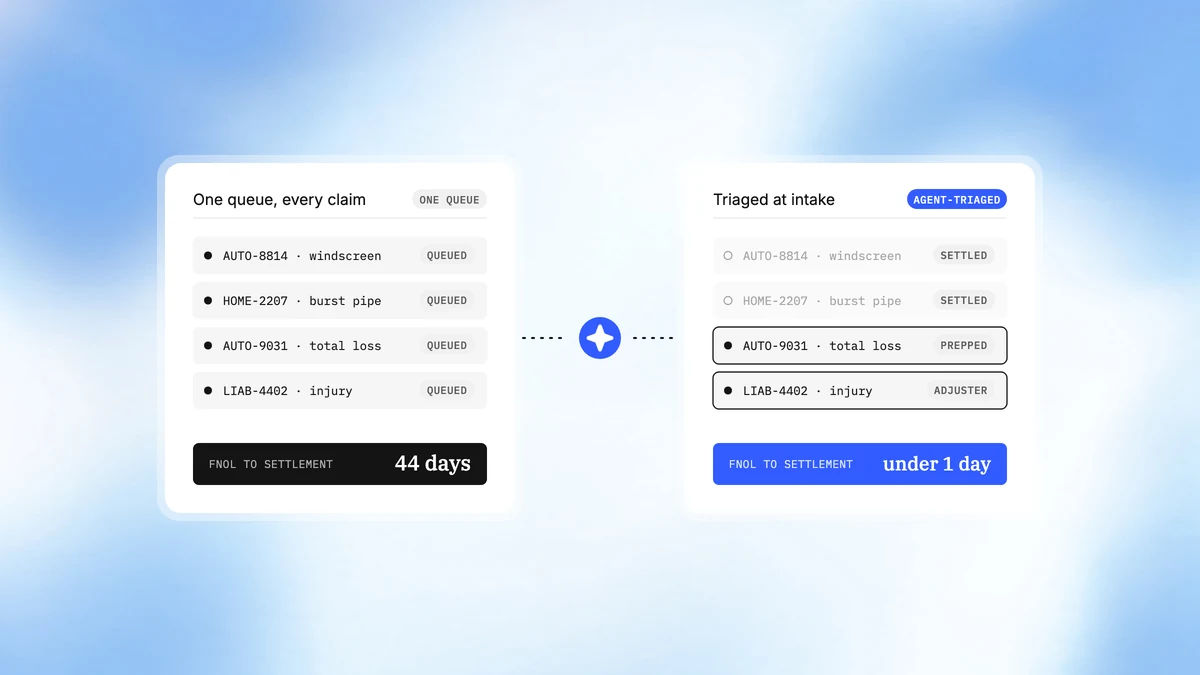
- Triage at intake, not after the file is open. Severity and complexity decide the path on arrival, so a clean claim goes straight through and a complex one routes to a person.
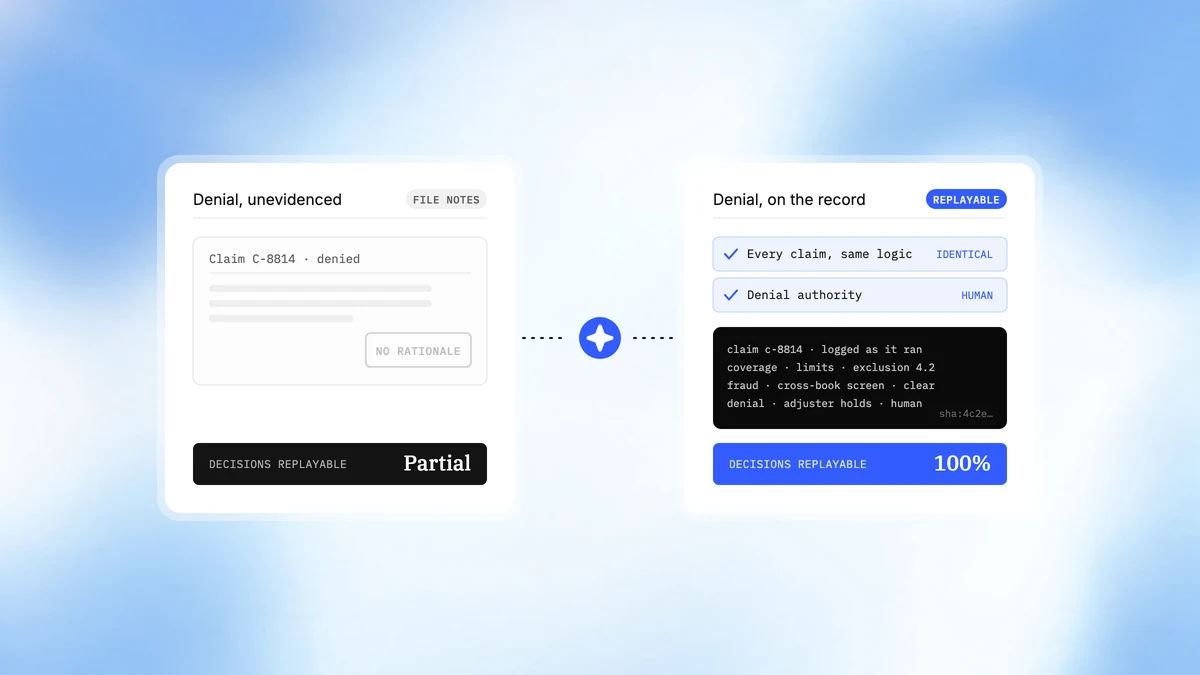
- The agent recommends, the adjuster decides. Denials, large losses, litigated matters, and complex claims always route to a human. What changed is not who holds authority, it is what the adjuster is holding when they pick up the file.
- Every claim runs identical logic in parallel. One configured environment forks per claim, so full volume runs at once instead of queuing. Simple claims stopped waiting behind complex ones, which is most of what a 44-day average is made of.
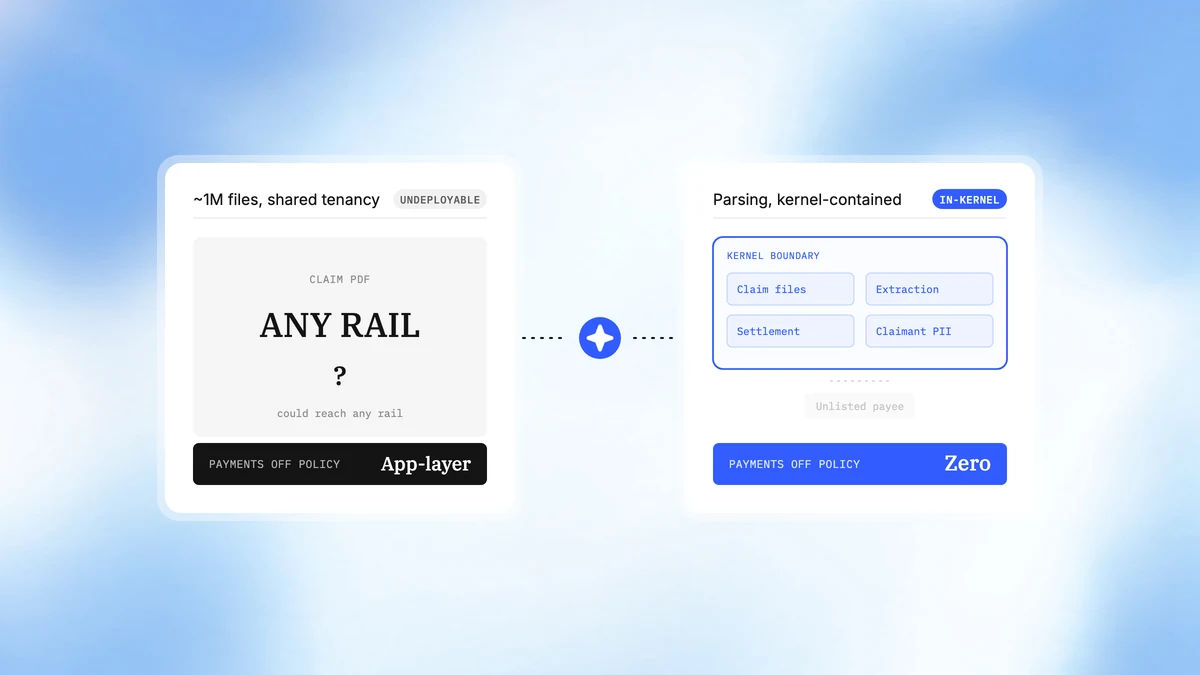
- Untrusted attachments are contained per claim. Each is processed inside its own disposable micro-VM, so a malicious file reaches neither the host nor another claim.
- Settlement can only reach sanctioned payment paths. Egress is allowlisted in the kernel, so an agent that is wrong or manipulated cannot move money outside policy. The path does not exist.
- Proven in shadow before it settled anything. The agents ran against real claims in parallel with adjusters, settling nothing, until the evidence was in. Straight-through settlement switched on for the simplest, lowest-value claims first.
The control plane and storage run inside the carrier's own infrastructure, so claimant data never leaves the boundary. CreateOS is SOC 2 Type II and ISO 27001 certified, which is what turned procurement from a fight into a formality.
Outcome Derived
Simple claims that took weeks settle in under a day, many in minutes, and the adjuster's day now starts at judgment instead of data entry.
| Metric | Before | After |
|---|---|---|
| Cycle time, simple claims | Up to 44 days | Under 1 day, minutes for many |
| Straight-through processing, simple claims | Low | 60% to 70% |
| Cost per claim, fully loaded | $120 | $72 to $84 |
| Annual claims-handling cost | $30.0M | $18.0M to $21.0M |
| Lifecycle work completed before adjuster opens file | Baseline | 30% to 40% |
| Audit coverage of automated decisions | Partial | 100% replayable |
| Unauthorized payments | Risk | Zero, enforced in-kernel |
- $9.0M to $12.0M a year. Reduction in handling cost on a $30M base, at a conservative 30% to 40% improvement. From taking volume off the claims team, not from cutting it.
- A retention lever, not an efficiency one. Settling the routine claim inside a day, at the moment the promise is being tested, is why this was funded out of the claims organization rather than IT.
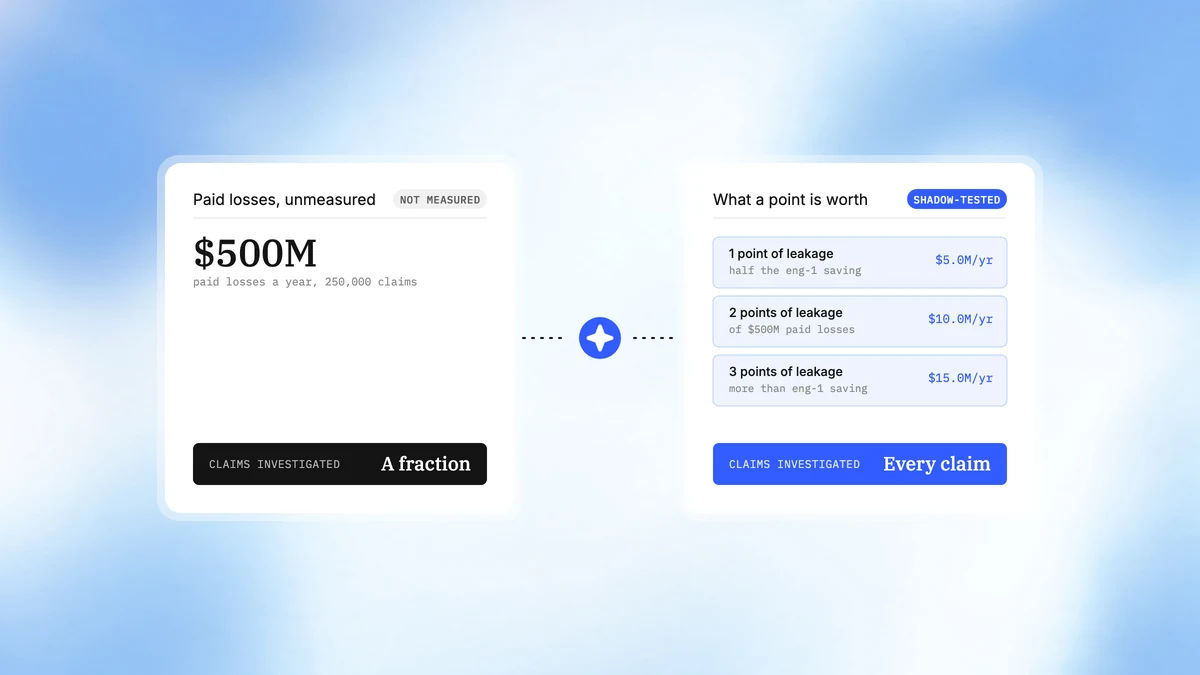
- Leakage is the larger prize, and not claimed here. Named industry estimates put it between 7% and 14% of total claims payouts (Insurance Thought Leadership, 2026, a trade publication), which dwarfs the operational saving. Recovery still has to be validated on a specific book rather than promised from a range. It is the subject of the next engagement.
Highlights
- Simple claims settle in under a day, many in minutes. Between 60% and 70% go straight through without an adjuster opening the file.
- The adjuster's day starts at judgment, not data entry. The 30% to 40% of the lifecycle that was mechanical is complete before a human is involved.
- $9.0M to $12.0M a year out of a $30M handling base. From taking volume off the claims team, not from cutting it.
- Cycle time is a retention lever, not an efficiency one. A claim is the moment the promise is tested, which is why this was funded out of claims rather than IT.
Frequently asked questions
What does claims processing automation settle without an adjuster?
Simple, low-value claims, and only after they have been proven in shadow. Triage happens at intake, so severity and complexity decide the path on arrival. Denials, large losses, litigated matters, and complex claims always route to a human. This blueprint models 60% to 70% straight-through processing on simple claims, settling in under a day.
How does automation compress a claim cycle measured in weeks?
By removing the queue rather than speeding up the adjuster. One configured environment forks per claim, so full volume runs at once and simple claims stop waiting behind complex ones. That queueing is most of what a long average cycle is made of. The mechanical part of the lifecycle is finished before a human opens the file.
Can a claims agent make a payment it should not?
No. Egress is allowlisted in the kernel, so settlement can only reach sanctioned payment paths. An agent that is wrong or manipulated cannot move money outside policy, because the path does not exist. Unauthorized payments are held at zero and enforced in the kernel rather than promised by the model.
What happens to a malicious attachment on a claim?
Each untrusted attachment is processed inside its own disposable micro-VM, so a malicious file reaches neither the host nor another claim. Every claim arrives carrying unvetted files, which is why the carrier's previous evaluation died in procurement. Shared-tenancy tooling cleared neither that constraint nor the good-faith and timeliness rules claims handling sits under.
Does this claim a reduction in claims leakage?
No. Leakage is the larger prize and it is deliberately not claimed here. Named industry estimates put it between 7% and 14% of total claims payouts, but recovery has to be validated on a specific book rather than promised from a range. It is the subject of a separate engagement.