On this page
Claims-handling cost base; engagement-1 reduction $9.0M to $12.0M per year.
Paid losses a year across 250,000 claims, the leakage recovery base.
Value of recovering 1 point of paid-loss leakage per year.
Value of recovering 3 points of paid-loss leakage per year.
Challenge
Leakage is the gap between what a carrier paid and what it should have paid. Our client, a mid-size P&C carrier, paid roughly $500 million in losses a year across 250,000 claims and could not tell us how much of it leaked. That was the honest starting point, and as it turned out the most important thing they said.
- It is not mainly fraud. It is an estimate nobody validated against expected cost, a subrogation opportunity nobody chased, a coverage limit applied loosely, a duplicate invoice that cleared.
- The real figure is far above the folklore. Named industry estimates put claims leakage between 7% and 14% of total claims payouts (Insurance Thought Leadership, 2026). What it is on any specific book has to be measured, not assumed, and the lower figures that circulate in this market have no study behind them.
- At that range, roughly $35M to $70M of this book. Money that should not have left the building, invisible in any single claim and indistinguishable from bad luck in the loss ratio.
- The cause is capacity, not carelessness. A thorough investigation on every claim is the cure, and no claims floor has the hours. So investigation quality tracks how busy that file's adjuster was that week.
- Combined ratios above 100 change the math. When underwriting loses money before investment income, a single point of loss recovery is the difference between an underwriting profit and a loss.
Two bases, and which one is worth attacking
Handling cost
- $30M baseA third of it recoverable, which is a real saving.
- Bounded by the work itselfThere is a floor: the claims still have to be handled.
Paid losses
- $500M baseOne point of it is $5M, three points is $15M.
- Nobody has measured the gapLeakage is what was paid above what should have been paid.
Solution
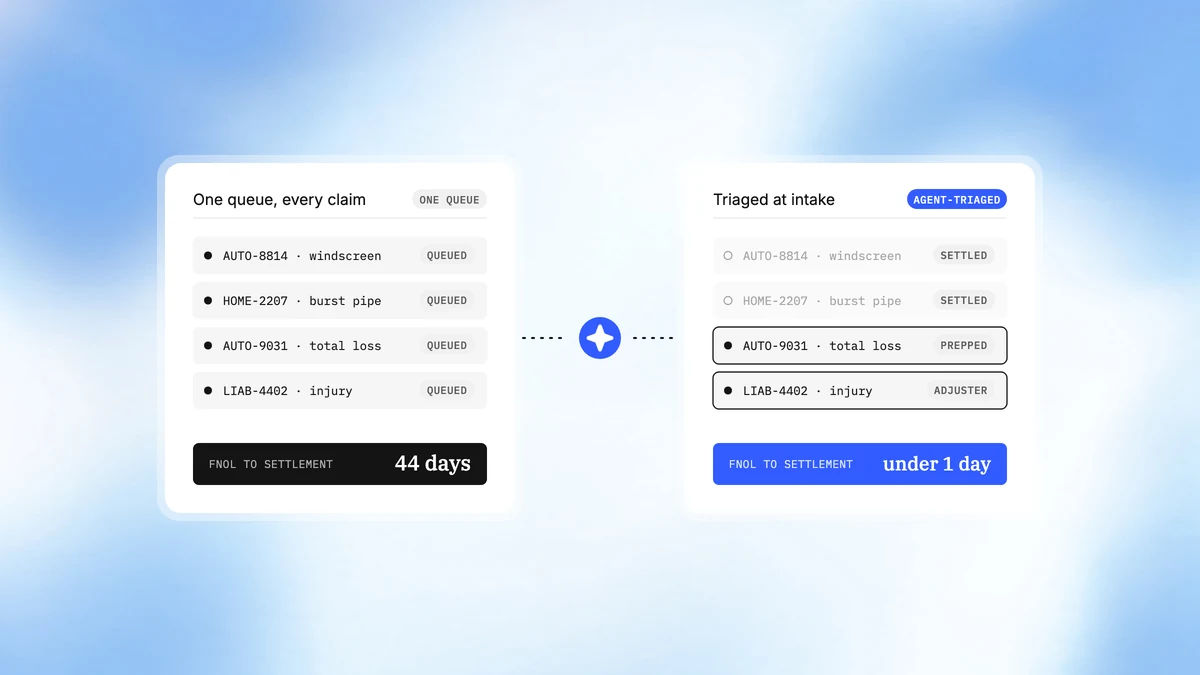
The carrier had already deployed a CreateOS agent workforce on claims handling, which had compressed cycle times and taken cost out of the operation. This second engagement went after the larger number.
Only the claims an adjuster had time for
Estimates, coverage and fraud screens checked on a fraction of 250,000 a year.
$5.0Mper point of paid-loss leakage
Every claim, not a sample
Overvalued estimates and missed recoveries, found where nobody was looking.
We do not quote a portable leakage percentage. The baseline is measured on the carrier's own book, in shadow.
If investigation quality is a capacity problem, the answer is to apply the same complete investigation to every claim. That is a thing software can do and a claims floor cannot.
- Every estimate is validated against expected cost. For that damage type, that region, that repair. An estimate running high no longer needs an adjuster with a free afternoon to catch it.
- Fraud screening looks across the book, not inside one file. The same shop, the same claimant behaviour, the same loss narrative recurring across claims is invisible in a single file and obvious across many. It runs before money moves.
- Coverage, limits, and exclusions checked with equal rigour every time. Which is where quiet overpayment lives.
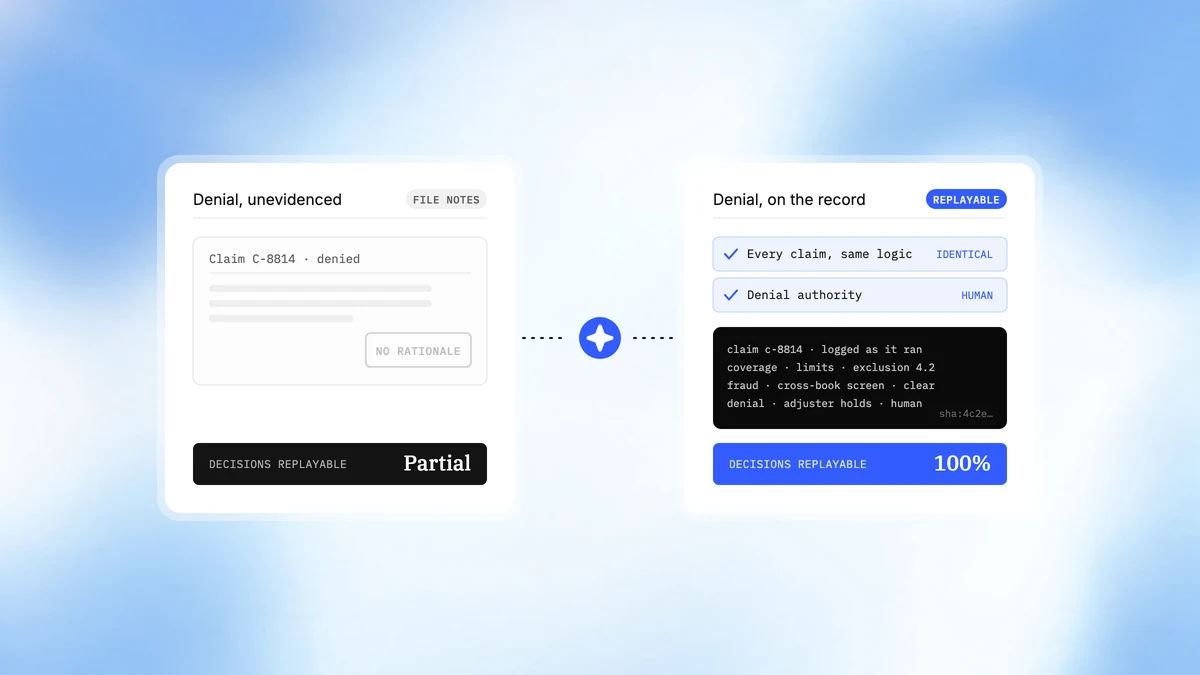
- Identical logic on every claim, whatever the volume. Reproducibility is the mechanism, not a performance detail: the same investigation for every claimant, every time. Within a claim, coverage, valuation, and fraud run in parallel, so completeness costs no cycle time.
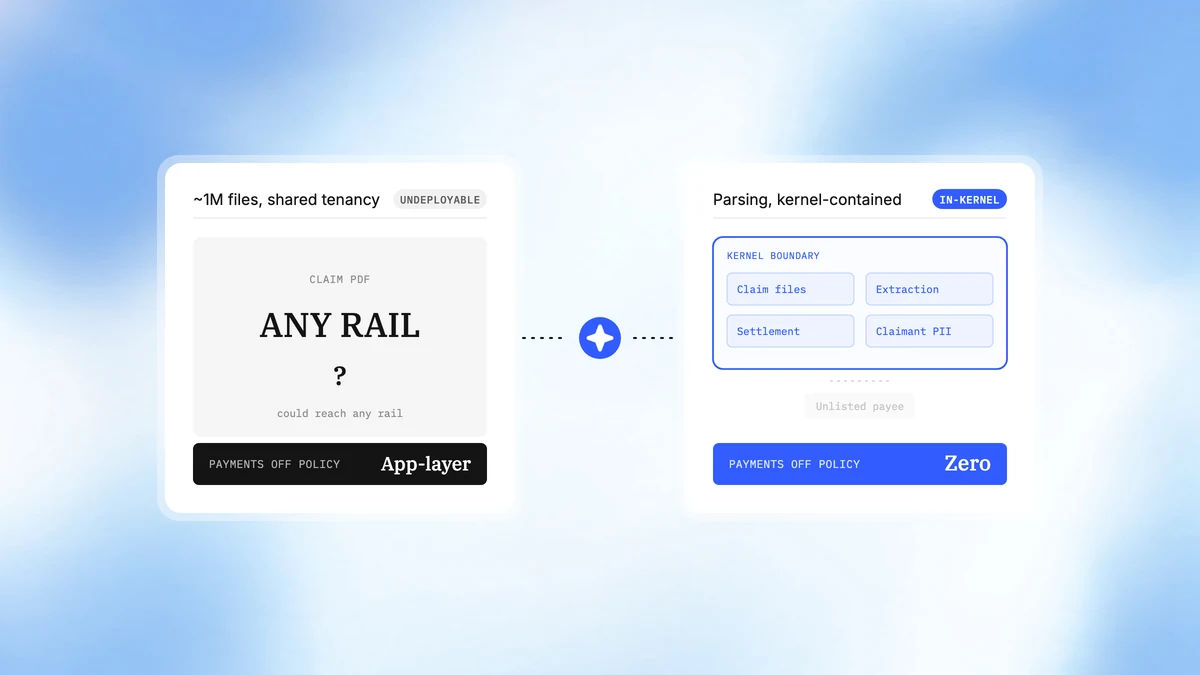
- Inside the carrier's boundary throughout. Untrusted attachments contained per claim, settlement egress allowlisted in the kernel, claimant data never leaving the carrier's infrastructure. CreateOS is SOC 2 Type II and ISO 27001 certified.
We did not promise a leakage number, and that shaped the engagement. Leakage recovery is tied to a specific book, not a process gain that travels between carriers. Anyone quoting a guaranteed percentage from a benchmark deck is quoting someone else's book.
So the engagement measures instead. A baseline on the target line comes first and becomes the yardstick for everything after. The agents then run in shadow for four weeks against real claims, settling nothing, and every case is compared claim by claim: where does the agent find an overvalued estimate, a missed recovery, a fraud pattern, a coverage limit that a human under time pressure did not? That comparison, on your own claims, is the business case.
Outcome Derived
Shadow mode quantified what the manual process had been missing, and it did so before a single settlement decision was handed to an agent.
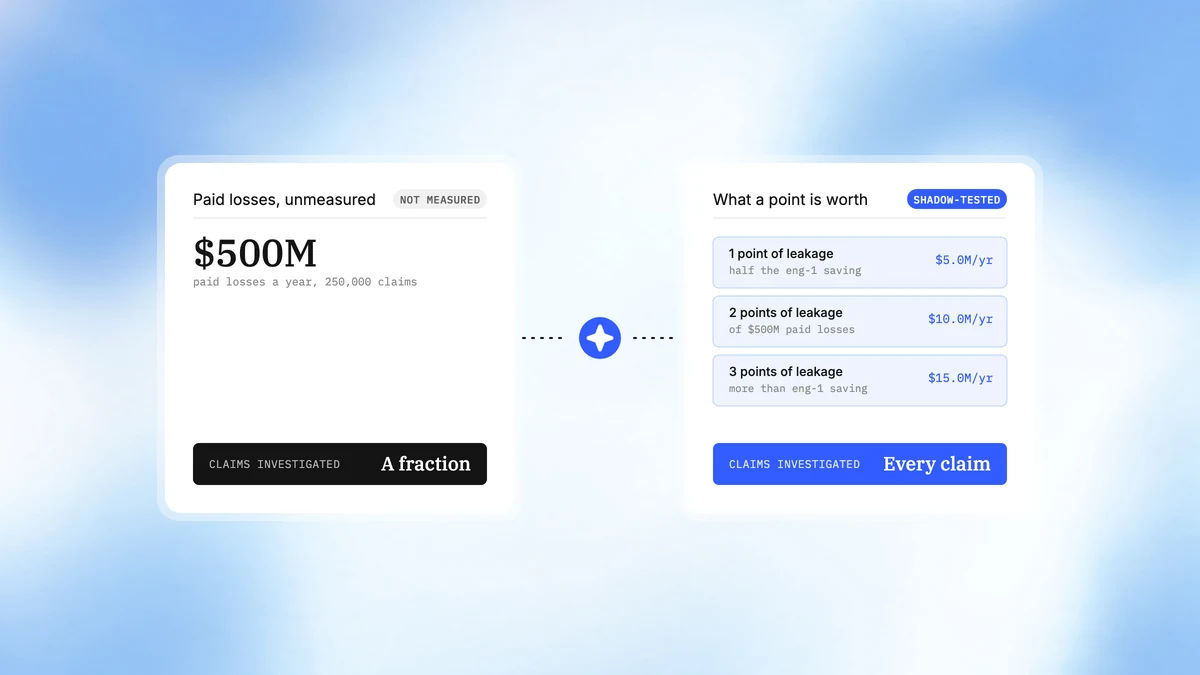
The economics of leakage recovery are unlike anything on the handling-cost side, because the base is so much larger. Handling cost on this book was $30 million a year. Paid losses were $500 million. Which means:
| Lever | Base | Value of recovery |
|---|---|---|
| Claims-handling cost reduction (engagement 1) | $30.0M | $9.0M to $12.0M per year |
| Leakage, 1 point of paid losses recovered | $500M | $5.0M per year |
| Leakage, 2 points recovered | $500M | $10.0M per year |
| Leakage, 3 points recovered | $500M | $15.0M per year |
- One point of leakage is worth half the handling-cost saving. Three points is worth more than all of it. On a book sitting anywhere inside the 7% to 14% range, three points is a fraction of what is there.
- Handling cost funds the project, leakage is why the CFO cares. With combined ratios above 100, this is where the money actually is.
- The baseline is the deliverable, not a promised percentage. We measure your book, run the agents in shadow against your own claims, and let what they caught make the argument. If it is small, you know before you commit.
Highlights
- Handling cost on this book: $30M a year; engagement-1 reduction $9.0M to $12.0M per year.
- Paid losses: $500M a year across 250,000 claims, the leakage recovery base.
- 1 point of leakage recovered = $5.0M/year; 2 points = $10.0M; 3 points = $15.0M.
- One point of leakage is worth roughly half the entire handling-cost saving; three points is worth more than all of it.