On this page
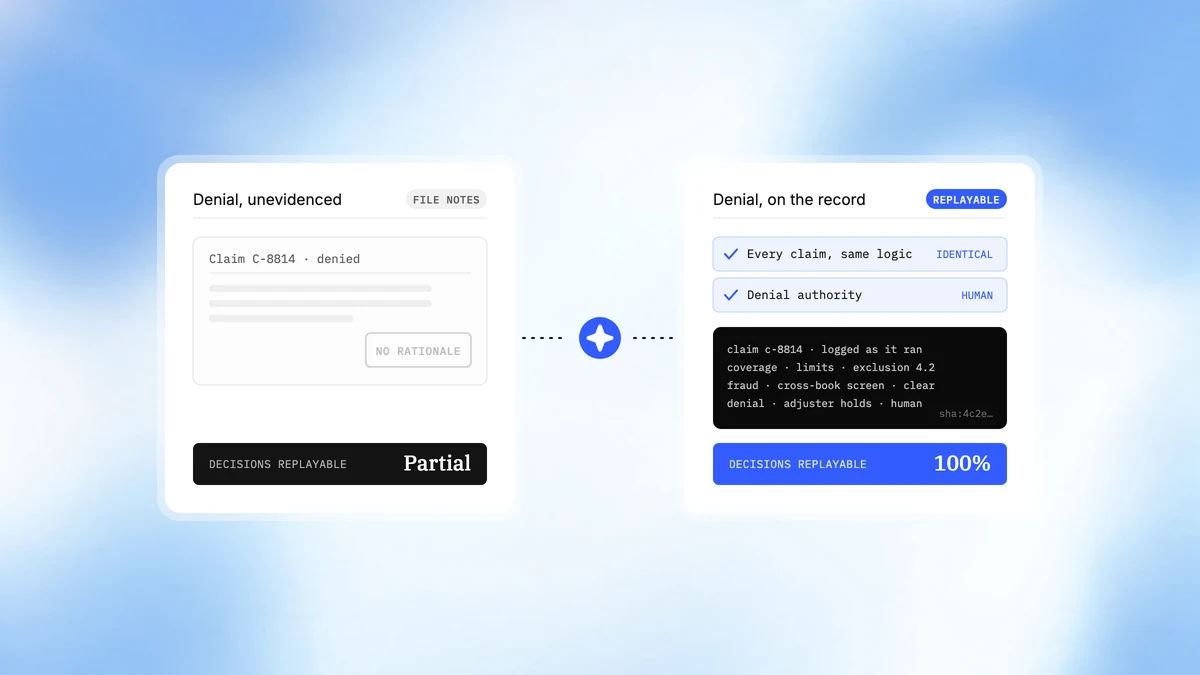
Of decisions replayable; full chain logged as it happens.
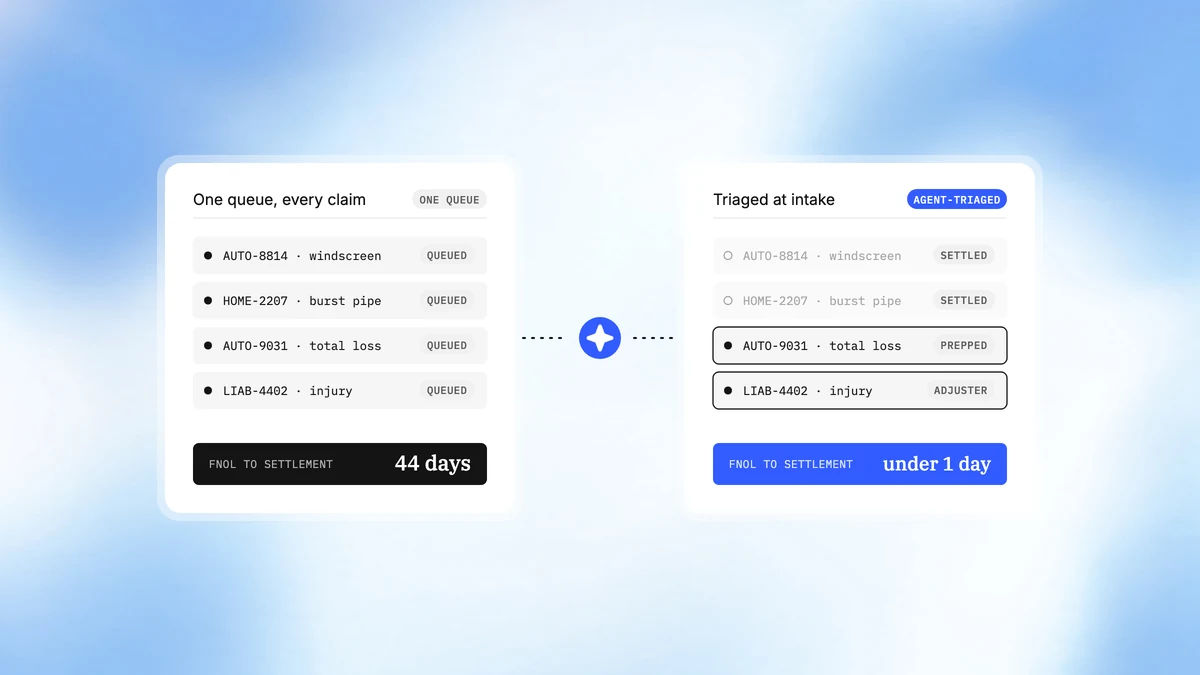
Routine claims cycle time; timeliness exposure down from up to a 44-day cycle.
Wrongful denials, proven in shadow before go-live.
Investigation consistency across every claim, regardless of adjuster workload.
Challenge
It is the right question, and it is the single largest reason claims automation stalls at the legal and compliance gate. But the carrier's real vulnerability had nothing to do with AI.
- A wrongful denial is bad-faith exposure, not a service failure. Claims handling is regulated for good faith and timeliness. A late payment is a market-conduct finding, not an inconvenience.
- Examiners ask about consistency, not individual correctness. The question is whether the carrier treats similar claimants similarly, and whether it can prove it.
- Human consistency at volume does not exist. The adjuster with eleven open files does not investigate the twelfth as thoroughly as the adjuster with three. The Friday claim does not get the Monday treatment.
- Unevenness is exactly what an examination is designed to find. Two claimants with substantially identical losses could receive materially different outcomes, with nobody acting in bad faith.
- The defense depended on whatever was in the file notes. Which ranged from thorough to three words.
Where the bad-faith exposure comes from
- It depends on the adjusterAnd on their workload the week the claim landed.
- And on timingA 44-day cycle is itself a timeliness exposure.
Two similar claims, handled differently
Not a wrong decision. An inconsistent one.
- The defence is the file noteWhose quality varies, written after the fact.
- The examiner reconstructs itFrom whatever the file happens to contain.
So the carrier had a fairness problem before we arrived. The fear was that automating would make it worse. The finding was that the manual process was the exposure, and that it was undocumented.
Solution
We built the fair-handling argument into the architecture rather than bolting a compliance report onto the end. Three commitments shaped it.
A room of judgment calls
The adjuster with eleven open files does not investigate the twelfth like the adjuster with three.
100%replayable
Identical logic on every claim
The same investigation whatever the volume or the day, logged as it happens.
The agent never denies a claim. Denials, large losses and litigated matters stay with a human adjuster, by design.
- The agent never denies a claim. Load-bearing, and not negotiable in any CreateOS claims deployment. Denials, large losses, litigated matters, and complex claims route to a human who holds the decision and the settlement authority. A carrier that automates the word no is building a liability, not an efficiency.
- Every claimant gets the same investigation. Identical logic runs on every claim regardless of volume, day of week, or how many files the assigned adjuster has open. That is the precise opposite of the unevenness an examiner looks for.
- Consistency is the defense, not a byproduct. The carrier's counsel understood the implication before we finished explaining it.
- Every decision is replayable. The full chain is written to the log as it happens, including coverage and fraud rationale, rather than reconstructed afterwards. Where the agent recommended and a human decided, both are recorded, as is the reason a claim was routed rather than settled.
- Timeliness exposure fell out of the same system. Late payment is a market-conduct finding in its own right, and a 44-day cycle leaves a great deal of room for one. Compressing routine claims to under a day removed that category without anyone working on it.
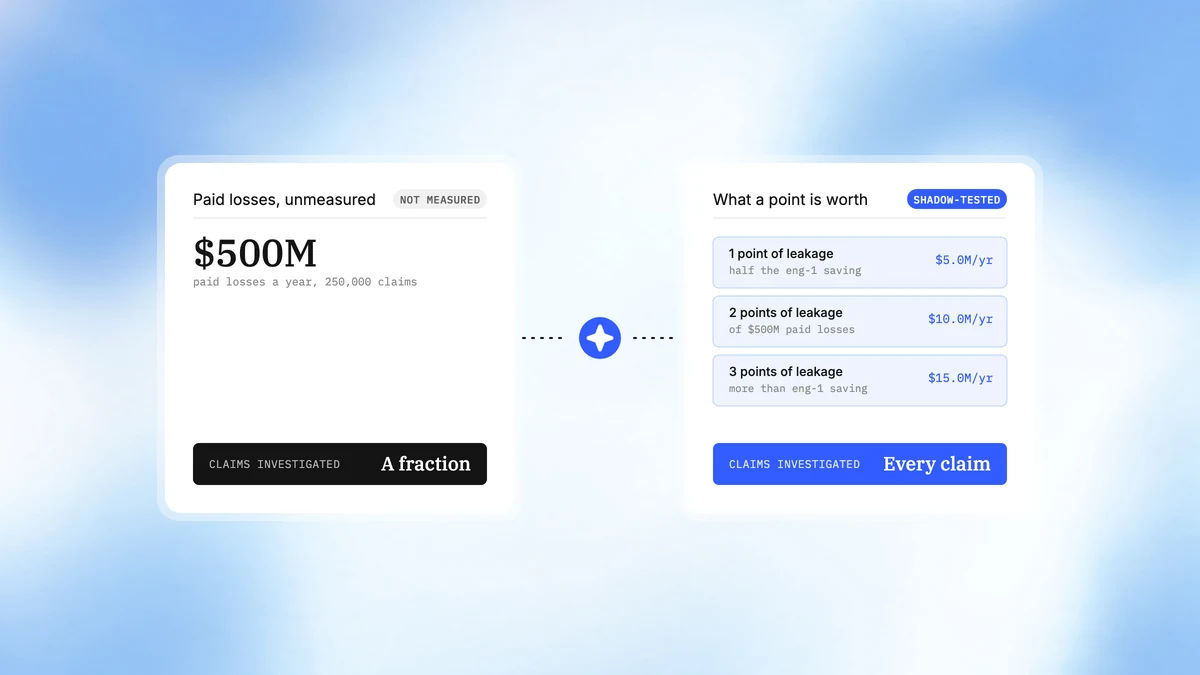
- No increase in wrongful denials was a gate, not a target. Agreed in writing before the pilot. Four weeks of shadow running, denying and settling nothing for real, then straight-through settlement on the simplest claims first.
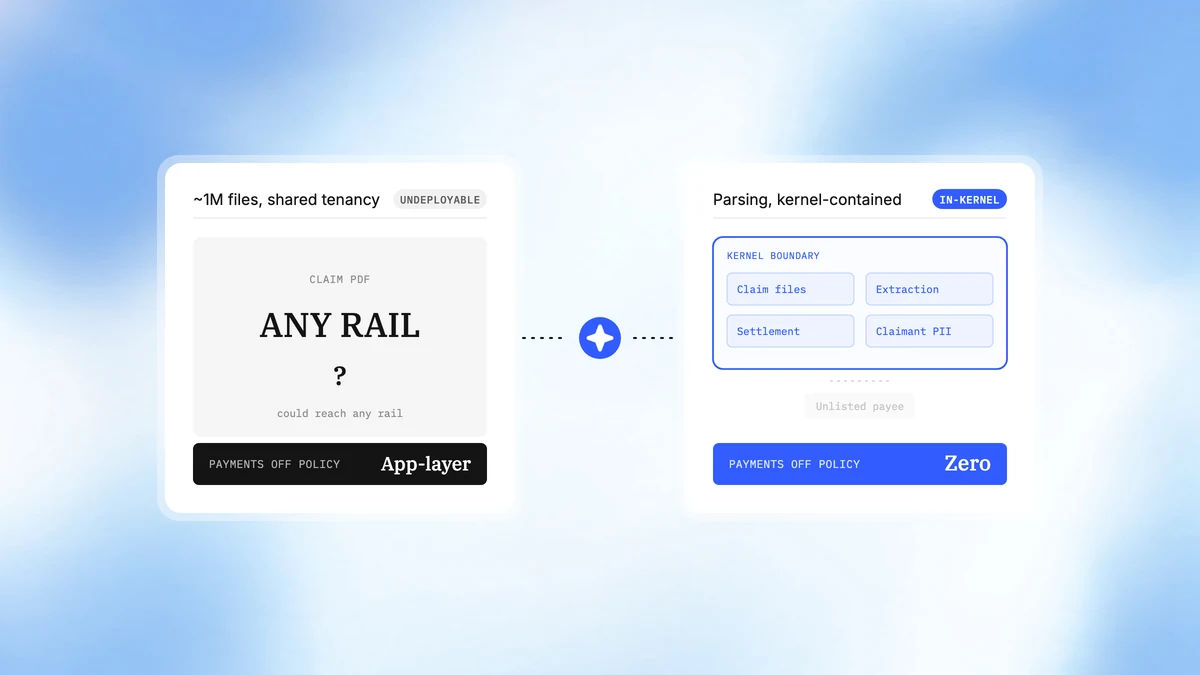
The controls run below the application: claimant data stays inside the carrier's boundary, untrusted attachments are contained per claim, and settlement egress is allowlisted in the kernel. CreateOS is SOC 2 Type II and ISO 27001 certified.
Outcome Derived
The carrier ended up with something it did not have before automation and could not have built manually: a documented, consistent, replayable claims process.
| Fair-handling dimension | Manual baseline | With the agent workforce |
|---|---|---|
| Consistency of investigation across claimants | Varies by adjuster workload and timing | Identical logic on every claim |
| Denial authority | Human | Human, unchanged and non-negotiable |
| Wrongful denials | Unmeasured | No increase, proven in shadow before go-live |
| Decision rationale on file | File notes, quality varies | Full chain logged as it happens |
| Audit coverage | Partial | 100% of decisions replayable |
| Timeliness exposure | Up to 44-day cycle | Routine claims under 1 day |
| Evidence available to a market-conduct examiner | Reconstructed | Already assembled |
- Automation was expected to be the fairness risk. It became the fairness control. The manual process could not demonstrate that similar claimants were treated similarly, because it could not guarantee that they were.
- A record instead of a reconstruction. The carrier can see its own claims handling, prove what it did and why, and answer an examiner with evidence rather than assertion.
- The obligations do not move. A well-documented decision can still be a wrong one, and the consistency is only as good as the rules encoded into it, which is why the system runs the carrier's own coverage rules and fair-claims standards, not ours.
The chief claims officer's summary at the end of the pilot was shorter than ours: "We're not faster and riskier. We're faster and we can finally show our work."
Highlights
- 100% of decisions replayable, full chain logged as it happens.
- Timeliness: up to a 44-day cycle → routine claims under 1 day.
- Wrongful denials: no increase, proven in shadow before go-live.
- Identical logic on every claim, consistency of investigation across claimants.
- Denial authority stays human, unchanged and non-negotiable.