Full memo production time, down from 20 to 40 hours.
Analyst capacity returned a year. Eight to ten analysts' worth.
Claims cited and traceable.
MNPI and data-leakage incidents, enforced in-kernel and self-hosted.
Challenge
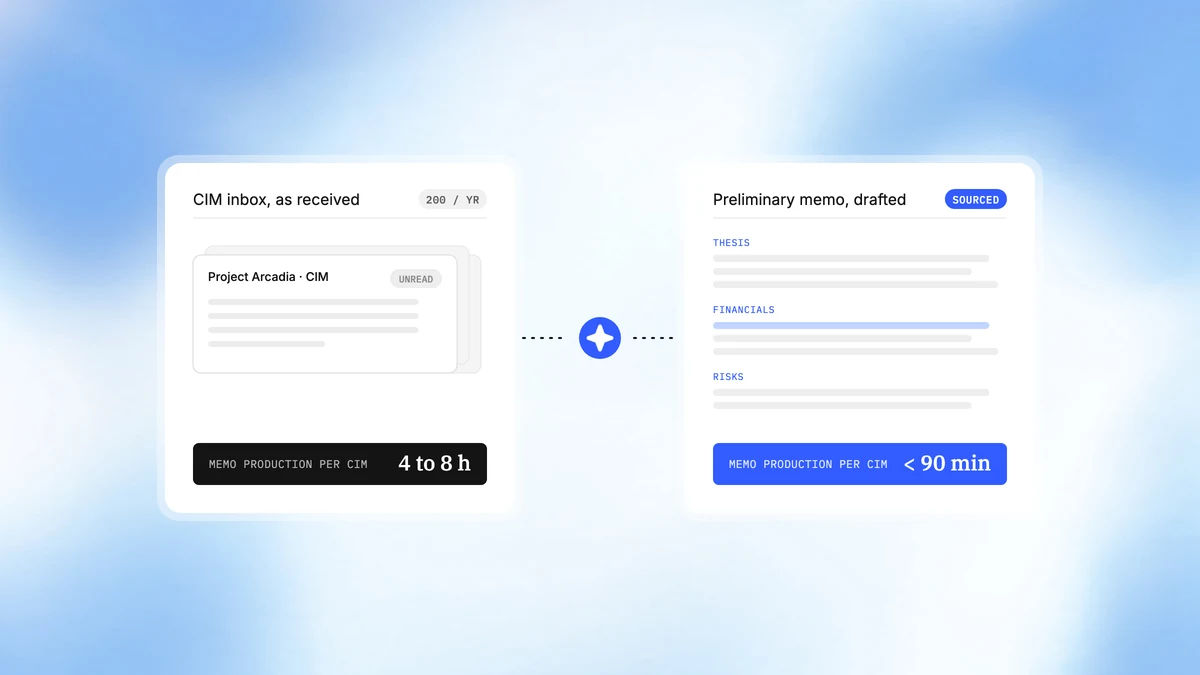
The investment memo is the unit of work at a firm like this, and the one that reaches the investment committee with a recommendation attached takes twenty to forty hours. Very little of that is thinking.
- The thinking happens in the last stretch. Source material gathered from filings, transcripts, market data, news, and internal notes. Read, extracted, spread. Models built, comparables assembled, the document drafted into house format, footnoted, and checked. Then the analyst forms a view.
- $4.2M of judgment a year spent on gathering and formatting. 35% of deal-team capacity goes to memo assembly rather than analysis. The firm is paying senior-analyst rates for work that is, honestly, clerical.
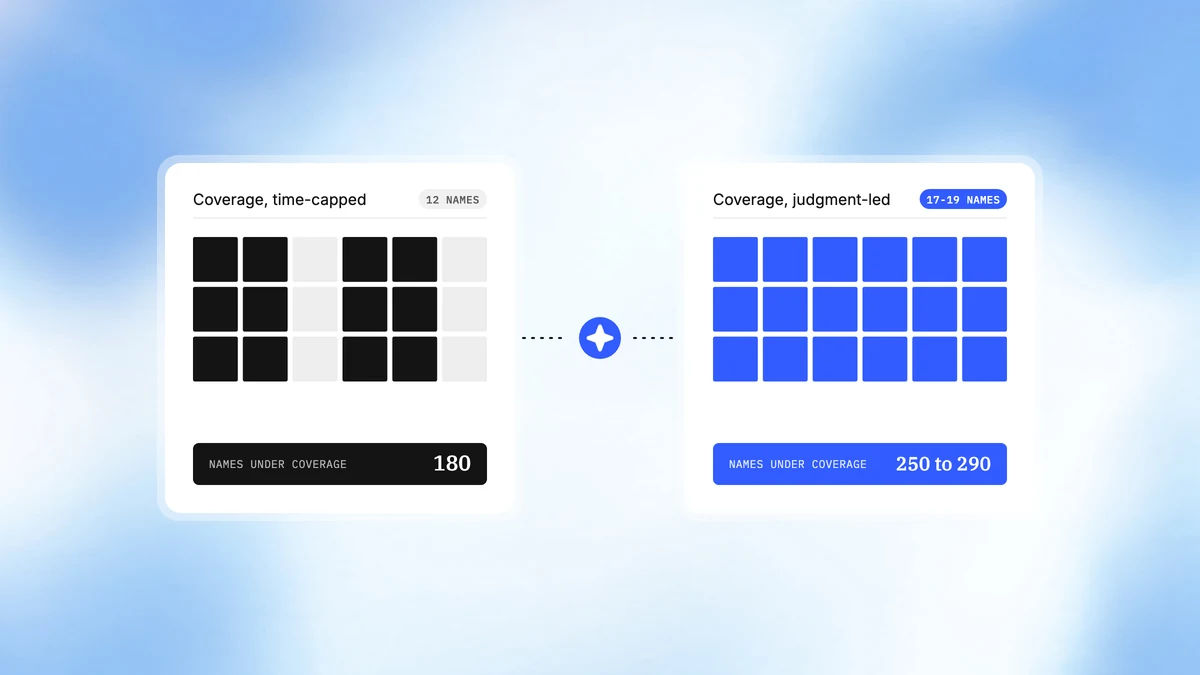
- The second-order cost is worse than the first. When a memo takes three to five working days, an analyst covers fewer names, reacts slower to an earnings surprise, and quietly passes on ideas they could not get to.
- Slow synthesis is a coverage problem, not an efficiency one. And coverage is where the edge lives.
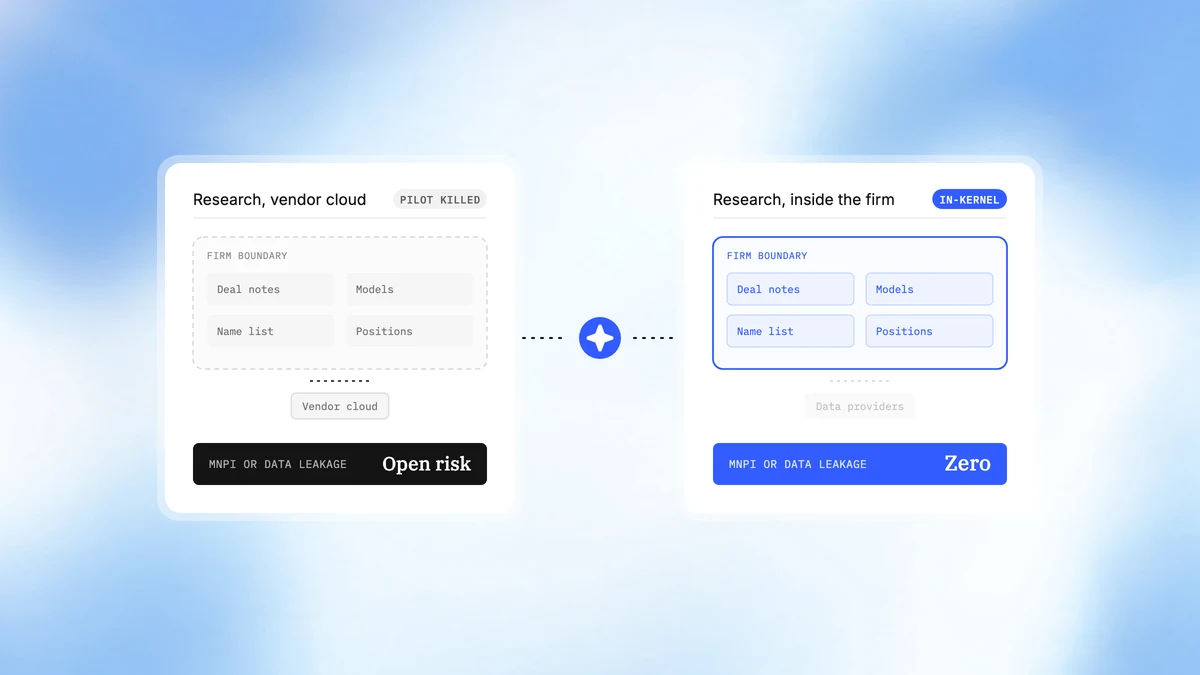
- Confidentiality killed the first attempt. Every credible tool wanted internal notes, the names under review, and in some cases positions in a vendor cloud. What a firm is looking at is itself alpha, so handing it over is a giveaway rather than a productivity trade.
- Accuracy killed the second. An ungrounded model that invents a figure transfers the checking burden and corrupts the decision it feeds. A memo with one fabricated number is worse than no memo, because someone will act on it.
Where the twenty hours goes
Twenty to forty hours
Under eight
Gather the source material
Gather the source material
Filings, transcripts, market data, notes, by hand
One working corpus, from approved sources
Build the models and comparables
Build the models and comparables
Spread and format
Run in a contained environment
Draft the memo
Draft the memo
Transcription dressed as analysis
Drafted, every claim cited at source
Form the view
Form the view
Whatever time is left
The work that was always the point
Solution
CreateOS built and deployed a crew of specialized agents that do the gathering, extraction, modeling, and first-draft synthesis, and hand the analyst a sourced, structured memo in the firm's own format to interpret, challenge, and own.
Twelve million buying judgment
Forty analysts at $300,000 each, with 35% of that capacity going to memo assembly.
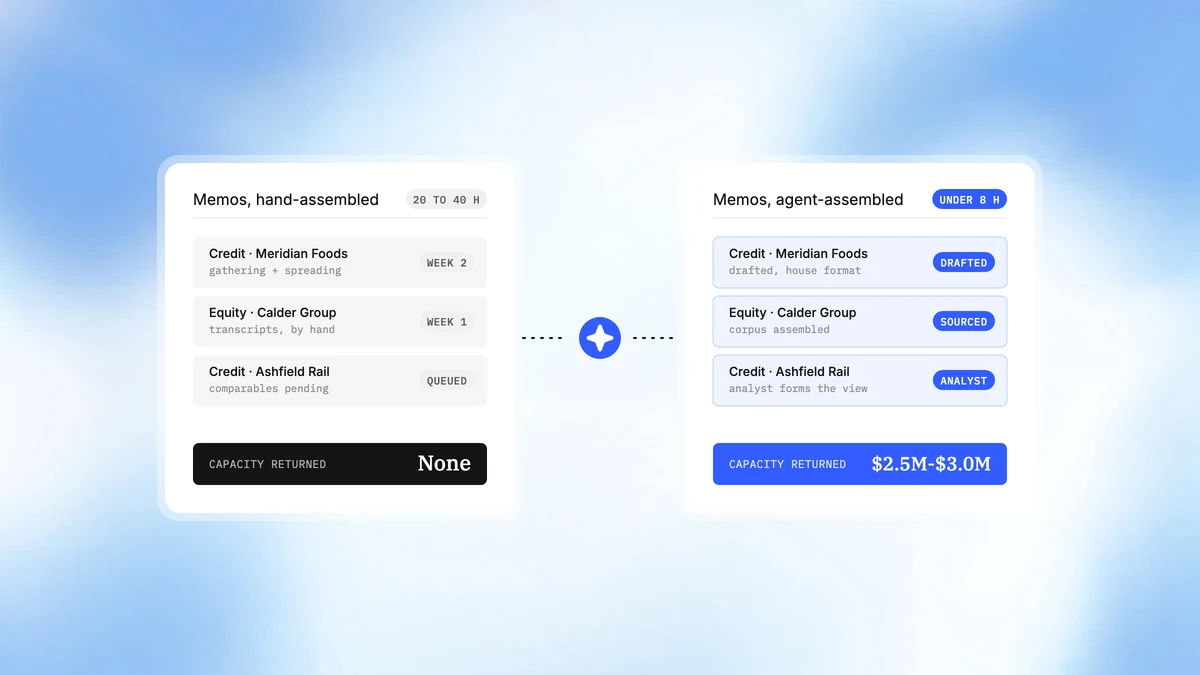
$2.5M-$3.0Mcapacity returned
Gathering and drafting handled
Eight to ten analysts' worth moved onto analysis without hiring one.
- Filings, transcripts, market data, news, and internal research. Collected into a single working corpus from approved sources, so the analyst starts from an assembled picture.
- Models, comparables, and scenarios run in a contained environment. With the generated analytical code executed inside the boundary rather than anywhere else.
- Ungrounded generation on numerical content is not permitted. Every claim, number, and assertion is grounded in a traceable source. That is the primary defence against a fabricated figure entering an investment decision.
- MNPI screening runs on corpus and draft. Against the firm's own information-barrier policies, inline rather than after the fact.
- Separation of duties keeps the output sourced. Splitting who gathers from who analyses from who drafts from who checks for MNPI is what holds both the citations and the barriers. A single monolithic agent gives you neither.
- Research and intentions cannot leak outward. Control plane and storage sit inside the firm's own infrastructure, and egress is allowlisted in the kernel so gathering reaches approved providers and nothing else. A confidentiality control and an information-barrier control at once.
- Separate mandates are separate machines. Each research workstream runs in its own guest kernel, keeping strategies cleanly walled from one another.
CreateOS is SOC 2 Type II and ISO 27001 certified. The research-tool market is crowded at the application layer, but almost all of it runs in someone else's cloud. We own both the agents and a runtime the firm hosts itself, which is the only arrangement under which a firm will point agents at the data that actually matters.
Outcome Derived
The memo now arrives drafted and sourced. The analyst spends the day on the view.
| Metric | Before | After |
|---|---|---|
| Full memo production time | 20 to 40 hours | Under 8 hours |
| Document data extraction | Baseline | 3x to 5x faster |
| Analyst capacity spent on assembly | 35% | Most of it reclaimed |
| Names covered per analyst | Constrained by memo time | Increased |
| Claim grounding | Inconsistent | 100% cited and traceable |
| MNPI and data-leakage incidents | Open risk | Zero, enforced in-kernel and self-hosted |
| Audit coverage of sources and steps | Partial | 100% logged |
- $2.5M to $3.0M of analyst capacity returned a year. Forty analysts at $300,000 is $12.0M. 35% consumed by memo and data assembly is $4.2M. Reclaiming a conservative 60% to 70% of that load gives the range, and the arithmetic is deliberately simple so a CFO can take it apart.
- Eight to ten analysts moved onto analysis. Without hiring one or removing one. The contract is written against the firm's own measured baseline.
- Coverage is the actual point. The same forty analysts cover more names and react faster to events. A firm that can form a sourced view on a credit event the same afternoon is playing a different game from one that needs a week, which is why the head of research signs rather than the COO.
- Return enhancement is context, not a promise. The 3% to 5% associated with adopting generative AI in the investment function dwarfs the $3.0M, but attributing basis points of return to a research system is exactly the claim a CIO should reject, and we reject it first.
- The reclaimed time is redeployed, not removed. This is not a cost-cutting programme dressed as an edge story.
- Nothing here takes an investment decision. The analyst owns the interpretation, the conviction, and the decision, which stay human by fiduciary necessity. Any vendor claiming otherwise is selling something a serious firm cannot buy.
What We Would Prove, and How
Weeks 1 to 2, baseline. Measure the firm's actual memo production time, the share of analyst capacity spent on assembly, and current coverage. This becomes the success yardstick and protects both sides.
Weeks 2 to 6, build and integrate. Stand up the agent crew, integrate to the firm's data providers, document stores, and internal research along allowlisted paths, encode the information-barrier policies, deploy self-hosted inside the firm's boundary, scoped to one defined coverage area.
Weeks 6 to 9, augmented run. Analysts produce memos with the agents alongside their normal process. Compare draft quality and time to the firm's own output, confirm every claim is grounded and the MNPI controls hold, tune. Proving accuracy and confidentiality is the whole game at this stage.
Week 9 onward, controlled rollout. Expand across coverage areas and strategies as the grounding record builds, with the analyst owning the judgment throughout.
Success criteria, agreed up front: memo production time down at least 50%, analyst assembly capacity materially reclaimed, 100% of claims grounded and traceable, zero MNPI or data-leakage incidents, 100% source-and-step audit coverage.
Highlights
- Full memo production time: 20 to 40 hours → Under 8 hours.
- $2.5M to $3.0M of analyst capacity returned a year. Eight to ten analysts' worth.
- 100% of claims cited and traceable; Zero MNPI and data-leakage incidents.
- The memo now arrives drafted and sourced. The analyst spends the day on the view.