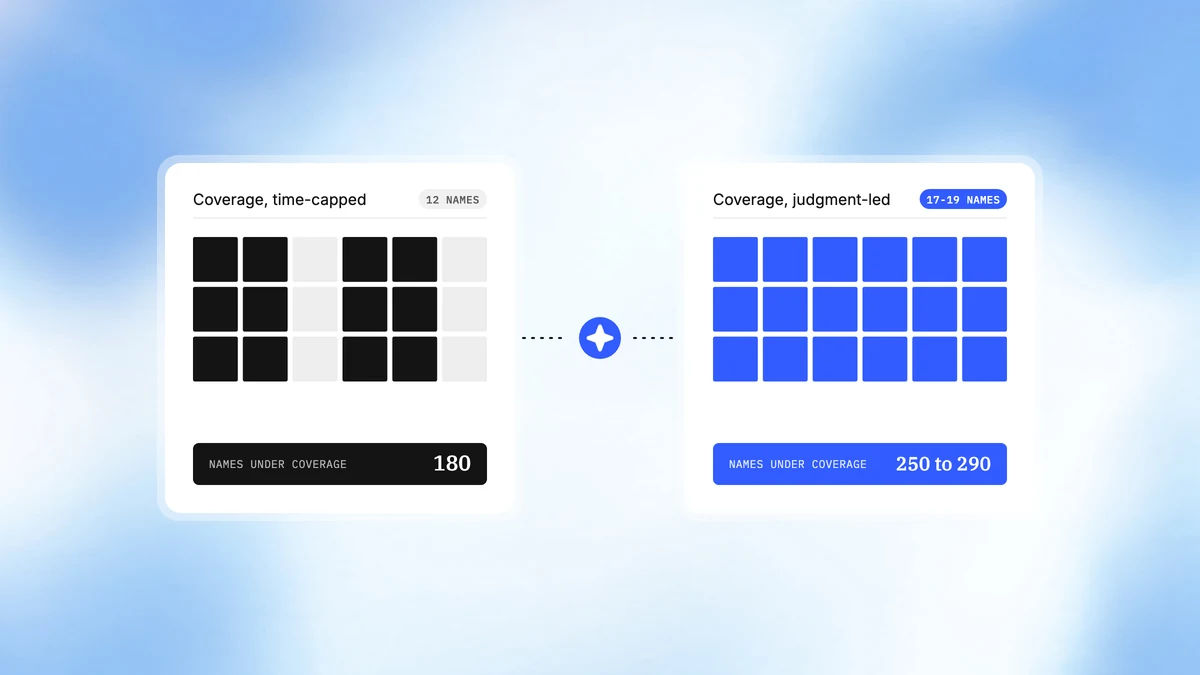
Names under active coverage (17 to 19 per analyst), up from 180 (12 per analyst).
Coverage up roughly 40% to 60%, on the same fifteen analysts.
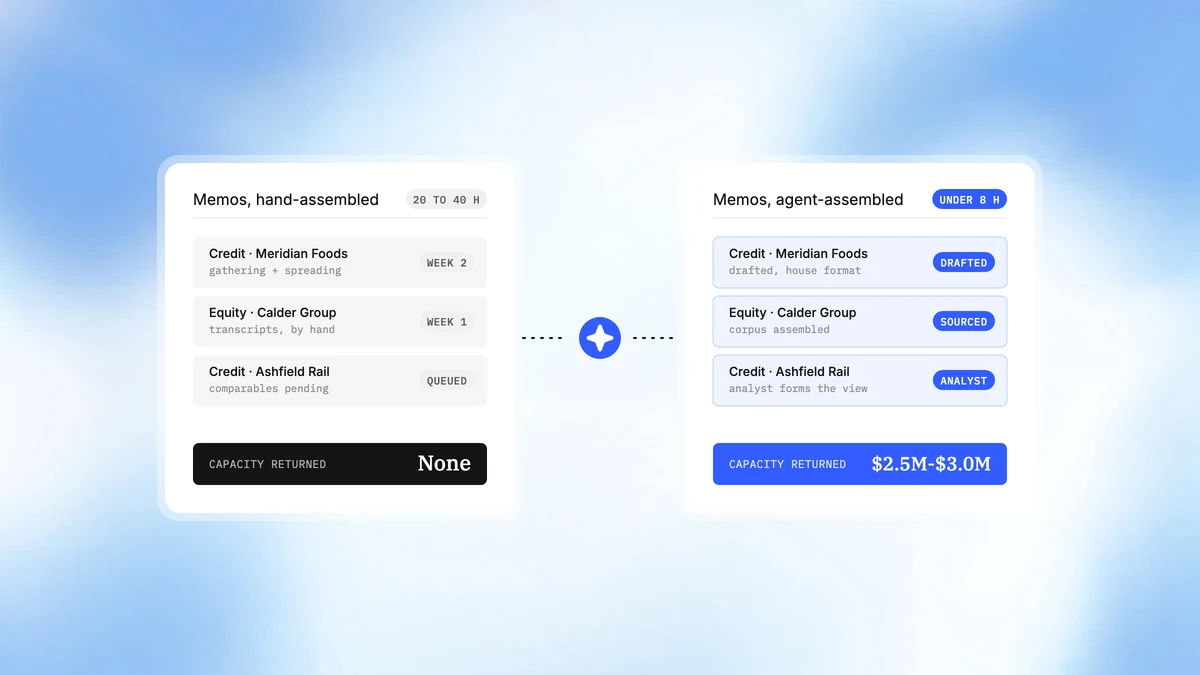
Research note production, down from 20 to 40 hours.
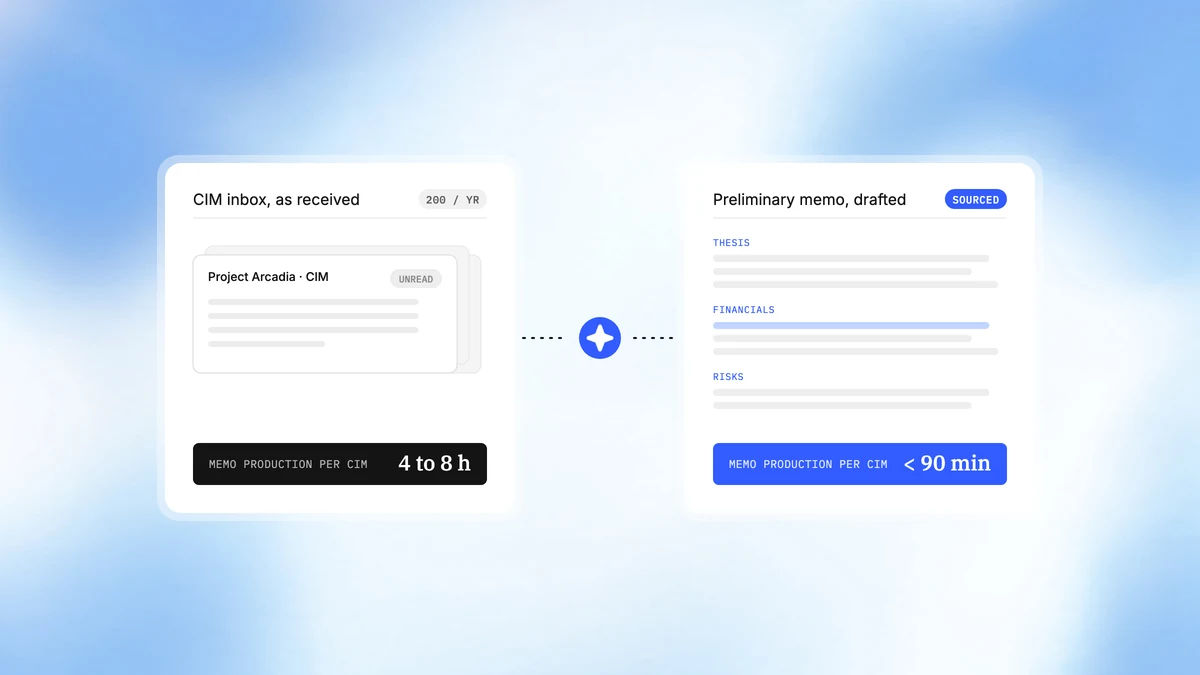
Quarterly refresh per name: drafted and sourced.
Challenge
The constraint is synthesis time. A full research note runs twenty to forty hours, and a quarterly refresh runs a working day or more once the transcript is read, the model updated, the comparables re-pulled, and the write-up redone. Twelve names across four quarters leaves very little room for anything else.
- An analyst wanting a thirteenth name has to drop one. Because the assembly load per name is fixed. The names the fund does not cover are not names it rejected.
- Events outrun the process. Earnings season compresses 180 transcripts into a few weeks. A guidance cut lands at 4pm while the analyst who owns it is mid-way through two other names, and by the time a sourced view exists the move has happened.
- Theses run in sequence, so only one gets tested. An analyst holds the bull, the bear, and the case management is telling. Building all three properly is three times the work, so two get a paragraph and one gets a model. The scenario that would have changed the position is the one nobody had time to build.
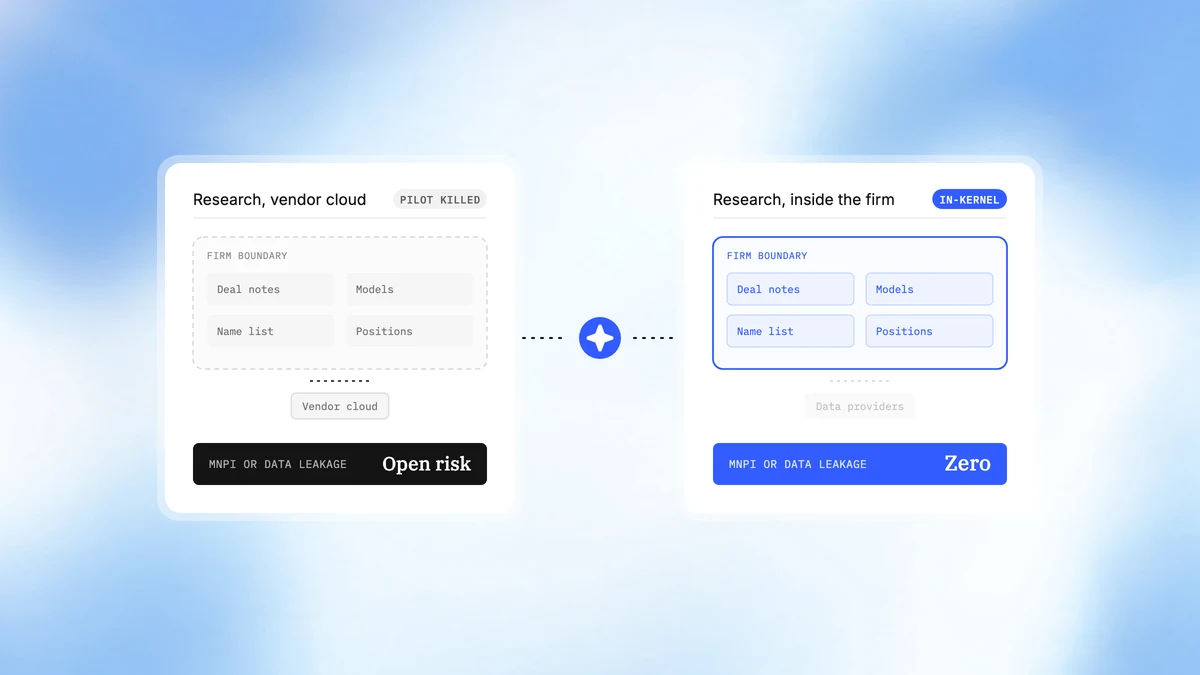
- The good tools could not touch the data that mattered. Feeding a vendor cloud internal notes, and worse the list of names under work, broadcasts the fund's intentions to a third party. What a fund is looking at is itself alpha.
- So the tools ran on public data, where they added little. And the real research stayed manual.
Why coverage stops at twelve names
- Events outrun the processEarnings season compresses 180 transcripts into a few weeks.
- Theses run in sequenceThe analyst holds bull, bear and base. Only one gets built.
The assembly load per name is fixed
180 names across fifteen analysts, and a thirteenth means dropping one.
- The good tools could not touch the dataInternal notes, and the list of names under work, broadcast outward.
- So they ran on public materialWhere they added little, and the real research stayed manual.
Solution
CreateOS built and deployed a research agent crew inside the fund's own infrastructure, and then did the thing a vendor cloud structurally cannot: pointed it at the fund's real coverage, its internal notes, and its live names.
- Bull, bear, and management's case built in parallel. A configured research environment forks, so all three are modelled simultaneously against the same corpus. The analyst gets three scenarios to compare instead of one to defend.
- Earnings season stops queueing. 180 transcripts do not wait behind fifteen analysts. Each name opens its own environment, so the fund wakes up to drafted, sourced refreshes rather than a backlog.
- A quarterly refresh is not a rebuild. One configured analytical environment runs consistently, so a model or note is reproduced rather than re-derived. Research waiting on a data release pauses instead of burning compute.
- Every claim is grounded in a traceable source. With MNPI screened against the fund's information barriers, and every source, model, and step logged.
- The fund's intentions cannot leak outward. Control plane and storage sit inside the fund's own boundary, and egress is allowlisted in the kernel so gathering reaches approved providers and nothing else. The path does not exist.
- Strategies and mandates are walled from each other. Each workstream runs in its own guest kernel, which is what let the fund point this at live coverage rather than public data.
CreateOS is SOC 2 Type II and ISO 27001 certified. The research-tool market is crowded, but almost all of it runs in someone else's cloud, and the buy side will not put its alpha there. We own both the agents and a runtime the fund hosts itself. That is the whole reason this system runs on the names that matter instead of the ones that don't.
Outcome Derived
The fund did not get faster analysts. It got analysts who spend their day on the part of the job that compounds.
| Metric | Before | After |
|---|---|---|
| Research note production | 20 to 40 hours | Under 8 hours |
| Quarterly refresh per name | A working day or more | Same-day, drafted and sourced |
| Names under active coverage | 180 (12 per analyst) | 250 to 290 (17 to 19 per analyst) |
| Scenarios modeled per name | 1, sometimes 2 | Bull, bear, and base, in parallel |
| Time to a sourced view on an event | Days | Same session |
| Claim grounding | Inconsistent | 100% cited and traceable |
| MNPI and data-leakage incidents | Open risk | Zero, enforced in-kernel and self-hosted |
Coverage up roughly 40% to 60%, on the same fifteen analysts.
- Synthesis time falls 60% to 70%, coverage does not. Because judgment does not compress. The analyst still reads the drafted note, challenges it, and forms a view, and that part is the job. What drops far enough to fit seventeen to nineteen names is the fixed clerical load that capped the book at twelve.
- The fund is not claiming its analysts think faster. It is claiming they stopped spending Thursday spreading a model.
- Reaction speed does not show up in a capacity table. A guidance cut lands at 4pm, the transcript is ingested, the model updated, the three scenarios rebuilt, and a sourced note is on screen before the next open. The fund acts on the day, not on the week.
- Return enhancement is context, not a promise. The 3% to 5% associated with adopting generative AI in the investment function dwarfs every efficiency figure here. It is an association across adopters, not a causal claim, and we do not price against it or model it.
- Wider coverage is only an edge if the judgment is real. Nothing here automates a trade or a thesis. That is precisely why the system is built to hand the analyst more time to apply it.
What We Would Prove, and How
Weeks 1 to 2, baseline. Measure the fund's actual note production time, quarterly refresh load, names covered per analyst, and time-to-view on events. This becomes the yardstick and protects both sides.
Weeks 2 to 6, build and integrate. Stand up the agent crew, integrate to the fund's market-data providers, document store, and internal research along allowlisted paths, encode the information-barrier policies, deploy self-hosted inside the fund's boundary, scoped to one coverage area.
Weeks 6 to 9, augmented run. Analysts run the agents alongside their normal process through a full earnings cycle if the calendar allows. Compare draft quality and time to the fund's own output, confirm every claim is grounded and the MNPI controls hold, tune.
Week 9 onward, controlled rollout. Expand coverage areas and strategies as the grounding record builds, with the analyst owning the judgment throughout.
Success criteria, agreed up front: note production time down at least 50%, names under coverage per analyst materially increased, 100% of claims grounded and traceable, zero MNPI or data-leakage incidents, 100% source-and-step audit coverage.
Highlights
- Coverage up roughly 40% to 60%, on the same fifteen analysts.
- Names under active coverage: 180 (12 per analyst) → 250 to 290 (17 to 19 per analyst).
- Research note production: 20 to 40 hours → Under 8 hours.
- Quarterly refresh per name: a working day or more → Same-day, drafted and sourced.