On this page
Cost per loan originated: ~$7,000 to $7,650
Operational cost to originate: down 15% to 22%
Annual cost reduction: $13.5M to $19.8M per year
Underwriter time on data assembly: reclaimed to credit judgment
Challenge
A mid-size commercial bank originating 10,000 loans a year across consumer and small-business lending. The problem was never the AI. It was finding somewhere to run it that the risk function would sign.
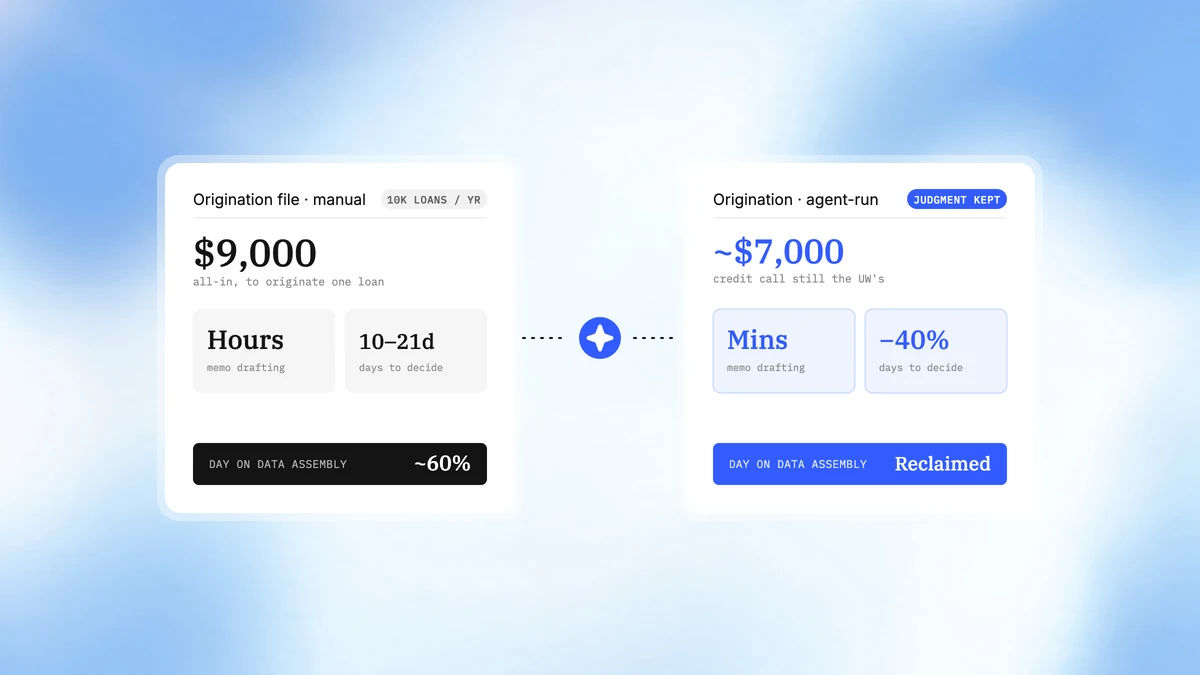
- Roughly $9,000 all-in to originate a single loan. Once labour, technology, compliance, and overhead are counted, and the bulk of it is expert labour. The $9,000 is our stated modelling assumption for this composite bank, replaced with the client's measured cost to originate in Phase 0.
- About 60% of the working day is not underwriting. Pulling tax returns, spreading financial statements, chasing missing documents, hunting through document stores. The credit judgment the bank pays a premium for happens in what is left over.
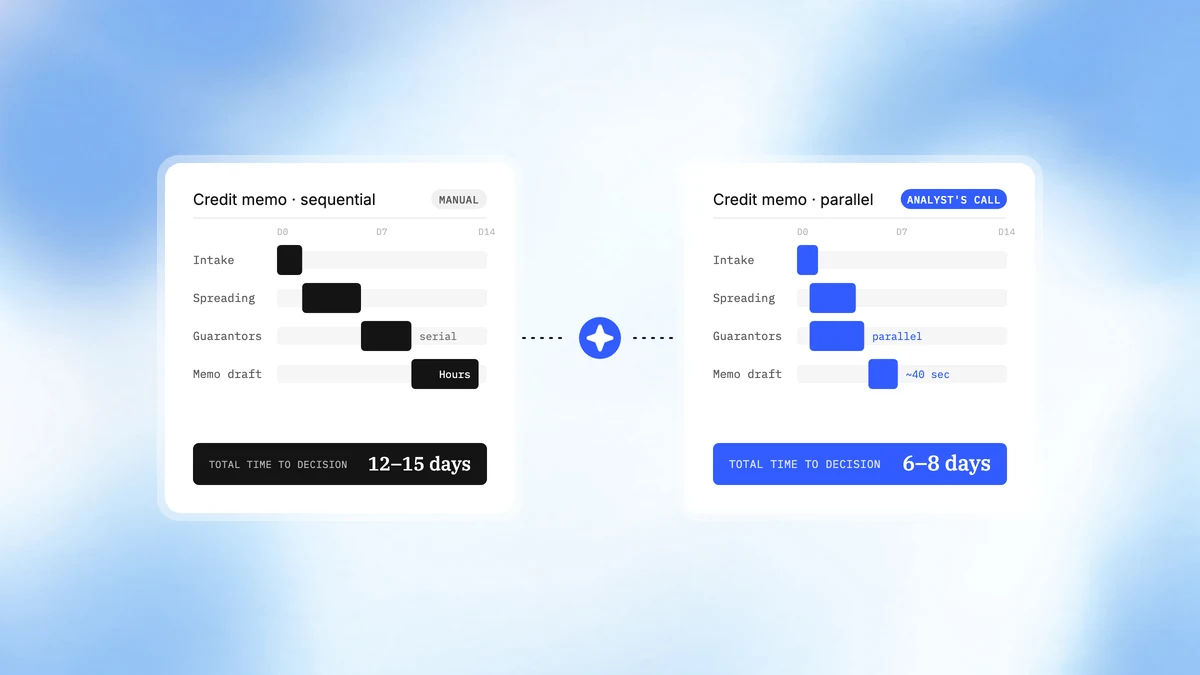
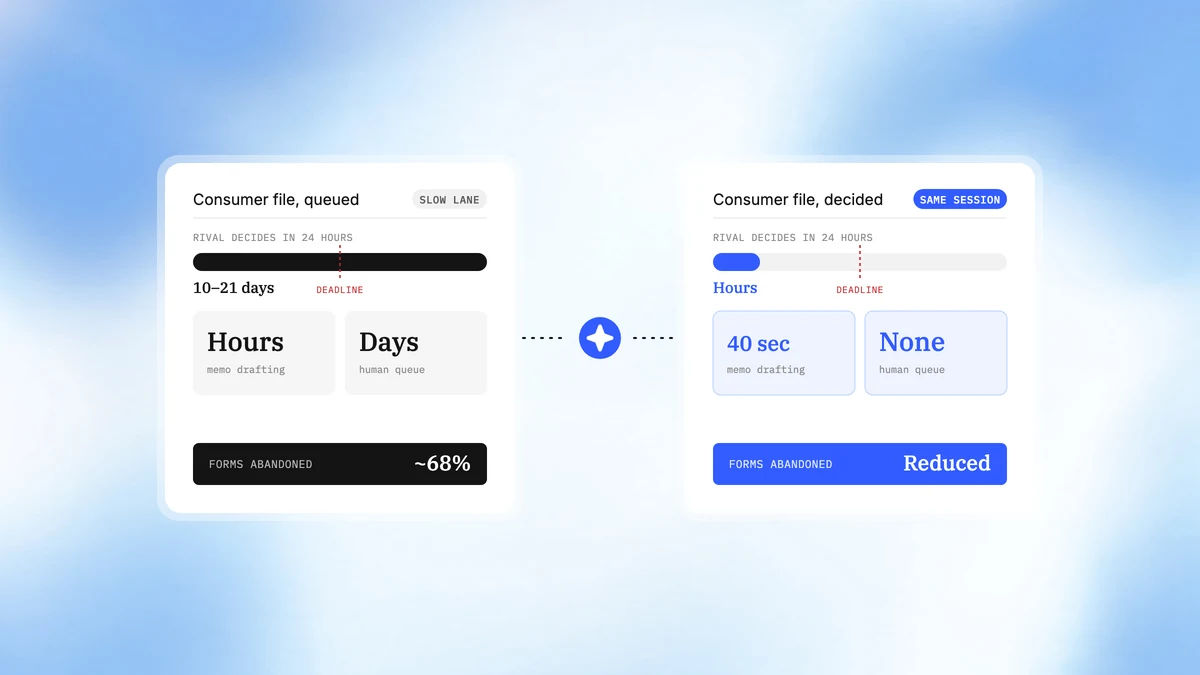
- Manual underwriting runs 10 to 21 days. Against the 24 to 72 hours an automated path takes, with commercial approval cycles routinely running into a second week.
- Credit memos became an assembly exercise. What should be synthesis takes hours per file, and turnover in credit teams runs high because the work is not the work people trained for.
- Previous attempts died in the risk review, not the pilot. Underwriting agents touch income documents, tax returns, bank statements, and bureau pulls, the most sensitive data the bank holds.
- For a credit decision, that is a non-starter rather than a negotiation. Vendors wanted to run extraction on infrastructure the bank does not control, in a region it cannot guarantee, under a model it cannot document, when the model is legally the bank's own responsibility.
Current origination spend
10,000
Loans originated a year
$9,000
All-in cost to originate one
$90M
A year, and the bulk of it is not credit work
Solution
CreateOS builds, deploys, and operates an agent workforce inside the bank's own environment. Not a platform handed over for the bank's team to learn and run, and not a SaaS tool the data has to travel to. We build the agents, integrate them, run them on infrastructure we own that sits inside the bank's boundary, and operate them against agreed service levels and the bank's own credit policy.
- Documents are extracted and spread automatically. Income, tax returns, bank statements, and financials, which is where the lost 60% of the underwriter's day comes back. Untrusted uploads are handled in the tightest boundary in the system.
- Bureau, banking, and approved third-party data arrive as one picture. Rather than as a morning of tab-switching across sources.
- Scored against the bank's own models and policy. Producing the factors behind the score rather than a black-box number, with policy exceptions flagged explicitly on every file.
- Adverse-action reasons are explainable by construction. Regulation-compliant on every decline, with the full decision chain logged including the factors behind each score.
- The memo is drafted in the bank's own format. What took analysts hours of assembly is drafted in well under a minute, leaving the synthesis to the underwriter.
- Straight-through, escalate, or hold, by the bank's credit policy. The routing is the bank's rules applied consistently. The credit decision stays with the underwriter.
Spreading, enrichment, scoring, policy checks, and drafting run in parallel rather than in sequence, so in-policy applications come back decision-ready in hours and everything else lands on an underwriter's desk with the case already built and the open questions surfaced. The underwriter still decides. They just stop doing the clerical work first.
Why This Clears the Risk Review
The agents are the visible half. The half that gets the deployment approved is underneath.
Per-VM kernel isolation. Every case runs in a Firecracker micro-VM with its own guest kernel. Extraction code executes against applicant financials inside a contained boundary, and a malicious document is contained to a disposable machine rather than the host.
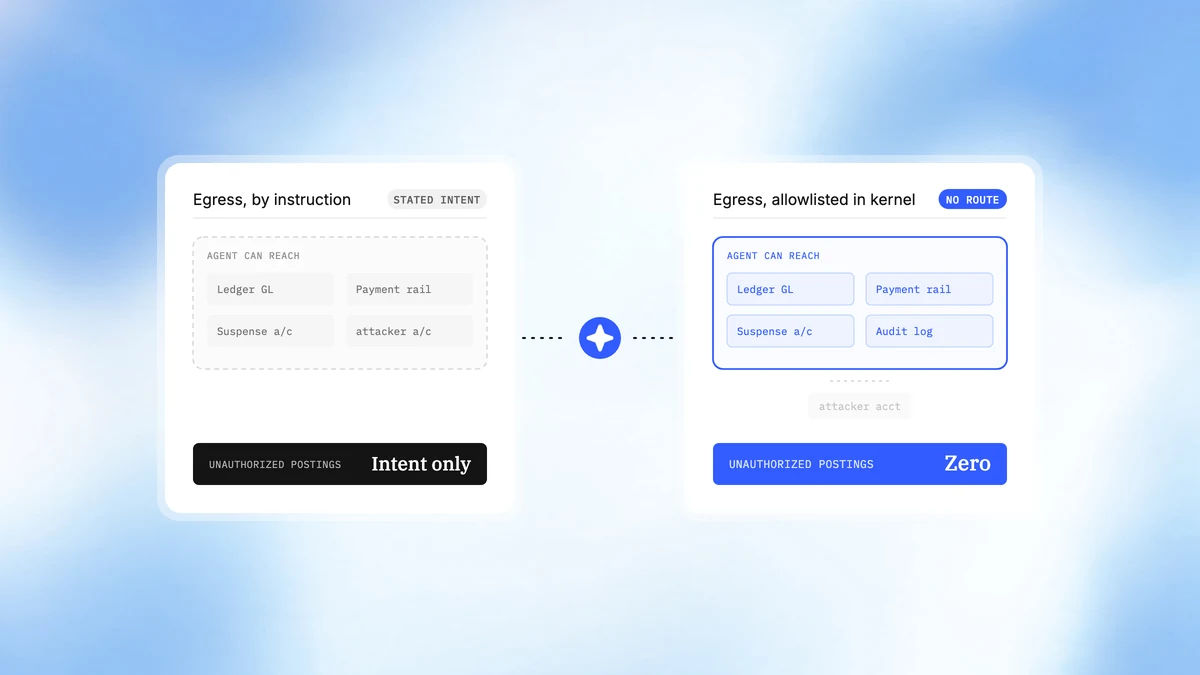
Kernel-level egress governance. Outbound access is allowlisted in the kernel using eBPF. The enrichment agent can reach the approved bureaus and nothing else. Applicant financial data cannot be exfiltrated, because the network path does not exist.
Full self-hosting and data residency. Control plane and storage run inside the bank's own infrastructure, in the bank's region. This is what keeps the credit model documented, validatable, and legally the bank's, rather than a tenancy on a vendor's black box. In lending, that distinction is the whole ballgame.
Reproducibility through templates. One configured underwriting environment, baked as a template, forks per applicant. Every application runs identical logic in an isolated copy, and volume is processed in parallel rather than queued behind the slowest file. Reproducibility is not an engineering nicety here. Identical logic applied to every applicant is the direct answer to the inconsistency a fair-lending examiner probes.
CreateOS is SOC 2 Type II and ISO 27001 certified.
Outcome Derived
Against a baseline of 10,000 loans a year at a $9,000 all-in cost to originate, the bank's current origination spend is $90M annually. The impact figures below are the benchmarked ranges from 2025 and 2026 deployments, applied to that baseline. Swap in your own volume and cost and the arithmetic moves, but the levers do not.
| Metric | Before | After |
|---|---|---|
| Cost per loan originated | $9,000 | ~$7,000 to $7,650 |
| Operational cost to originate | Baseline | Down 15% to 22% |
| Annual cost reduction | $90M base | $13.5M to $19.8M per year |
| Underwriter time on data assembly | ~60% of the day | Reclaimed to credit judgment |
| Underwriter productivity | Baseline | Up 20% to 40% submissions per head |
| Credit-memo drafting | Hours | Minutes |
| Time-to-decision | 10 to 21 days | Down 40% to 50% |
| Adverse-action coverage | Inconsistent | 100% explainable and replayable |
- $13.5M a year at 15%, $19.8M at the top of the range. Per loan, $9,000 falls to roughly $7,000 to $7,650. We lead with the conservative figure because anyone who has run a credit shop will test it.
- The capacity line is the one that gets missed. A 20% to 40% lift in submissions per underwriter books more volume with the same credit team, or holds volume with a smaller one.
- The retention argument, stated without a number. Give an analyst their judgment back and the job becomes the one they signed up for. We do not put a turnover percentage on it, because we have not measured one. It is a cost the spreadsheet rarely carries and one the CFO feels every year in recruiting and ramp.
What We Would Prove, and How
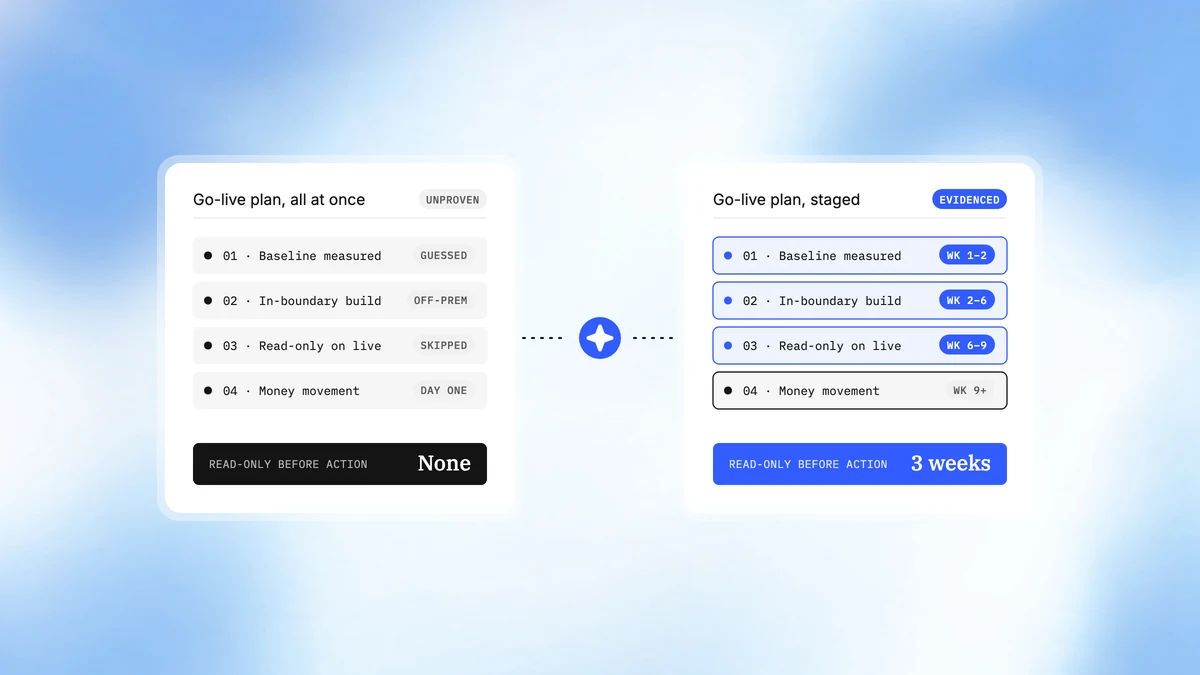
Phase 0, weeks 1 to 2. We measure the bank's actual cost to originate, time-to-decision, underwriter throughput, default rate, and abandonment. This becomes the contract's yardstick and protects both sides in procurement.
Phase 1, weeks 2 to 6. Stand up the crew, integrate to the origination system, bureaus, banking-data providers, and document store along allowlisted paths, encode the credit policy, deploy self-hosted inside the boundary.
Phase 2, weeks 6 to 10. Champion-challenger shadow run. Agents underwrite real applications alongside human underwriters, binding nothing. We compare case by case and test explicitly for disparate impact before anything goes live.
Phase 3, weeks 10 onward. Controlled go-live on the cleanest in-policy segments first, humans on every decline and every exception, scope expanding as the evidence builds.
Success criteria, agreed against the Phase 0 baseline: time-to-decision down at least 40%, cost per loan down at least 15%, underwriter throughput up at least 20%, no degradation in default rate, no disparate impact, and 100% explainable adverse-action coverage.
Highlights
- $13.5M to $19.8M a year on a $90M origination base, as cost per loan falls from $9,000 to roughly $7,000 to $7,650.
- We lead with the conservative 15%, not the 22% top of the benchmarked range, because anyone who has run a credit shop will test it.
- 20% to 40% more submissions per underwriter, so the bank books more volume with the same credit team, or holds volume with a smaller one.
- Credit analysts get their judgment back, because the clerical assembly comes off their desk. Turnover in credit teams is a cost the spreadsheet rarely carries and the CFO feels every year in recruiting and ramp.