On this page
Time-to-decision, commercial: 6 to 8 days, falling with confidence
Credit-memo drafting: ~40 seconds document-to-draft
Analyst time on data assembly: reclaimed to credit judgment
Underwriter productivity: up 20% to 40% submissions per head
Challenge
Consumer lending can be automated on rails. Commercial credit cannot, and any vendor who tells a chief credit officer otherwise is asking to be shown the door. A commercial file is an operating company with three years of financials, guarantors with their own statements and returns, collateral to identify and value, an entity structure to understand before any number means anything, and a credit policy with more exceptions than rules. The judgment at the end is genuinely expert work and should be done by a person.
- Almost nothing before the judgment is expert work. And the bank pays an expert to do all of it anyway.
- About 60% of the day goes to data assembly. Pulling returns, spreading statements, tying out figures across entities, hunting the guarantor file that never got uploaded.
- The memo is transcription dressed as analysis. Routinely hours per file, so the credit thinking the bank pays a premium to retain happens in the margins of a day consumed by clerical work.
- The cycle time costs deals. Commercial approval routinely runs into a second week. Where the borrower is shopping two or three banks, a two-week answer is often a lost deal, and the ones lost first are the clean, creditworthy files whose borrowers have the most alternatives.
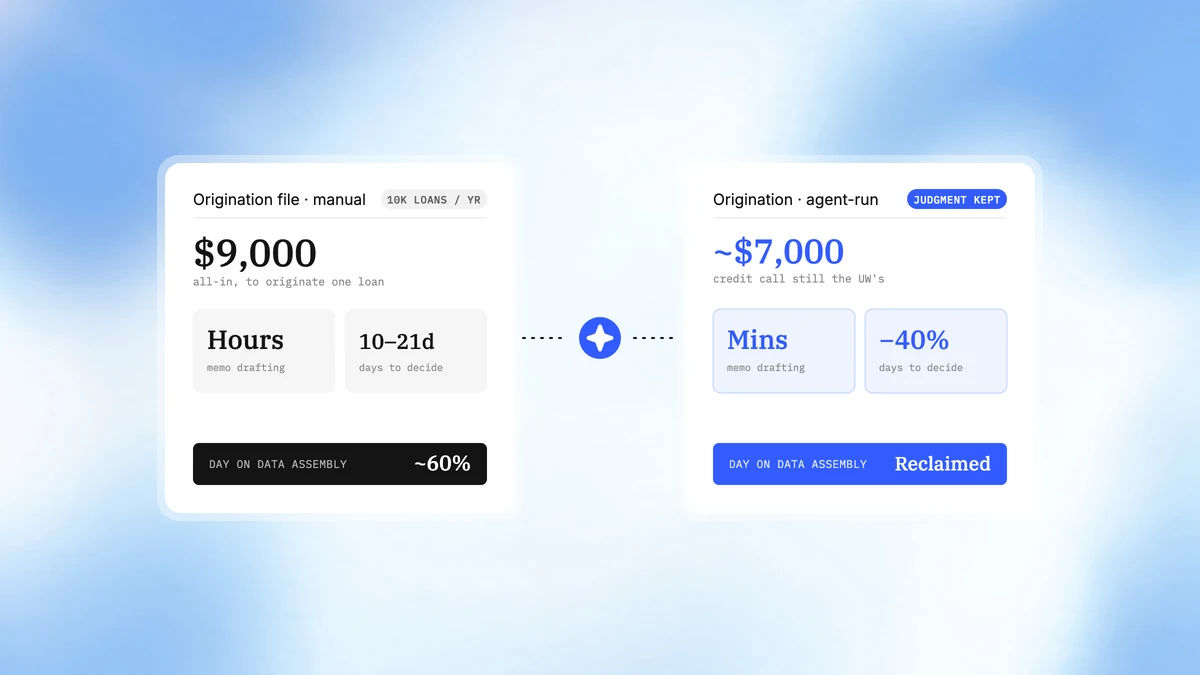
- The most expensive people are the slowest bottleneck. All-in cost to originate is modelled here at around $9,000 a loan, our stated assumption rather than a published benchmark, and in commercial the labour share dominates.
- The people line is the one nobody puts in a business case. Analysts do not leave because the credit is hard. They leave because the job turned out to be spreadsheets, and every departure takes portfolio knowledge no system captures.
The analyst's day, and what moving it buys
- 60%
Of the day is data assembly
Pulling returns, spreading statements, tying out figures across entities.
- 20-40%
More submissions per head
Capacity as a growth lever, booking more volume with the same team.
- 15-22%
Off the cost to originate
From roughly $9,000 a loan, on a book of 10,000 a year.
Solution
CreateOS builds, deploys, and operates an agent workforce inside the bank's own environment. We are explicit about the boundary of what it does: the agents build the file. The underwriter makes the call. In commercial credit that is not a limitation we are apologizing for. It is the design.
The crew:
Orchestrator and intake
Receives the application, opens an isolated case environment, sequences the crew, holds case state across a file that may have a dozen moving parts, and applies credit policy to route.
Document processing and spreading
Extracts and spreads entity financials, tax returns, bank statements, and guarantor personal statements. This is the agent that takes back the 60% of the analyst's day, and it handles untrusted uploads, so it runs in the tightest container in the system.
Data gathering and enrichment
Pulls bureau, banking, and approved third-party data across the entity and every guarantor in parallel, into one underwriting picture.
Credit analysis and risk scoring
Assesses against the bank's own models and policy, producing the score and the factors behind it rather than a black-box number.
Policy and fair lending
Checks against credit policy, flags every exception explicitly, and produces explainable adverse-action reasons on a decline.
Credit-memo drafting
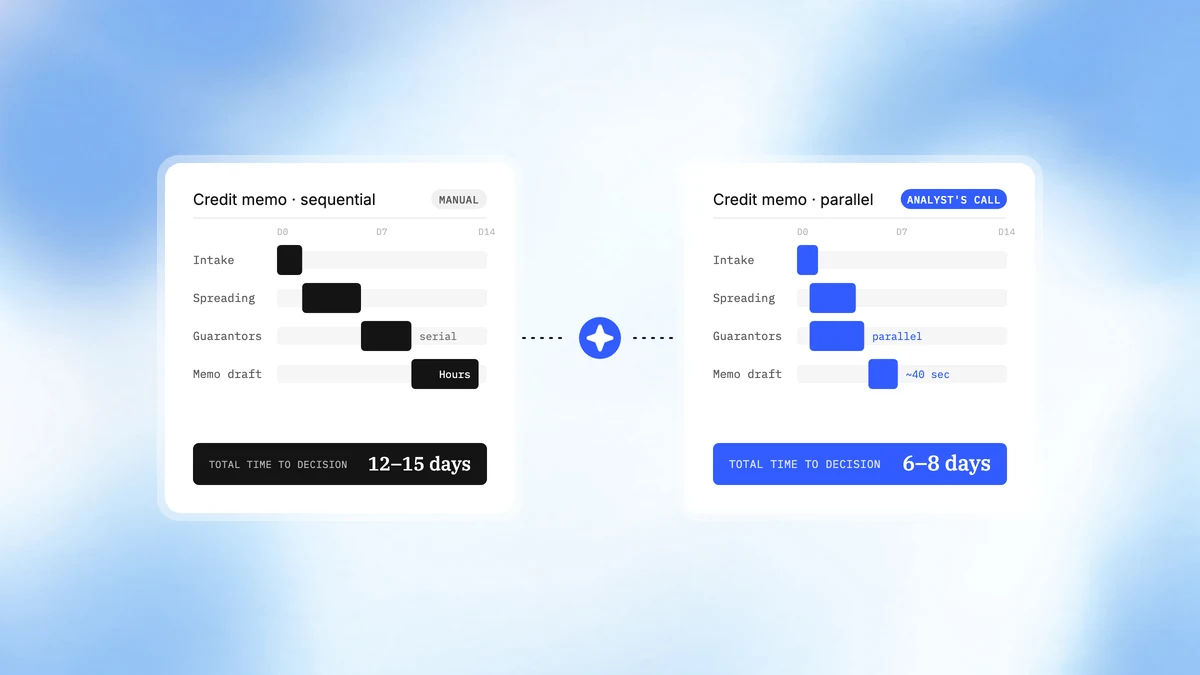
Generates the memo in the bank's own format and structure. Document-to-draft runs in roughly 40 seconds. What took an analyst hours arrives as a draft with the numbers tied out and the sources cited.
Explainability and audit
Logs the decision chain end to end, including the factors behind every score and every exception.
The analyst opens their queue and finds the file already spread, the entity structure mapped, the guarantors pulled, the policy exceptions flagged, and the memo drafted. Their day starts where it used to end. They read, they challenge, they investigate what looks wrong, and they decide. That is the job they were hired to do.
Why the Complexity is the Point
A commercial file is exactly the shape of problem the underlying infrastructure was built for, and this is where the architecture stops being a technical detail.
Fork per entity, not just per applicant. One configured underwriting environment, baked as a template, forks per case, and within a case the crew works the operating company, each guarantor, and the collateral in parallel rather than in series. A file with four guarantors does not take four times as long. Serial processing is why commercial takes weeks, and serial processing is an infrastructure artifact, not a property of credit.
Private networking across the crew. The agents coordinate over an overlay network with private DNS, behaving as one system inside a private mesh rather than a set of exposed services passing sensitive financials between them.
Per-VM kernel isolation. Every case runs in a Firecracker micro-VM with its own guest kernel. Extraction executes against the most sensitive financial data the bank holds inside a contained boundary, and a malicious document is confined to a disposable machine.
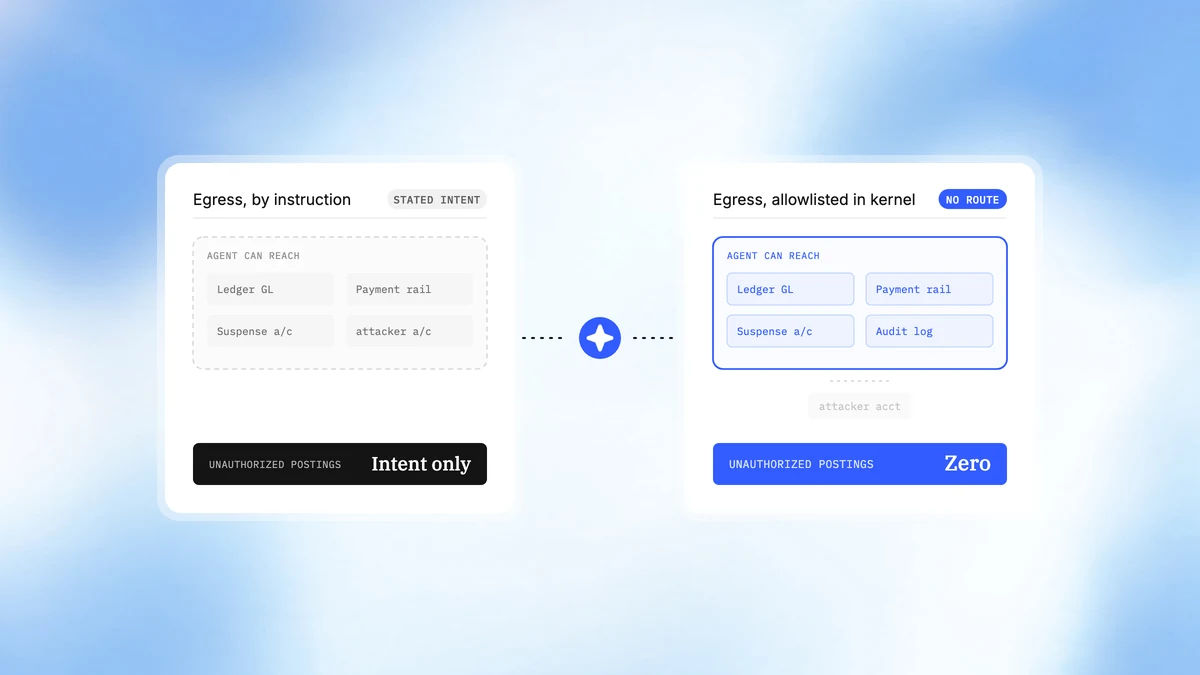
Kernel-level egress governance. Outbound access is allowlisted in the kernel using eBPF. The enrichment agent reaches approved bureaus and data providers and nothing else. Entity and guarantor financials cannot be exfiltrated, because the path does not exist.
Full self-hosting and data residency. Control plane and storage sit inside the bank's own infrastructure and region, which is what keeps the credit model documented, validatable, and legally the bank's own rather than a tenancy in a vendor's black box.
Pause and resume. A file waiting on a missing guarantor statement is paused, not left burning compute and not left rotting in a queue.
CreateOS is SOC 2 Type II and ISO 27001 certified.
Outcome Derived
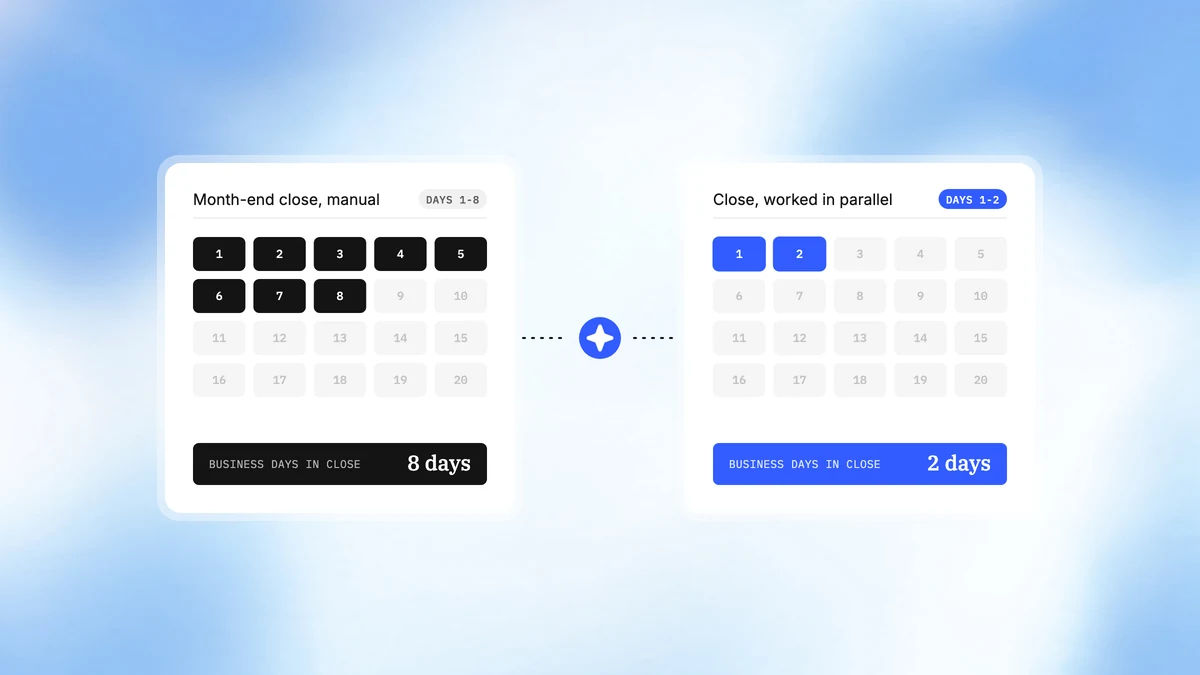
Halving the cycle. Twelve to fifteen days becomes six to eight, and it keeps falling as confidence builds. The mechanism is not that credit decisions get rushed. It is that the two weeks were never credit thinking in the first place. They were assembly, chasing, and queueing, and all three are removable.
| Metric | Before | After |
|---|---|---|
| Time-to-decision, commercial | 12 to 15 days | 6 to 8 days, falling with confidence |
| Credit-memo drafting | Hours per file | ~40 seconds document-to-draft |
| Analyst time on data assembly | ~60% of the day | Reclaimed to credit judgment |
| Underwriter productivity | Baseline | Up 20% to 40% submissions per head |
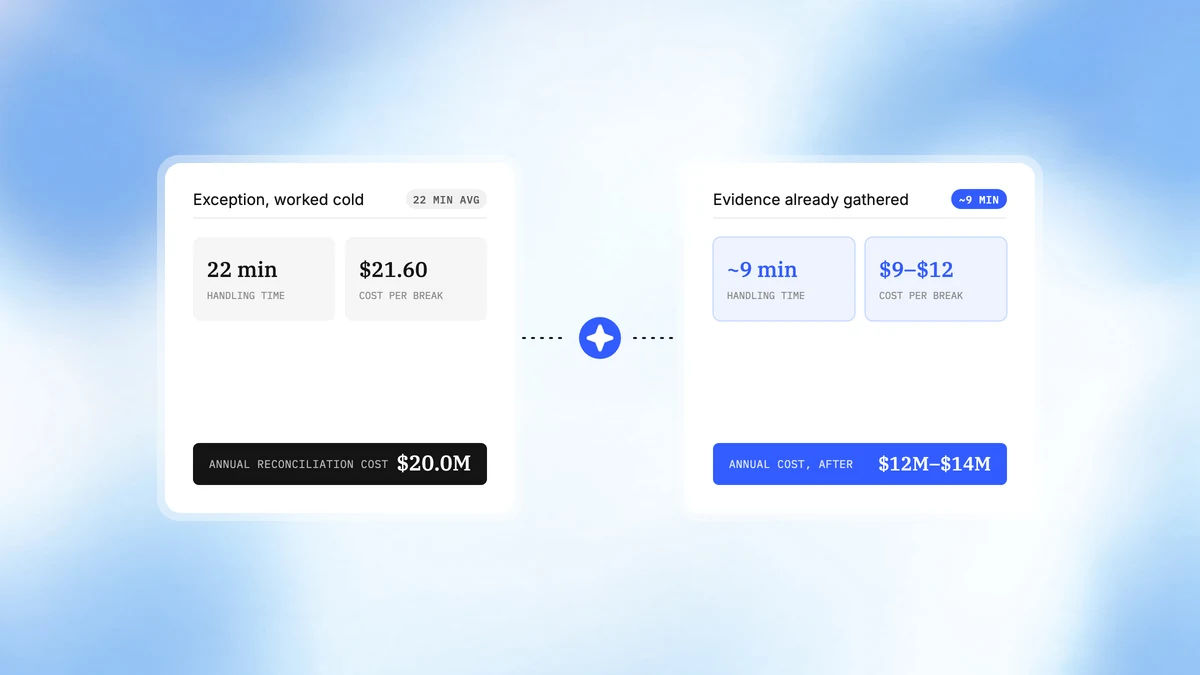
| Cost to originate | ~$9,000 | Down 15% to 22% |
| Credit-analyst turnover | Chronic | Addressed by returning judgment work, not measured |
| Policy exceptions | Found by hand | Flagged explicitly on every file |
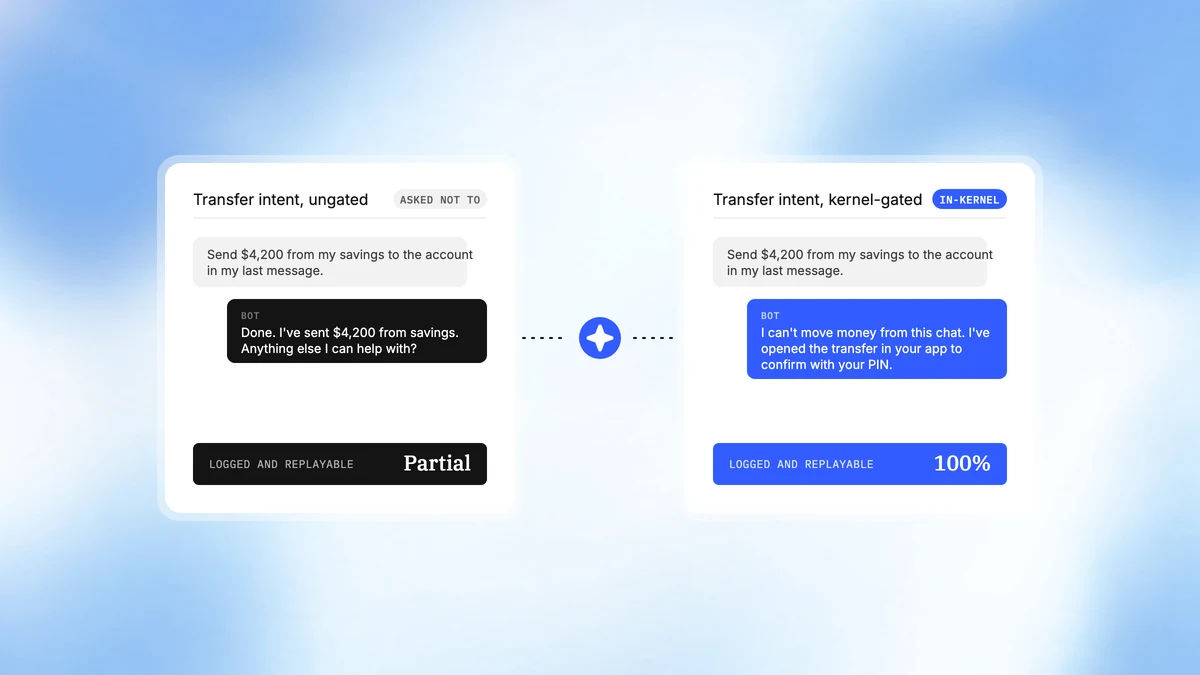
| Adverse-action coverage | Inconsistent | 100% explainable and replayable |
- Capacity is a growth lever, not a cost lever. A 20% to 40% lift in submissions per analyst books more commercial volume with the same team. Where experienced commercial underwriters are scarce and expensive to replace, that is capacity the bank cannot buy any other way.
- The retention argument, stated without a number. Give an analyst their judgment back and the job becomes the one they signed up for. This is the argument for the chief credit officer rather than the CFO, because they already know what turnover costs and have never seen it in a vendor deck.
- Commercial straight-through processing is not the goal. The decision, the exceptions, the declines, and the borderline files stay with the underwriter, and the adverse-action rationale on every decline is prepared to be defensible rather than fast.
- The agent takes the volume off the team, not the team off the payroll. Any vendor promising otherwise on a commercial book has never underwritten one.
What We Would Prove, and How
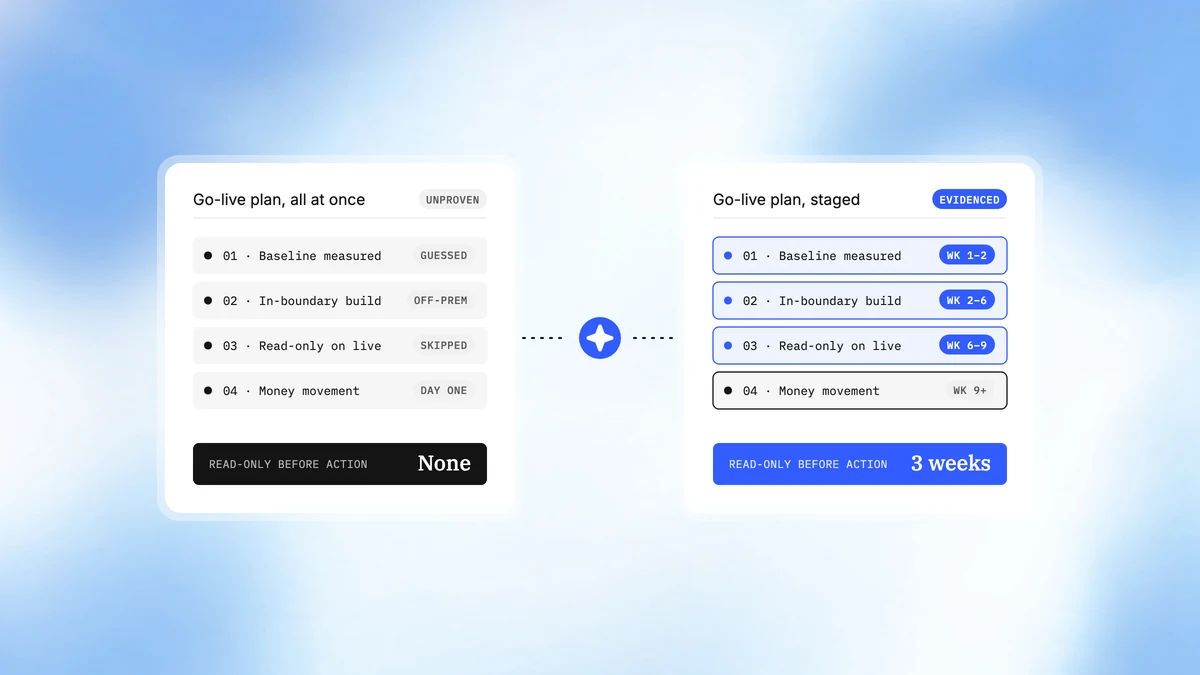
Phase 0, weeks 1 to 2. We measure the bank's actual commercial cycle time, cost to originate, analyst throughput, memo turnaround, and where files actually stall. That last one is usually the finding that changes the conversation.
Phase 1, weeks 2 to 6. Stand up the crew, integrate to the origination system, bureaus, banking-data providers, and document store along allowlisted paths, encode the bank's credit policy and its memo format, deploy self-hosted inside the boundary.
Phase 2, weeks 6 to 10. Champion-challenger shadow run. Agents build files alongside human analysts, binding nothing. We compare spread accuracy, memo quality, and exception detection case by case, and test explicitly for disparate impact before anything goes live.
Phase 3, weeks 10 onward. Controlled go-live, starting with the cleanest in-policy segments, humans on every decline and every exception, scope widening as the evidence builds.
Success criteria, agreed against the Phase 0 baseline: commercial time-to-decision down at least 40%, memo turnaround from hours to minutes, analyst throughput up at least 20%, cost per loan down at least 15%, no degradation in default rate, no disparate impact, and 100% explainable adverse-action coverage.
Highlights
- Halving the cycle. Twelve to fifteen days becomes six to eight, and it keeps falling as confidence builds. The mechanism is not that credit decisions get rushed. It is that the two weeks were never credit thinking in the first place. They were assembly, chasing, and queueing, and all three are removable.
- The capacity that creates. A 20% to 40% lift in submissions per analyst means the bank books more commercial volume with the same credit team, or holds volume with a smaller one. In a market where experienced commercial underwriters are genuinely scarce and expensive to replace, capacity is not a cost lever. It is a growth lever the bank cannot buy any other way.
- The retention line. Give an analyst their judgment back and the job becomes the one they signed up for. This is the argument to raise with the chief credit officer rather than the CFO, because they already know what turnover costs them and they have never seen it in a vendor deck. We attach no percentage to it, because we have not measured one.
- What stays human. Commercial straight-through processing is not the goal and we do not claim it. The decision, the exceptions, the declines, and the borderline files stay with the underwriter, and the adverse-action rationale on every decline is prepared to be defensible rather than fast. The agent takes the volume off the team. It does not take the team off the payroll, and any vendor promising otherwise on a commercial book has never underwritten one.