Time to quote, standard risks, down from ~8 days.
Straight-through processing on standard risks.
Annual cost reduction on underwriting operations.
Quote capacity lift, same team.
Challenge
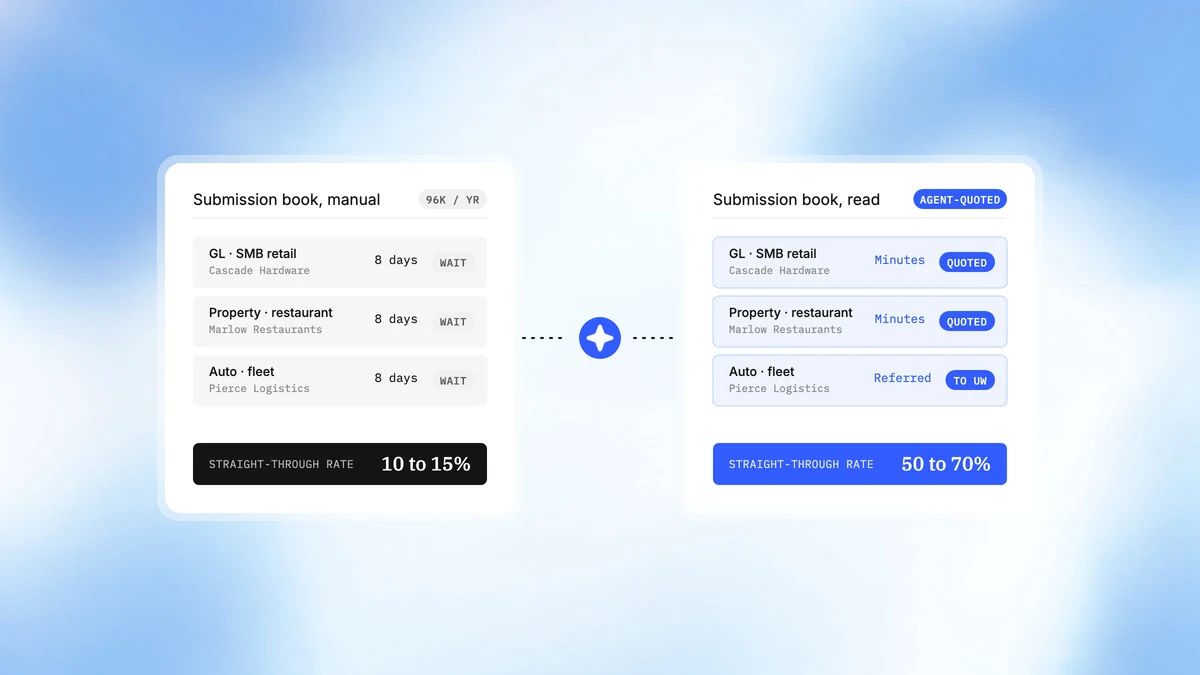
A mid-size commercial carrier runs a hundred underwriters seeing roughly eighty submissions each a month, close to 96,000 a year. Every one arrives as a broker email with attachments: ACORD forms, loss runs, financials, a schedule of values.
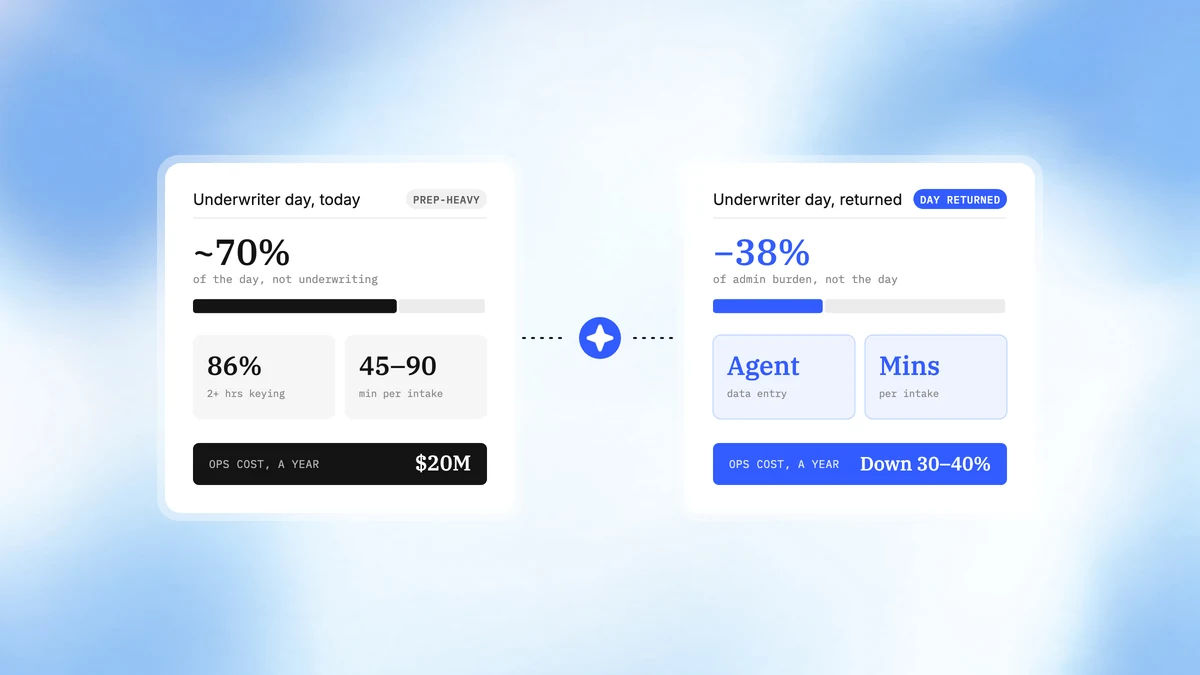
- 60 to 120 hours a month before any judgment happens. Intake review alone ran 45 to 90 minutes per mid-complexity submission, at eighty submissions a month.
- Roughly 70% of the day was not underwriting. The average underwriter spends 70% of their time on non-underwriting activities, 40% administrative and 30% negotiation and sales support (Accenture, P&C underwriting survey with The Institutes, 2022). A separate vendor survey put 86% of underwriters at more than two hours a day on manual data entry alone (hyperexponential, State of Pricing 2024). The carrier's own numbers matched.
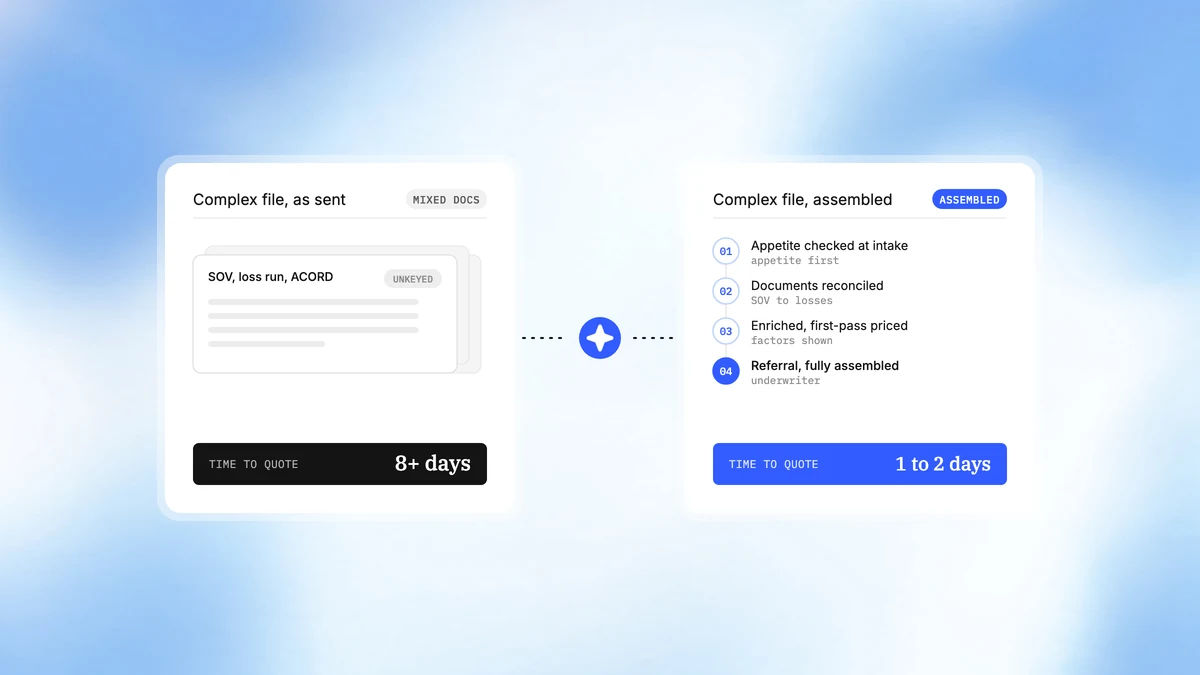
- Eight days to quote, twelve more to bind. Competitors running automated intake were coming back to the same broker inside 24 to 48 hours.
- The expense side left no room. This carrier's $20M operations line works out at roughly $208 to process a single submission, easy or hard, and it sits inside an industry whose combined ratio leaves no slack.
- Previous proposals stalled in review. Underwriting means running the insurer's filed rates, rating model, and policyholder data through somebody's code, and the rating model is the insurer's own regulatory responsibility, not a vendor's.
The intake the carrier receives
100
Underwriters
80
Submissions each, a month
12
Months
96,000
Broker submissions a year, none in a fixed shape
Solution
CreateOS built and deployed a crew of specialized agents that take a submission from the broker's inbox to a priced, enriched, appetite-checked quote. Standard in-appetite risks are quoted straight through. Complex or out-of-appetite risks route to an underwriter with the analysis already done and the referral reasons written.
- Appetite decides the path at intake. Straight-through, refer, or decline-to-quote is settled before an underwriter spends a minute on it.
- Broker emails, ACORD forms, loss runs, SOVs, and financials are read. Untrusted attachments arriving from outside the carrier are handled in the most tightly contained environment in the system.
- Enrichment completes the risk picture. Approved third-party property, hazard, financial, and prior-claims data, running in parallel with extraction rather than after it.
- Priced against the carrier's own filed rates. With the factors behind the number exposed rather than a black-box price, and the referral reasons written where the risk falls outside guidelines.
- Every risk runs through an identical environment. A fresh isolated environment forks per submission, so full volume is assessed simultaneously rather than queued. Submissions waiting on missing broker information pause rather than burning compute.
- The rating model stays the carrier's to own and defend. Control plane and storage run inside the carrier's own infrastructure, with egress allowlisted in the kernel so enrichment reaches approved providers and nothing else. Pricing models and policyholder data cannot leak, because the path does not exist.
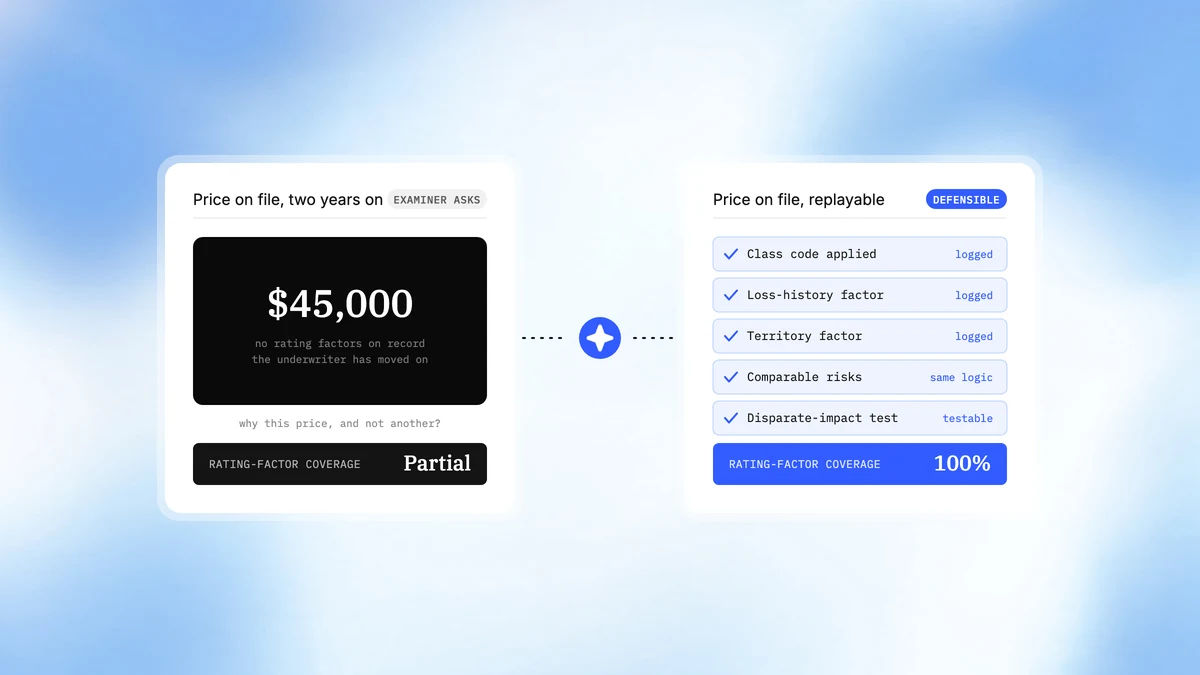
- Every decision and rating factor is logged. The full chain, including every appetite check, so a price can be explained rather than reconstructed.
CreateOS is SOC 2 Type II and ISO 27001 certified. Most agent builders own the logic and rent the runtime. When the agent is pricing regulated risk on the insurer's most sensitive data, that is backwards. We own both.
Outcome Derived
Standard risks are now quoted the same day the broker sends them. Underwriters see the risks that need an underwriter.
| Metric | Before | After |
|---|---|---|
| Time to quote, standard risks | ~8 days | Minutes to hours |
| Quote to bind | ~12 days | 24 to 48 hours |
| Straight-through processing | 10% to 15% | 50% to 70% on standard risks |
| Underwriter admin burden | Baseline | Down 38% or more |
| Quote capacity, same team | Baseline | Up 25% to 40% |
| Intake review per submission | 45 to 90 minutes | Minutes, agent-handled |
| Pricing consistency | Inconsistent | Reproducible by construction |
| Audit coverage | Partial | 100% of decisions and rating factors logged |
- $6.0M to $8.0M a year on a $20M operations line. 30% is the conservative floor we commit to in a pilot; 40% is the figure reported in production deployments. It comes from reclaiming intake and data-entry hours, not from cutting the underwriting team.
- The capacity lever is usually worth more than the saving. A 25% to 40% lift means the same hundred underwriters work through 24,000 to 38,400 more submissions a year with no new hire. Where the carrier was losing to whoever quoted first, capacity converts into hit rate.
- Growth as a model, not a benchmark. The carrier binds roughly 15% of what it quotes at about $35,000 average premium. A single point of hit rate is 960 more bound policies and $33.6M of new written premium, which at a 96% combined ratio is roughly $1.3M of underwriting profit. Both assumptions get replaced with the carrier's actuals.
- The 50% to 70% straight-through rate is for standard risks. It does not apply to complex specialty business, and any vendor who tells a chief underwriting officer otherwise has never underwritten a schedule of values.
- Appetite, pricing authority, and the bind stay with the underwriter. By design and by policy. The agents take the clerical half off the desk so judgment lands where judgment is the product.
- No loss-ratio improvement is claimed here. Better and more consistent pricing does improve it, and that prize dwarfs everything above, but it is validated on the carrier's own book in champion-challenger testing before anyone puts a number on it.
What We Would Prove, and How
Weeks 1 to 2, baseline. Measure the carrier's actual time to quote, underwriter capacity lost to intake, straight-through rate, expense ratio, and current loss ratio on the target line. This becomes the contract's yardstick and protects both sides in procurement.
Weeks 2 to 6, build and integrate. Stand up the agent crew, integrate to the carrier's policy administration, rating engine, document intake, and approved data providers along allowlisted paths, encode appetite and filed rates, deploy self-hosted inside the carrier's boundary, scoped to one line of business.
Weeks 6 to 10, champion-challenger shadow run. Agents underwrite and price real submissions alongside underwriters without binding anything. Compare decisions and prices case by case, validate the capacity claims on the carrier's own submission flow, and test explicitly for unfair and proxy discrimination before anything goes live.
Week 10 onward, controlled go-live. Straight-through quoting switched on first for the cleanest standard, in-appetite risks, underwriters on every referral and decline, scope expanding as the champion-challenger evidence builds.
Success criteria, agreed up front: time to quote down at least 40%, underwriter admin burden down at least 38%, straight-through rate materially lifted on standard risks, no degradation in loss ratio, no unfair or proxy discrimination, and 100% explainable rating-factor coverage.
Highlights
- Time to quote, standard risks: ~8 days → Minutes to hours.
- Straight-through processing: 10% to 15% → 50% to 70% on standard risks.
- Annual cost reduction on underwriting operations: $6.0M to $8.0M.
- Quote capacity, same team: up 25% to 40%.