Intake and reconciliation per complex submission: Minutes, agent-handled
Underwriter hours on complex intake: Largely returned
Time to quote, complex risks: 1 to 2 days
Quote to bind: Materially compressed
Challenge
The standard book was the easy part. The money was in the complex book, and so was the pain: multi-location property accounts with schedules of values running to hundreds of rows, five-year loss runs in whatever format the prior carrier felt like producing, financials, supplementals, and a broker cover email carrying the context none of the documents contained.
- Where judgment is the entire product, it gets the least time. These are the accounts the carrier employs senior underwriters for, and the ones where those underwriters spend the least of the day underwriting.
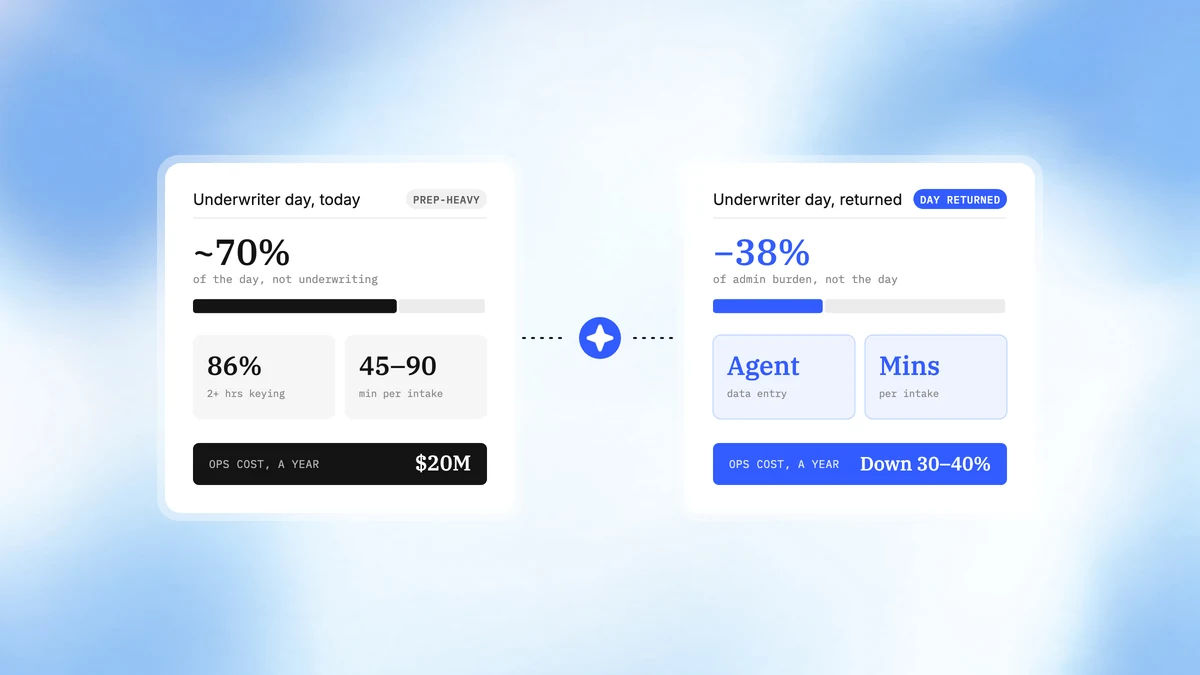
- ~38,400 hours a year on document reconciliation. Roughly $3.8M of the most expensive expert time. On a large schedule-of-values account, someone reconciles a spreadsheet of locations against a loss run that names them differently, then chases the broker for four missing fields.
- ~24,000 hours a year on business it declined. About $2.4M. A fifth of submissions fell outside appetite, and nobody knew until an underwriter had already opened and worked the file.
- Three weeks to bind loses the account next year. Submission to quote ran about eight days, quote to bind another twelve, and longer on complex accounts. In a broker market that is the account placed somewhere else.
- The tools said this segment could not be done. Standard risks yes, schedules of values and loss runs no. Which was true of tools that treat a submission as a form to be scraped rather than a set of documents to be read and reconciled against each other.
Where the underwriter's first two hours go
Two hours in
Minutes in
Is it in appetite?
Is it in appetite?
Nobody knows until an underwriter looks
Declined in minutes, with the reason written
Do the documents agree?
Do the documents agree?
Schedule of values read apart from the loss run
Each location matched to the losses attached to it
What is missing?
What is missing?
Property, hazard and prior-claims lookups by hand
Enrichment completed from approved providers
Underwrite it
Underwrite it
Whatever is left of the morning
The first action of the day
Solution
CreateOS built and deployed an agent crew specifically for the documents that defeat generic intake tooling.
- Out-of-appetite risks are declined in minutes, with the reason written. Before an underwriter spends an hour on a risk that was never going to be written. That alone is the 24,000 hours.
- Documents are reconciled against each other, not scraped in isolation. A location on the schedule of values is matched to the losses attached to it in the loss run, even when the two documents name it differently. Missing fields are identified and the chase list produced automatically.
- Enrichment handles the lookup work no underwriter should do by hand. On a multi-location account, approved third-party property, hazard, financial, and prior-claims sources are a large amount of it.
- A first-pass assessment and price with factors exposed. Against the carrier's own filed rates and models, with referral reasons written in full where the risk falls outside guidelines.
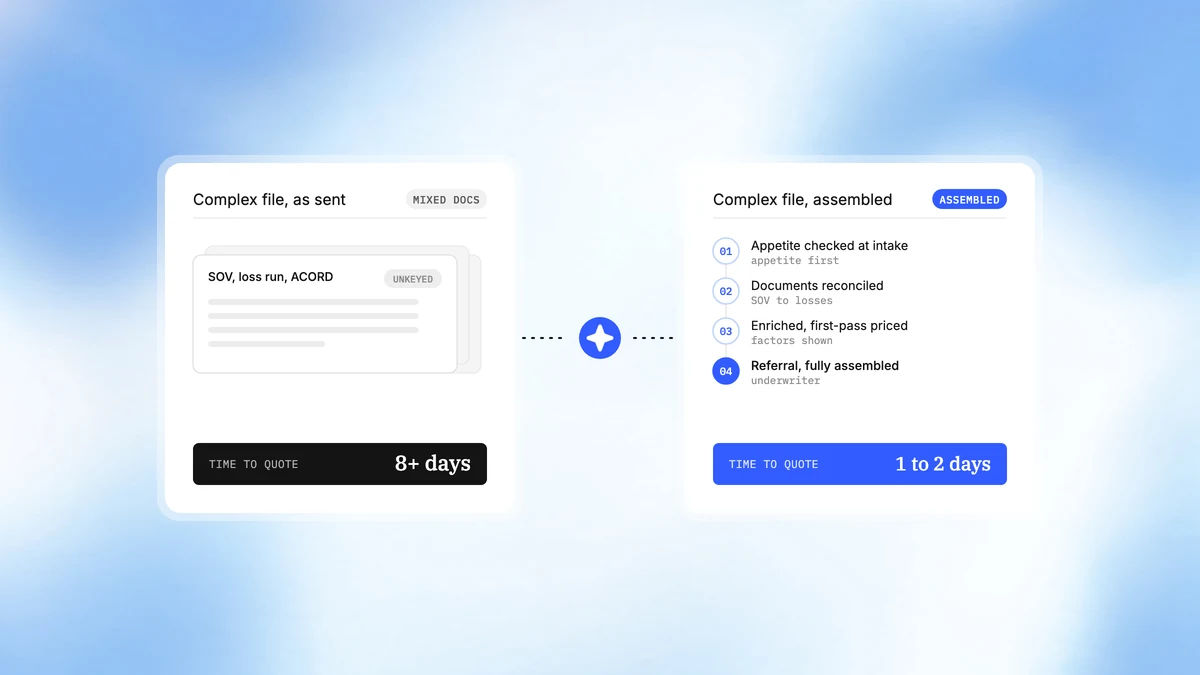
- The underwriter starts where they used to start after two hours. The output for a complex risk is not a quote. It is a fully assembled, reconciled, enriched, appetite-checked, first-pass-priced submission with the open questions surfaced and the broker chase list already sent.
- A hundred complex accounts work in parallel. Each forks into its own isolated environment with identical logic instead of queueing behind whichever underwriter has capacity, and anything waiting on a missing loss run pauses and resumes when it arrives.
- The rating model and policyholder data never leave. Extraction against untrusted broker attachments runs in its own guest kernel, egress is allowlisted to approved providers, and the control plane sits inside the carrier's own infrastructure.
CreateOS is SOC 2 Type II and ISO 27001 certified.
Outcome Derived
The underwriters kept the judgment. The agents took the reconciliation.
| Metric | Before | After |
|---|---|---|
| Intake and reconciliation per complex submission | ~2 hours | Minutes, agent-handled |
| Underwriter hours on complex intake | ~38,400 a year | Largely returned |
| Time to quote, complex risks | 8 days and up | 1 to 2 days |
| Quote to bind | ~12 days | Materially compressed |
| Out-of-appetite risks identified | After underwriter review | In minutes, before review |
| Hours spent on declined business | ~24,000 a year | Substantially eliminated |
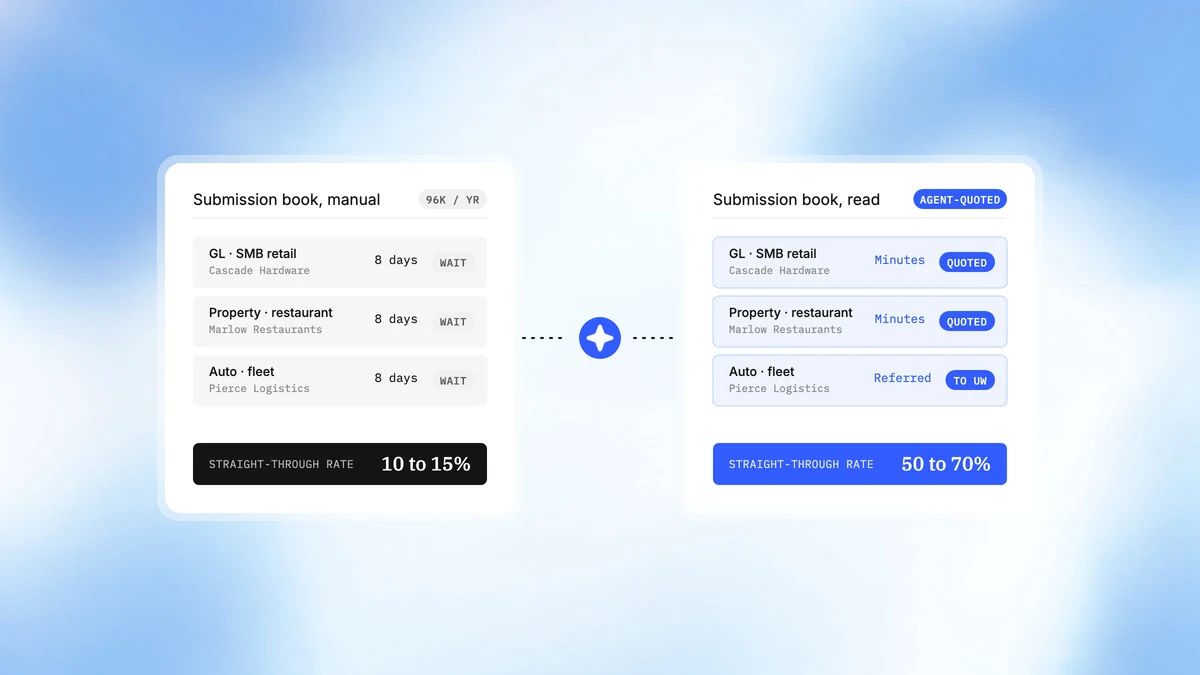
| Straight-through processing | 10% to 15% | Deliberately stays low here |
| Referral quality | Raw submission | Fully assembled and priced |
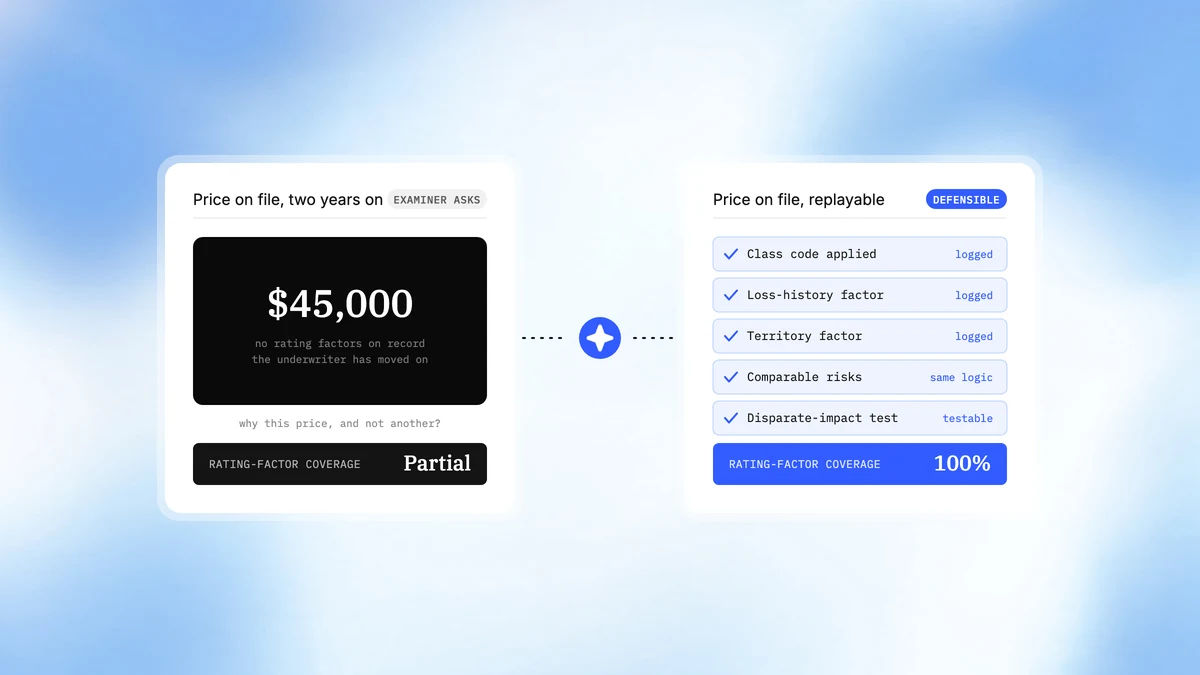
| Audit coverage | Partial | 100% of decisions and rating factors logged |
- Over 60,000 hours and roughly $6M a year of scarce capacity. Complex intake and reconciliation was ~38,400 hours (about $3.8M) and declined business another 24,000 (about $2.4M). None of it produced an underwriting decision. That pool sits inside the $6.0M to $8.0M total operations reduction across the line.
- Speed on the accounts where speed is worth the most. Complex risks carry the largest premiums and the longest cycles, so compressing submission-to-quote from eight days to one or two is worth more per account here than anywhere else in the book.
- The carrier that comes back first usually writes it. On a large specialty account in a broker market, that is frequently the whole contest.
- Straight-through processing does not apply here, and we do not claim it. The 50% to 70% figures belong to the standard book. On a large schedule-of-values account the correct rate is close to zero, because making exactly that call is why the carrier employs a senior underwriter.
- The agent reads, reconciles, chases, enriches, and prices first-pass. The underwriter does the underwriting. Any vendor promising to automate the specialty decision itself is selling to someone who has never had to defend one.
- No loss-ratio claim. More complete and consistent risk pictures do price better, and on complex business that is where the real money is, but it is validated on the carrier's own book before it goes near a headline.
What We Would Prove, and How
Weeks 1 to 2, baseline. Measure actual intake and reconciliation time on complex submissions, hours spent on business ultimately declined, time to quote, quote-to-bind, and the current loss ratio on the target specialty line.
Weeks 2 to 6, build and integrate. Stand up the agent crew, integrate to policy administration, the rating engine, document intake, and approved data providers along allowlisted paths, encode appetite and filed rates, deploy self-hosted inside the carrier's boundary, scoped to one specialty line.
Weeks 6 to 10, champion-challenger shadow run. Agents extract, reconcile, enrich, and price real complex submissions alongside the underwriters without binding. Compare the assembled file against what the underwriter produced by hand, measure the hours returned, and test explicitly for unfair and proxy discrimination.
Week 10 onward, controlled go-live. Agent intake and appetite triage switched on across the complex book, with every referral, decline, and bind decision staying with the underwriter.
Success criteria, agreed up front: intake and reconciliation time down at least 40%, out-of-appetite risks triaged before underwriter review, time to quote down at least 40%, no degradation in loss ratio, no unfair or proxy discrimination, and 100% explainable rating-factor coverage.
Highlights
- The underwriters kept the judgment. The agents took the reconciliation.
- Complex commercial risks carry the largest premiums and the longest cycles. Compressing submission-to-quote from eight days and up down to one or two, and cutting the chase cycles that stretch quote-to-bind past twelve days, is worth more per account here than anywhere else in the book, because the account itself is worth more. In a broker market, the carrier that comes back first on a large specialty account is frequently the carrier that writes it.
- What changes is what the underwriter is looking at when they make it. The agent does the reading, the reconciling, the chasing, the enriching, and the first-pass pricing. The underwriter does the underwriting. Any vendor promising to automate the specialty decision itself is selling to someone who has never had to defend one.
- This case study also makes no loss-ratio claim. More complete and more consistent risk pictures do price better, and on complex business that is where the real money is, but it is validated on the carrier's own book in champion-challenger testing before it goes anywhere near a headline.