Risk and Issues Spotting
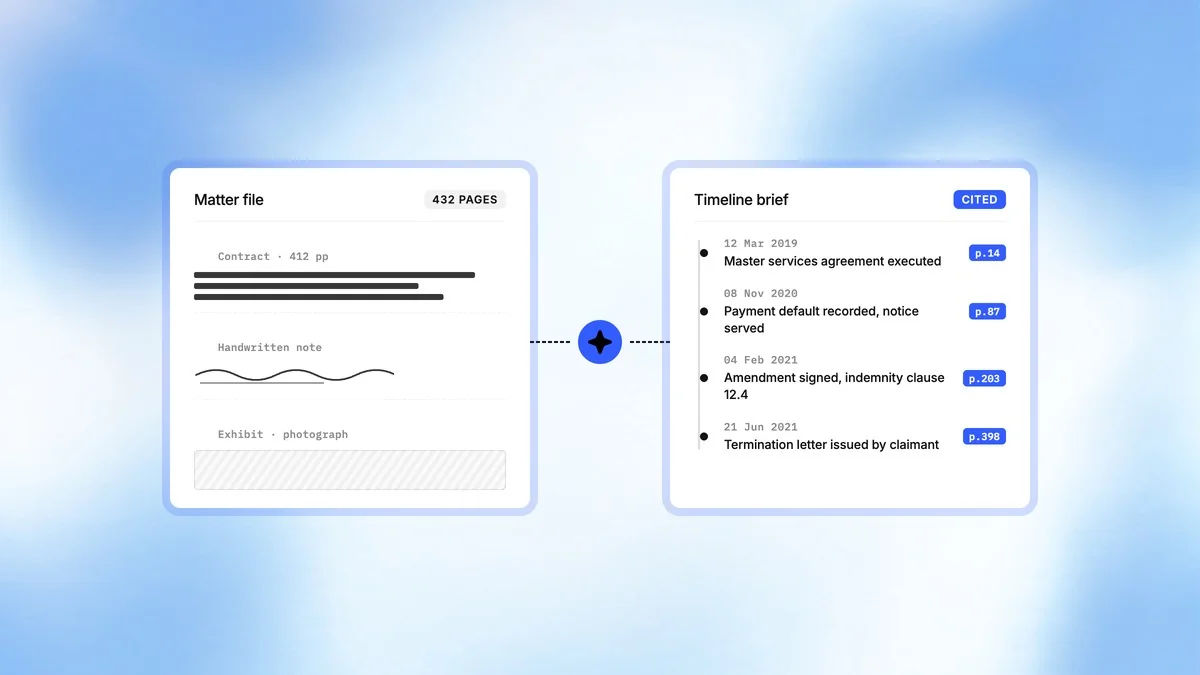
Read a document set and surface the legal risks and open issues a lawyer should look at first, each cited.
What It Does
The agent reads the set, surfaces risks and open issues, ranks them for attention, and cites the passage behind each. A lawyer reviews and decides what to act on.Without it: Spotting every risk and issue across a large set under deadline is hard, and the ones that matter most are easy to bury.
- Ranking follows your risk register's own categories, not a generic severity scale
- Absent documents the set implies should exist are raised alongside risky language
- Issues already open on the matter are marked as known, not raised again as new
- Findings stay in the review platform; the risk register is read, never written
Illustrative example
Review opens on a distribution dispute with a 600-document bundle. The agent puts the uncapped indemnity at clause 11.2 of the 2021 master agreement at the top with the paragraph cited, and raises that the master agreement refers to a Schedule 3 that is nowhere in the bundle. The reviewing associate works down the ranked list and decides which findings become risk register entries.
Review platform
The document set
Data room
Deal documents, index
Risk register
Risk categories, open items
Matter management
Issues already open
Risk and issues spotting
WatchStarts when
A document set is handed to the team for review
How far it goes
it flags and records, and takes no action itself
Risk list
Ranked by register category
Open issues
Flagged, register untouched
Source passages
Cited beside each finding
More Legal Agents
Litigation document review
Review large litigation document sets for relevance, issues, and risk, with every call cited and logged.
Contract review and redlining
Check contracts against your playbook, flag risky terms, and propose redlines for a lawyer to approve.
Clause extraction and comparison
Pull key clauses across a contract set and compare them side by side, each linked to the source.