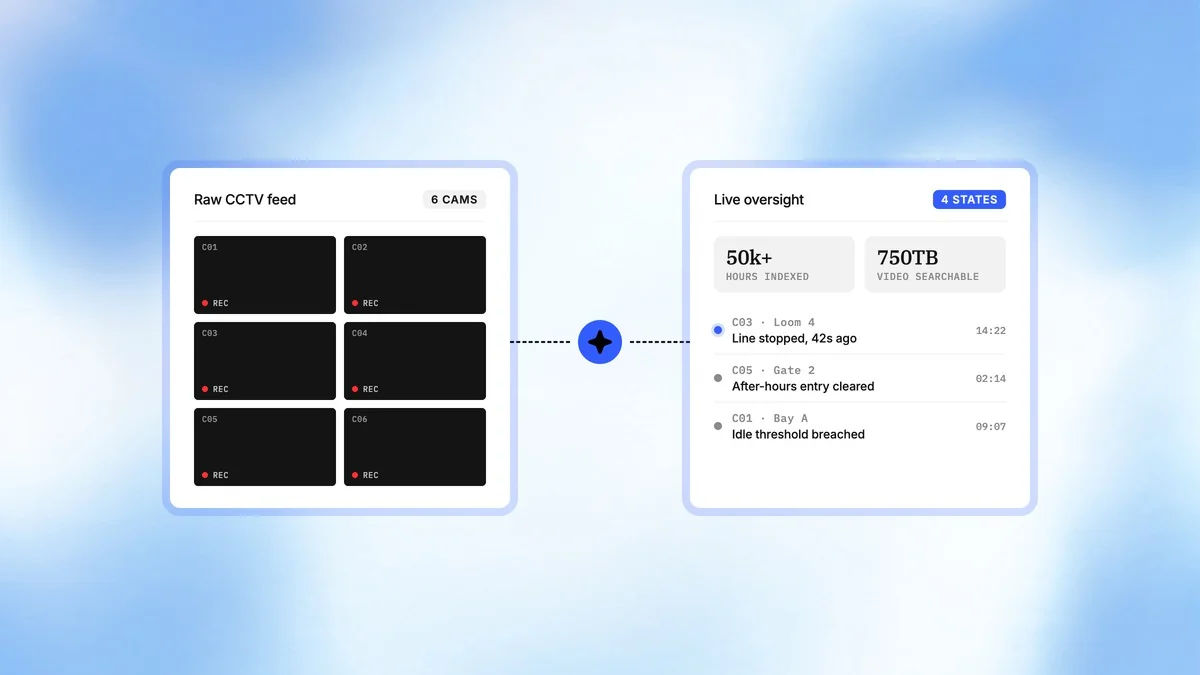
Full pilot across cotton processing facilities in four Indian states.
Hours of CCTV footage ingested, indexed and made searchable in the workspace.
Total footage moved into a unified CreateOS workspace with no on-site DVR risk.
Maharashtra, Tamil Nadu, Telangana and Gujarat live in the same pilot.
Why is the CreateOS Manufacturing Pilot Significant for Indian MSMEs?
In traditional manufacturing, CCTV usually sits in the background: running constantly, checked rarely, and reviewed only after a crisis. For Indian MSMEs (Micro, Small, and Medium Enterprises), the barrier to high-tech oversight hasn't been a lack of cameras, but a lack of usable data.
Over a 75-day pilot, cotton processing facilities across Maharashtra, Tamil Nadu, Telangana, and Gujarat connected their existing systems to CreateOS. By processing over 50,000 hours of video data (750+ terabytes) in a single workspace, these factories proved that you don't need an in-house DevOps team to achieve "Industry 4.0" visibility.
CreateOS solved the three primary friction points for these manufacturers: remote locations, unreliable local storage, and fragmented oversight.
The same cameras, before and after
CCTV as installed
CCTV as a workspace
Cameras record continuously
Cameras record continuously
Onto unreliable local storage
Into one workspace, 750+ TB of it
Footage exists
Footage exists
Checked rarely, if at all
Indexed and searchable, 50,000+ hours
Something goes wrong
Something goes wrong
Reviewed after the crisis
Surfaced on an operational dashboard
Four sites, four states
Four sites, four states
Overseen separately, or not at all
One view, no in-house DevOps team
Hardware isn't the gap. Usable data is.
Most MSMEs already have CCTV. What they lack is the workspace to turn it into something operations can act on.
How Did Factories Implement the CreateOS Workflow?
The deployment followed a standardised three-step path that turned raw hardware into an operational surface:
Connect CCTV to cloud storage
Factory operators pointed live recording systems at cloud buckets integrated with CreateOS. This removed the "single point of failure" risk inherent in on-site DVRs.
Build monitoring dashboards
Using the CreateOS workspace, teams assembled views that showed camera feeds alongside basic status indicators. The focus was on a clean, shared truth rather than complex AI modelling.
Simplify for non-technical users
Owners and supervisors needed a system that required no specialised training. Moving from ad-hoc spreadsheets and raw clips to a unified dashboard made daily operations feel manageable.
What Are the Next Steps for Operational Intelligence?
The first phase was about visibility; the next phase is about automated detection. With video data flowing through the CreateOS infrastructure, factories can now layer in specific detection for:
- Unauthorised access. to restricted zones.
- Irregular material handling. or routing errors.
- Equipment stoppages. and extended idle times.
- Line-level malfunctions. or blockages.
The goal is to move from reactive reviewing ("What happened yesterday?") to proactive signaling ("What is happening right now?").
Why Does This Deployment Matter for Global Supply Chains?
The pressures facing Indian textiles (traceability, quality control, and compliance) are now global. Whether in India or the US, buyers and regulators demand verifiable evidence of work conditions.
By repurposing existing CCTV hardware and bringing it into a unified workspace, CreateOS allows small operations to achieve:
Traceability
Time-aligned records of all key production areas, ready to share with buyers or auditors.
Accountability
Bottlenecks and policy violations identified in real time, not after the fact.
Continuous improvement
Live data drives operational decisions instead of static post-incident audits.
How Does This Reflect the CreateOS Philosophy?
Launched on February 4, 2026, CreateOS was built on the premise that advanced operations should be accessible. This pilot proves three core brand pillars:
One workspace
Creation and deployment unified so teams don't have to stitch tools together.
AI-assisted workflows
Accessible automation through no-code surfaces that operations teams can actually own.
Infrastructure choice
Hybrid compute for resilience and cost-efficiency, with no technical debt for the user.
Where CreateOS Goes Next
This deployment is a proof point. It shows that sectors traditionally underserved by software can stand up a meaningful digital layer in weeks. As CreateOS expands, the mission remains the same: handle the complex "under-the-hood" infrastructure so builders and owners can focus on their operations.
Highlights
- Scale: 50,000+ hours of video (750+ TB) processed across 75 days.
- Impact: Converted passive CCTV into active operational dashboards for MSMEs.
- Outcome: Improved traceability and accountability in Maharashtra, Tamil Nadu, Telangana, and Gujarat.
Builder profile
CreateOS is the unified execution layer for AI. It coordinates the full lifecycle: discovery, deployment, scaling, monitoring, and billing. Infrastructure, compute, LLM orchestration, agent deployment, and observability in one place instead of three.
Multi-tenant by default with hybrid deployment options for regulated industries: on-prem or bring-your-own-cloud, region-aware compute, and SOC 2-aligned controls. Used in production for everything from indie builders shipping apps in hours to enterprise pilots like the Indian textile MSME program that processed 50,000+ hours of CCTV across 75 days.