On this page
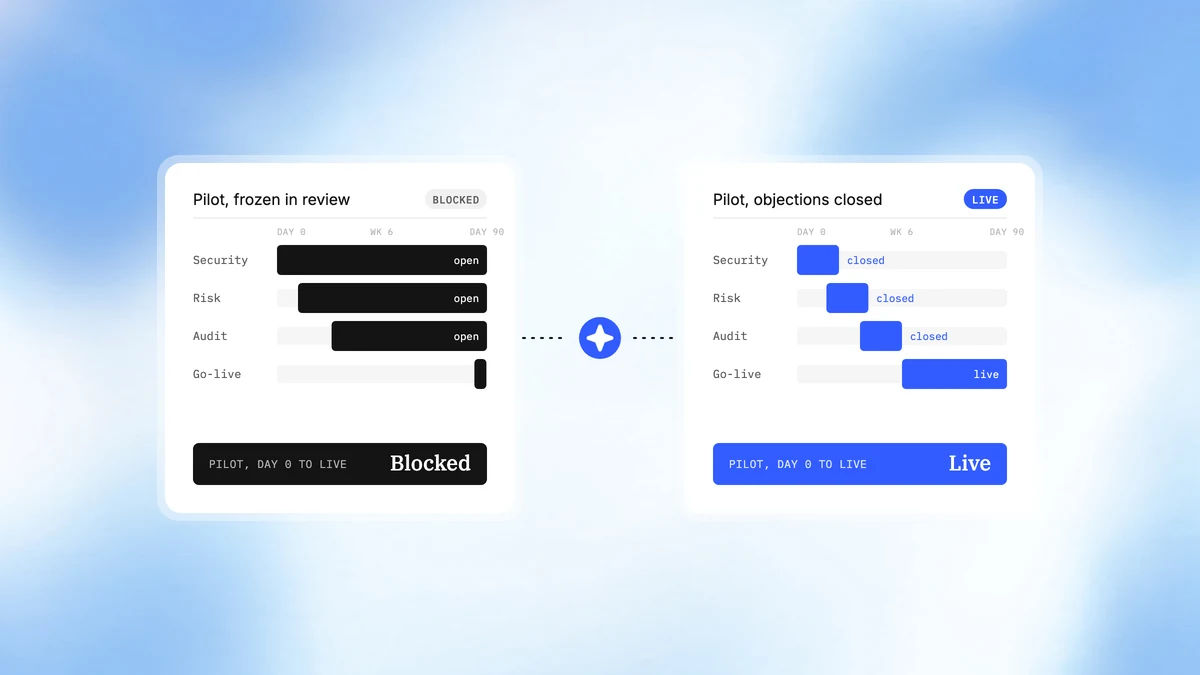
Pilot on one line: baseline, watch-only against a safe copy of the live schedule, enforce, readout.
Watch-only against real schedule data with nothing permitted to act.
The pilot commits to a single measure before it starts, and reports against it.
Challenge
Planning tools rewrite the schedule on their own, and each rewrite has a cost: expedite freight to recover a date, a changeover that need not have happened, or a customer promise quietly missed.
- The cost surfaces after the fact. Expedite spend appears in the month-end number, long after the change that caused it.
- Changes compound. One reschedule moves the constraint, and the next change is made against a plan already disturbed.
- Nobody sees the cumulative pattern. Individual changes look reasonable; the aggregate does not.
What one reschedule is priced against
- The rules already in placeFreeze windows, top-tier customer protection, changeover sequence.
- The material, not the plan for itA pull-in checked against what will physically arrive.
- Two operations downstreamRescuing one late order by starving a downstream cell.
A schedule change that looks reasonable
Individually defensible. The aggregate is not.
- What the change itself costsFreight premium, overtime, and the changeover it creates.
- The changes already made this weekOne reschedule moves the constraint the next is measured against.
Solution
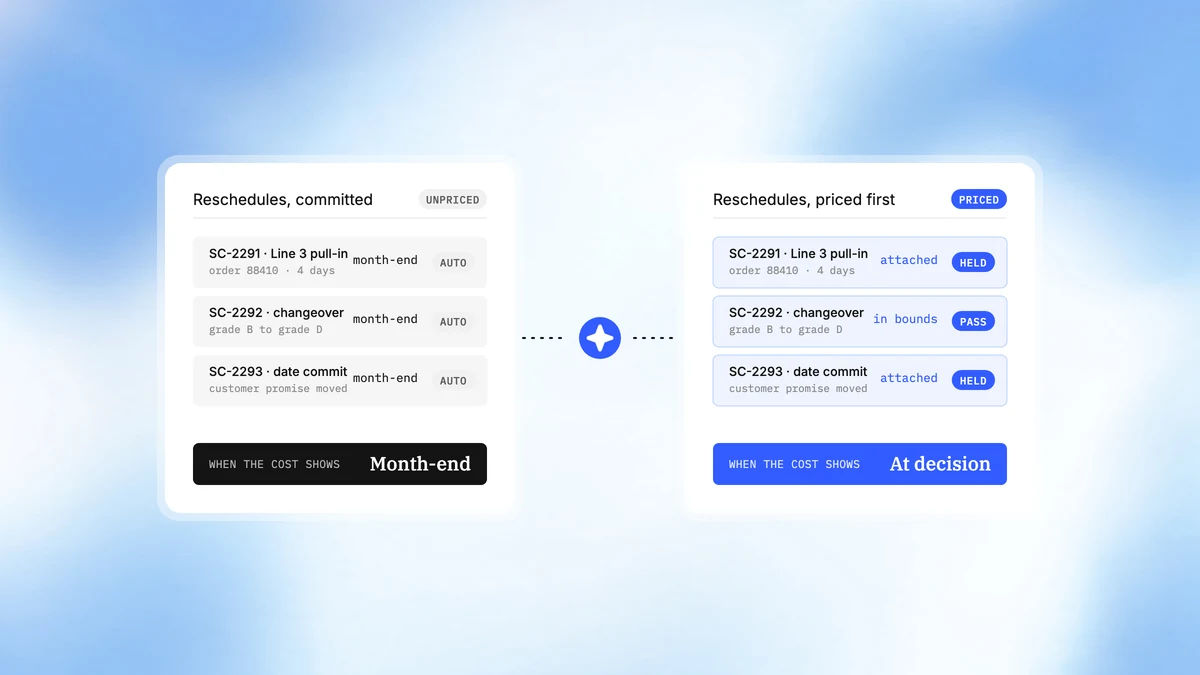
Rescheduling is not the problem. Rescheduling without seeing the freight bill is. The cost is priced before the change commits, not after it ships.
- Bounds set once, enforced every time. Changeover limits, date-commit rules and cost thresholds decide what passes automatically.
- Reality checks before commitment. Material availability, capacity and open commitments are verified against live data.
- Costly changes become a planner's decision. Held with the projected expedite cost attached, so the trade-off is visible at the moment of choosing.
- Every change and its rationale retained. Including the changes that were prevented.
What the Change Is Priced Against
Every planning tool will make the change faster. None of them will tell you what the change costs before the floor is already running to it.
- The rules the plant already has. Freeze windows, top-tier customer protection, changeover and family sequencing, single-source exposure, and the overtime and expedite ceilings finance already tracks. Stated in the plant's own terms and applied the same way at 9am and at 3am.
- The material, not the plan for the material. A pull-in is checked against what will physically arrive by the new date, including in-transit stock and supplier confirmation, rather than against the lead time the plan assumed when it ran.
- The operation two steps downstream. A change that rescues one late order by starving a downstream cell is the expensive kind. What the change does further along the line is checked before it commits.
- The projected cost of the change itself. Freight premium, overtime and the changeover a resequence creates are estimated and attached to the hold, so a planner approves a number rather than an impression.
- The changes already made this week. One reschedule moves the constraint and the next is made against a plan already disturbed. The cumulative pattern is surfaced, which no individual change makes visible.
The Reschedule Nobody Has Time to Check
The hardest changes happen at the worst moment. A supplier slips, a machine goes down, a top customer pulls an order in, and the change most likely to miss something is the one being made under the most pressure.
- Routine keeps its speed. A normal resequence inside the bounds flows through untouched. A check that queues every change gets routed around inside a week, and then it protects nothing at all.
- Held is not blocked. A hold is a one-action decision for the planner who owns the line, with the trade-off shown. It is not a ticket dropped into a shared queue to be triaged later.
- Escalation has a clock. Every hold names an owner and a wait, agreed before go-live, so a change that genuinely has to happen does not sit behind a control while the line waits.
- The reason survives the week. What triggered a change, what it cost, and who approved it is retained. The reasoning behind Tuesday's changes is usually gone by Friday's review, which is exactly why the same argument repeats every Monday.
Outcome Derived
This is a 60 to 90 day pilot on a single line, cell, category or product family. The figures below are what the pilot measures against a baseline captured in its first two weeks. They are targets and instrumentation, not results already delivered.
- Expedite dollars avoided. Measured against the reschedule and expedite baseline captured in weeks 1-2.
- On-time delivery movement. Tracked on the single line or value stream chosen for the pilot.
- Changeovers not incurred. Counted where a held change would have triggered one.
Highlights
- The check sits between a proposed change and the plan the floor runs to. Planning stays in the planning system.
- Freeze windows, top-customer protection, changeover and family sequencing, single-source exposure and expedite ceilings are enforced identically every time.
- Material arrival, real capacity and downstream starvation are verified against live data before the change is allowed to commit.
- A costly change reaches a planner with the projected expedite cost attached, so the trade-off is visible at the moment of choosing rather than at month end.
- Prevented changes are retained alongside released ones, which is what turns the Monday schedule review into a lookup instead of an argument.
Frequently asked questions
Do we have to replace our planning system?
No. The planning tools and the planners' own spreadsheets keep producing the schedule. This adds one check between a change being proposed and the floor running to it. Nothing is ripped out, no data moves into a new system, and no planner learns new software.
What kind of change actually gets held?
A change that breaks one of your rules or fails a live check: expediting above your cost limit, slipping a top-tier customer, starving a downstream operation, breaking a changeover constraint, or committing to material that will not arrive in time. Everything else passes without waiting for anyone.
Will this slow down replanning?
Routine resequences flow straight through. Only changes carrying real dollar risk stop, and they reach a planner with the projected expedite cost attached for a single approve or reject. A check that queued every change would be worked around within a week, which is why it does not.
What does the pilot measure?
One line or value stream over 60 to 90 days, against one number agreed before it starts. Weeks one and two capture reschedule frequency, expedite spend, changeover losses and missed ship dates. Weeks three to six run watch-only against real schedule data with nothing permitted to act.