On this page
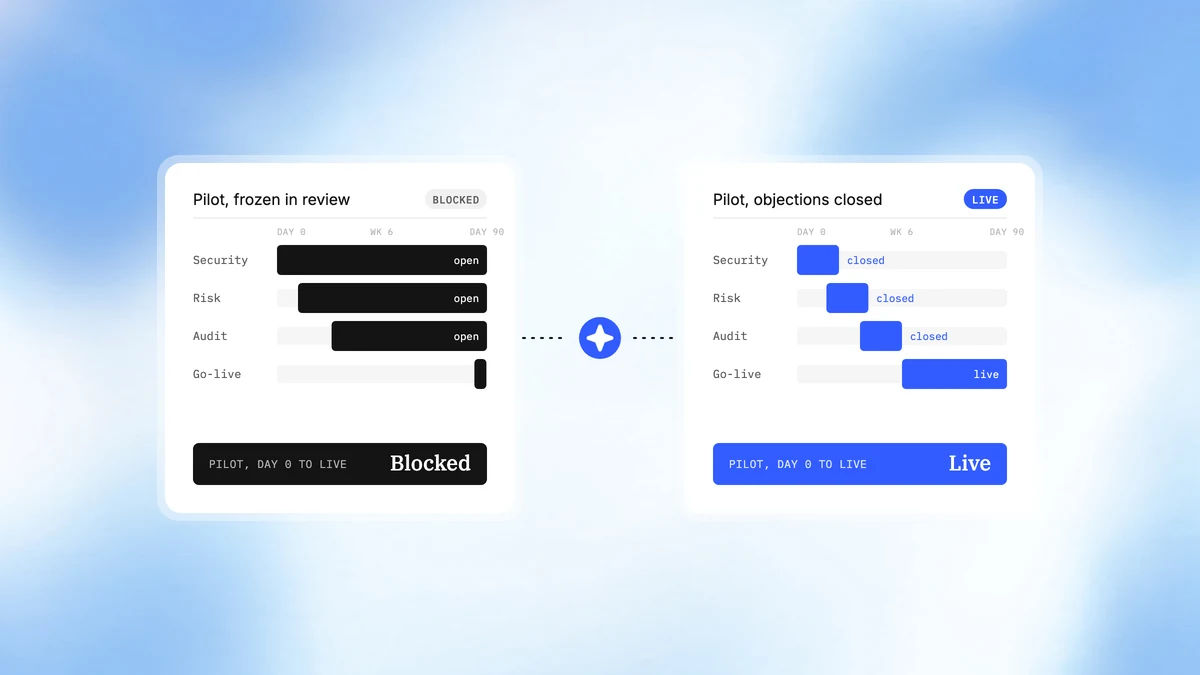
Pilot on one category or region: baseline, watch-only, enforce, readout.
Every reorder checked and scored inside your environment, with nothing blocked.
The readout reports working capital and stockout rate together, not one without the other.
Challenge
Automated replenishment fails in two directions at once. Order too much and working capital sits in a warehouse; order too little and the shelf is empty, or the gap is closed with margin-destroying expedite.
- Both failure modes cost, differently. One shows up in working capital, the other in service level and expedite spend.
- The forecast is trusted more than it should be. A reorder acts on a projection as though it were a fact.
- The correction arrives late. Inventory positions are reviewed on a cycle, while reorders are placed continuously.
Two ways a reorder is wrong
Ordered too much
- Working capital frozenCash sitting as stock nobody needed this quarter.
- Storage and dock capacity consumedA constraint the forecast never saw.
Ordered too little
- Service level missedAn empty shelf, and a customer who notices.
- Expedite freight to recoverPaid at a premium to undo a decision made overnight.
Solution
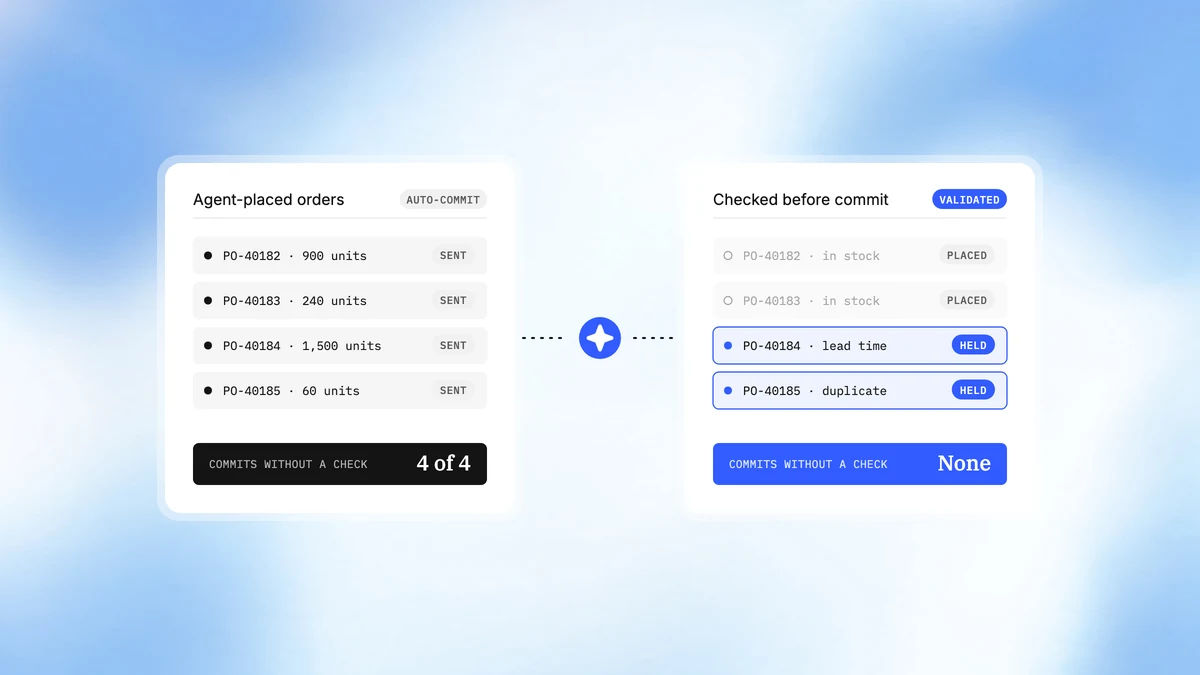
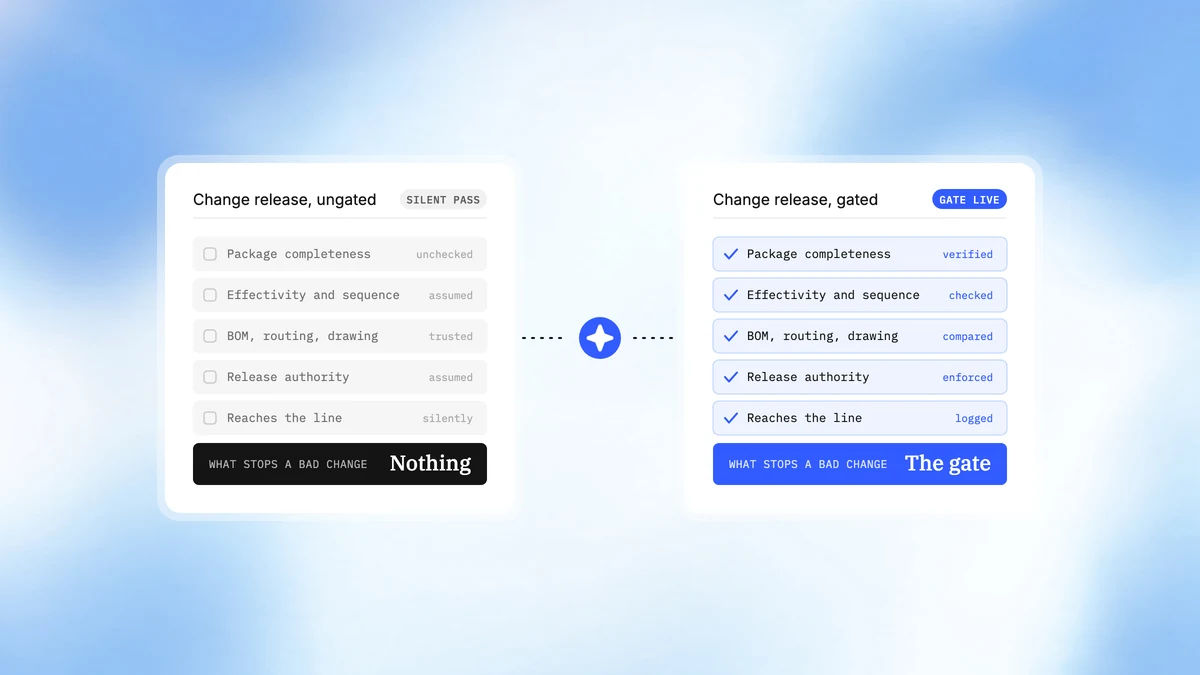
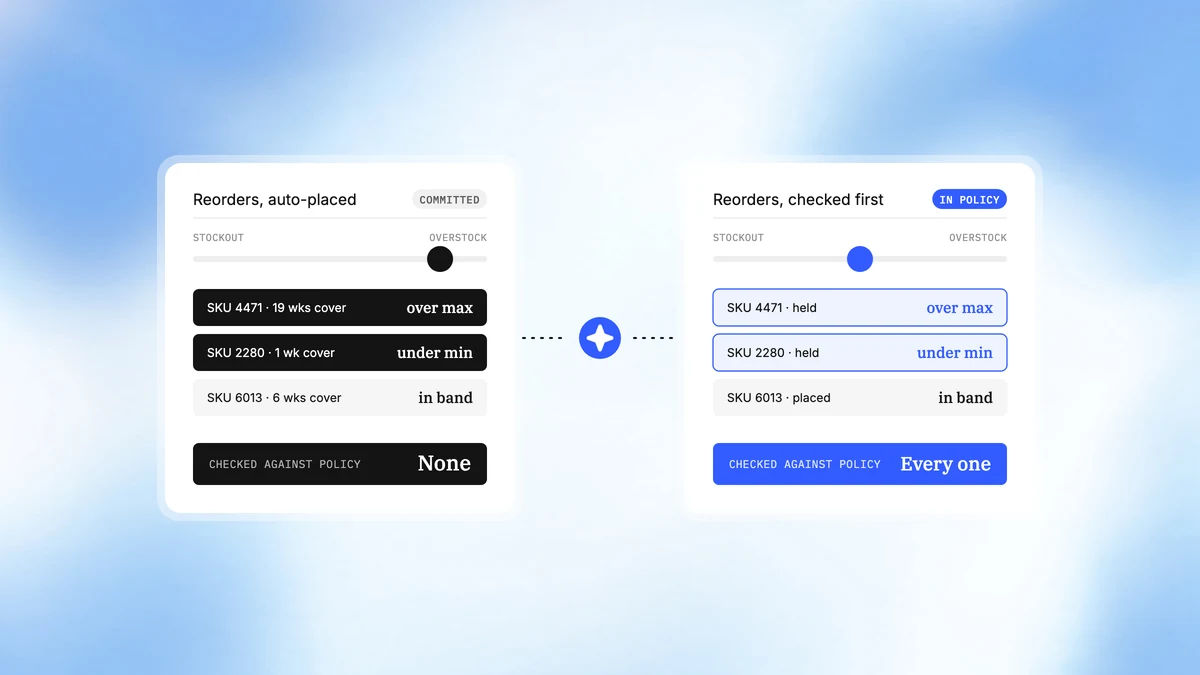
The reorder engine keeps running. Each buy it raises is checked against coverage policy and live stock before it becomes a commitment.
- A checkpoint before the reorder commits. Coverage, in-transit stock and open commitments checked against live data.
- Policy expressed as enforceable bounds. Minimum and maximum coverage, value thresholds and category rules decide what passes.
- Out-of-bounds reorders wait for a planner. Presented as a one-click confirm with the projected position attached.
- A record of every reorder and every hold. So a stockout or an overstock can be traced to the decision behind it.
The Nightly Run Nobody Watches
Reorder quantities flow toward the ERP overnight. Some come from a planning system, some from a spreadsheet a planner built, some from a forecasting tool the team is trying out. Almost none are checked one by one before they commit cash.
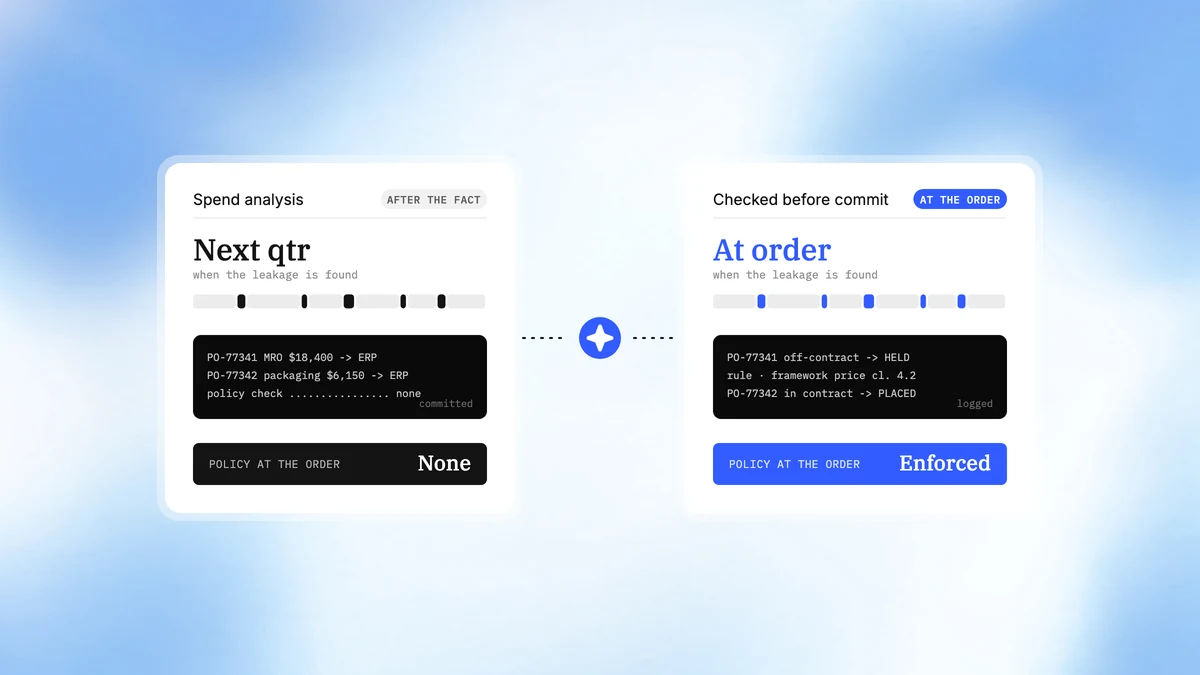
- The argument happens after the money moves. Planners override the forecast in spreadsheets and then debate it in the Monday meeting. By the time the meeting starts, the position has already been bought.
- One bad forecast multiplies quietly. Across thousands of items in a single night, an error does not announce itself. It surfaces at month end as stock that will not sell, or a shelf that is already empty and a sale already lost.
- Nobody can name the forecast that caused it. Without a per-reorder record there is nothing to point at, so the same mistake repeats on the next cycle and the meeting has the same argument with the same people.
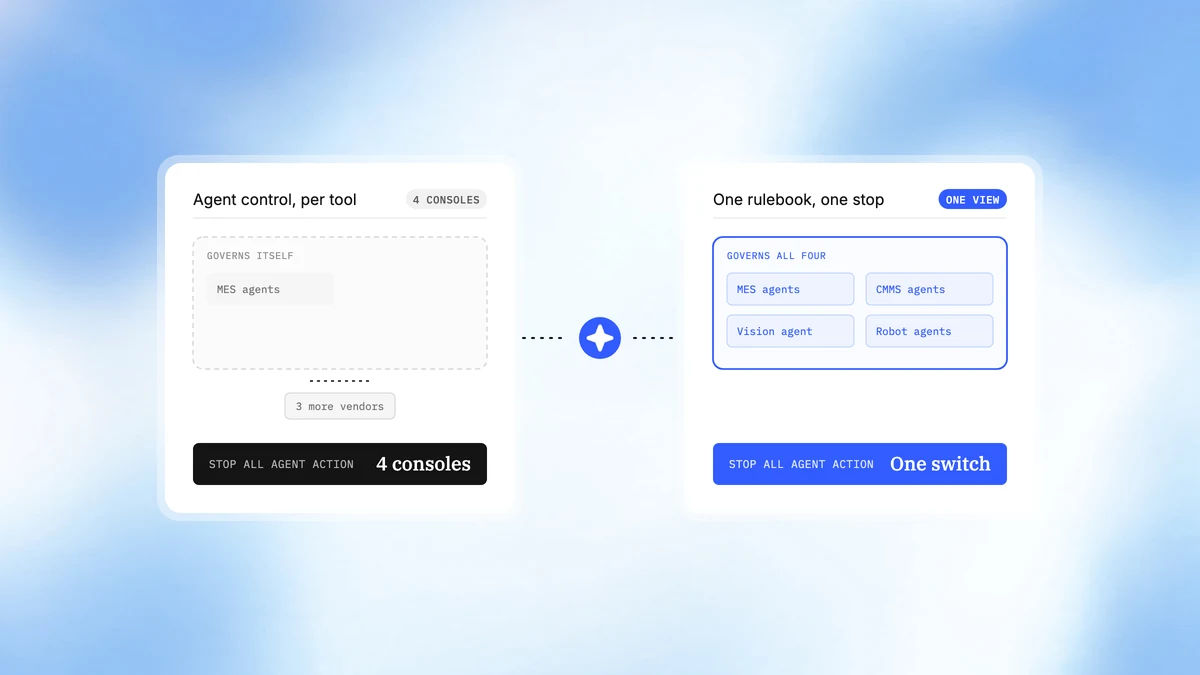
- The referee cannot also be the player. Most tools that produce the number also grade it. CreateOS builds no forecasting engine, which is the only reason its verdict on a reorder carries any weight.
What Each Reorder Is Checked Against
- Today's real position. On-hand, in-transit and already-committed stock at the moment the reorder would commit, rather than the snapshot the forecast ran against hours or days earlier.
- The coverage band, both bounds. Minimum and maximum weeks of cover for that item and location. Both, because the overstock and the stockout are the same control failing in opposite directions.
- Duplicate and overlapping commitments. Whether a purchase order is already open against the same requirement, which is the most common way a category quietly doubles its position without anyone deciding to.
- The constraints the forecast cannot see. Supplier minimums, dock and storage capacity, launch and discontinuation dates, and the working-capital ceiling agreed for that category.
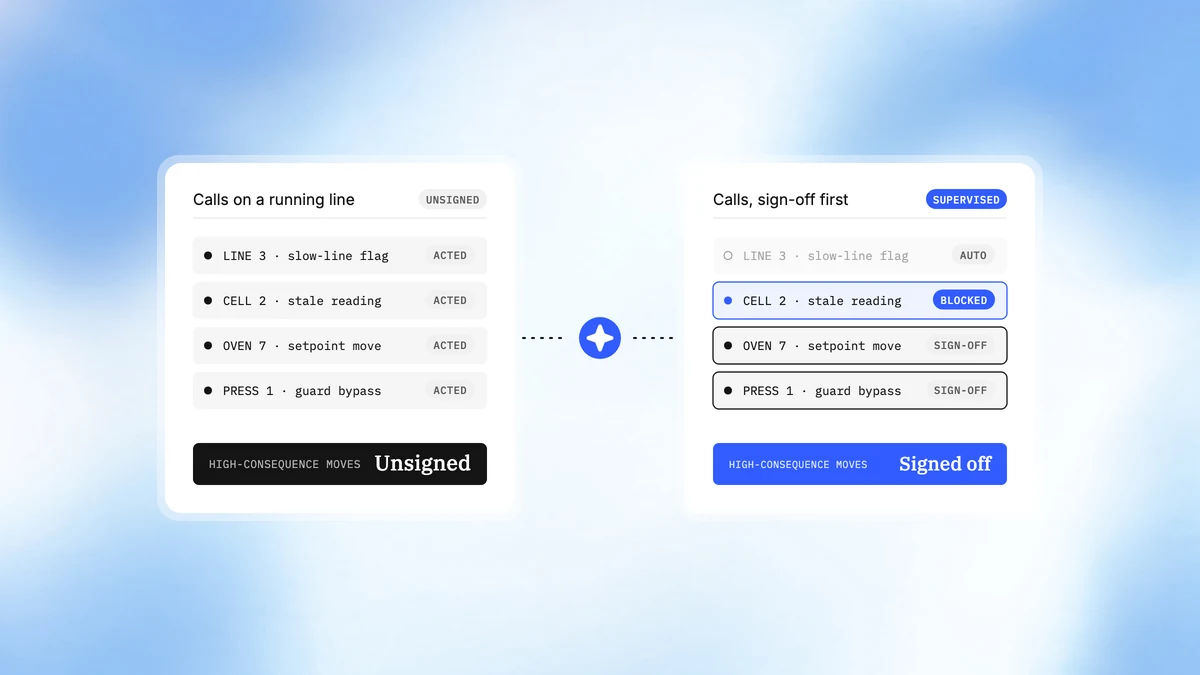
- Size and risk, not only rules. An unusually large reorder, or one on a constrained item, waits for a planner with the projected position attached. Routine restocking flows through untouched.
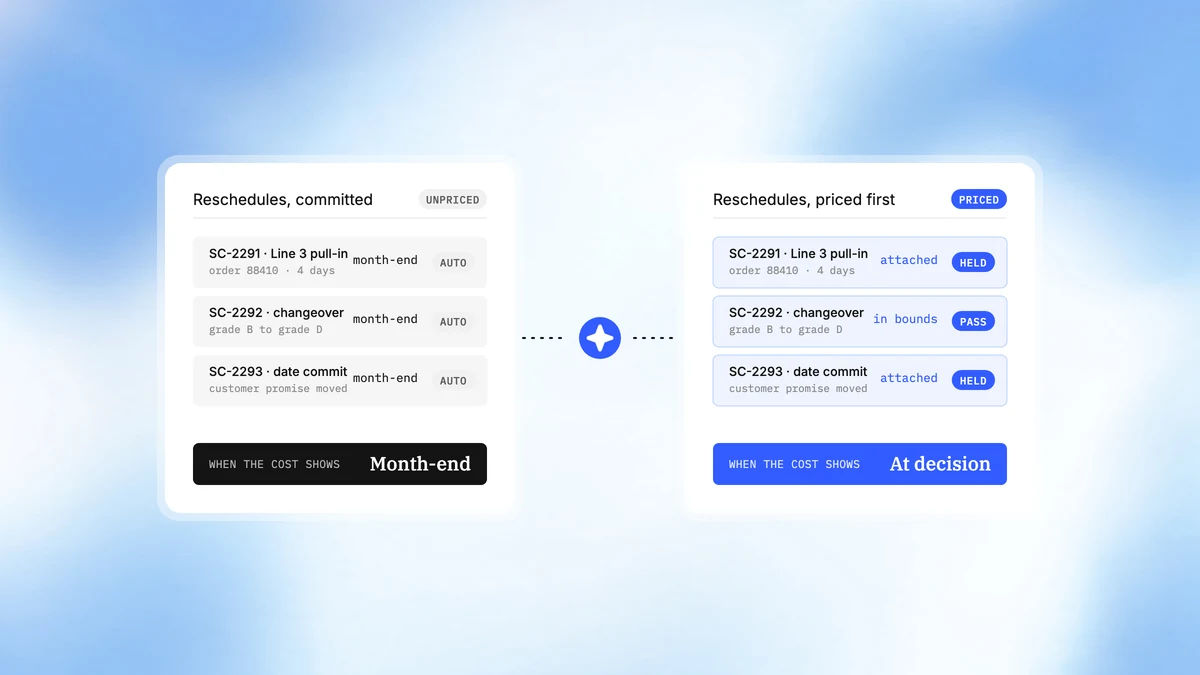
Either number can be improved by making the other worse.
Working capital and stockout rate are reported on the same category over the same window, so the trade is visible rather than selected.
Outcome Derived
This is a 60 to 90 day pilot on a single line, cell, category or product family. The figures below are what the pilot measures against a baseline captured in its first two weeks. They are targets and instrumentation, not results already delivered.
- Working capital released. Measured on the pilot category against the inventory held at baseline.
- Stockout rate movement. Tracked over the pilot on the same category, so both failure directions are visible.
- Reorders held and why. Each with the rule and the projected position that triggered the hold.
Highlights
- The checkpoint sits between whatever produces the reorder and the ERP that acts on it, so the source can be a planning system, a planner's spreadsheet or a newer forecasting tool.
- Working-capital ceilings, minimum and maximum coverage, supplier minimums, launch and discontinuation dates and service-level targets are enforced as written.
- Coverage, in-transit stock and open commitments are checked against today's position, not the position the forecast assumed when it ran.
- Both failure directions are reported together, because releasing cash while emptying the shelf is not an improvement.
- Every reorder and every hold is traceable to the decision behind it, which is what makes the same mistake stoppable next cycle.
Frequently asked questions
Do we need an AI forecasting tool for this to be useful?
No. The checkpoint governs reorders heading into the ERP whatever produced them, including a planner's spreadsheet. It works on the process you run today, and it is the control that makes it safe to let more of that process run on its own later.
How is this different from the controls already in our ERP?
ERP controls mostly catch an error after the reorder has committed, and they cannot tell you which forecast caused a working-capital swing. This checks each reorder before it commits and keeps a record that traces a swing back to the specific decision behind it.
What stops a reorder?
A breach of the coverage band in either direction, a duplicate of an open commitment, a supplier minimum or dock constraint the forecast did not see, or a value above the ceiling set for that category. It is stopped, or routed to a planner as a one-action confirm with the projected position shown.
Why report stockouts and working capital together?
Because either one alone can be improved by making the other worse. Releasing cash by under-ordering is not a result. The readout carries both movements on the same category over the same window, so the trade is visible instead of selected after the fact.