On this page
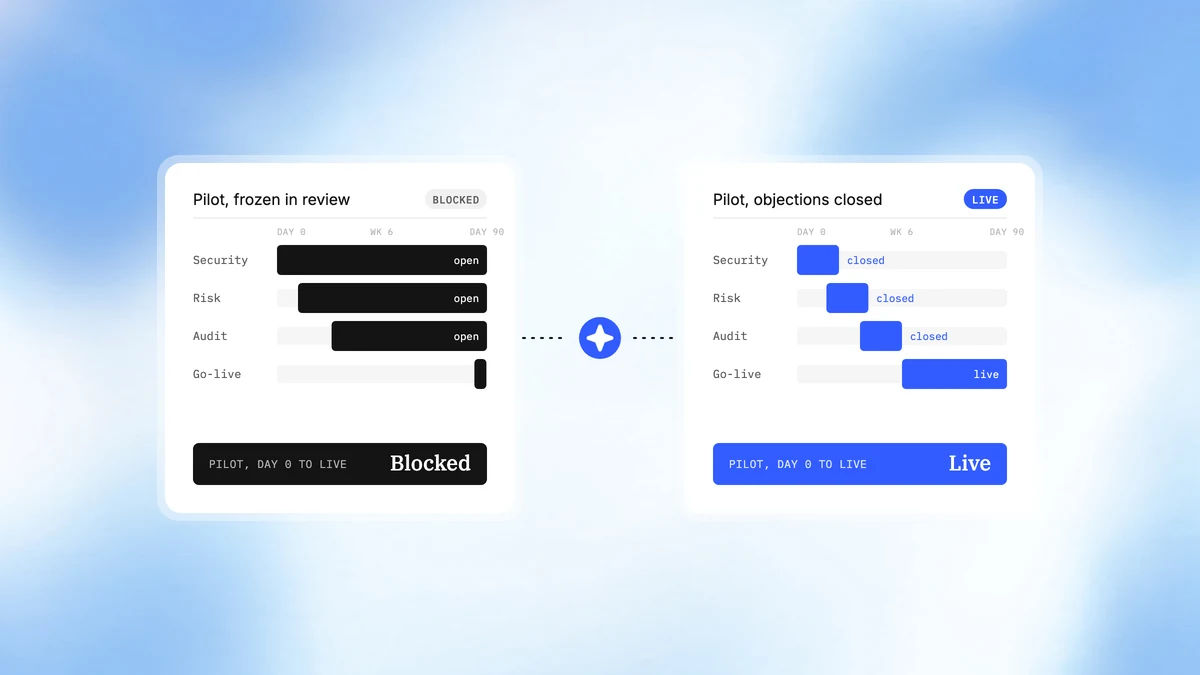
Pilot length: baseline, watch-only, enforce, then a readout against one agreed number.
Watch-only phase. Every agent action is scored and nothing is blocked, so the value is visible at zero risk.
Runs inside the manufacturer's own environment, including at the plant.
Challenge
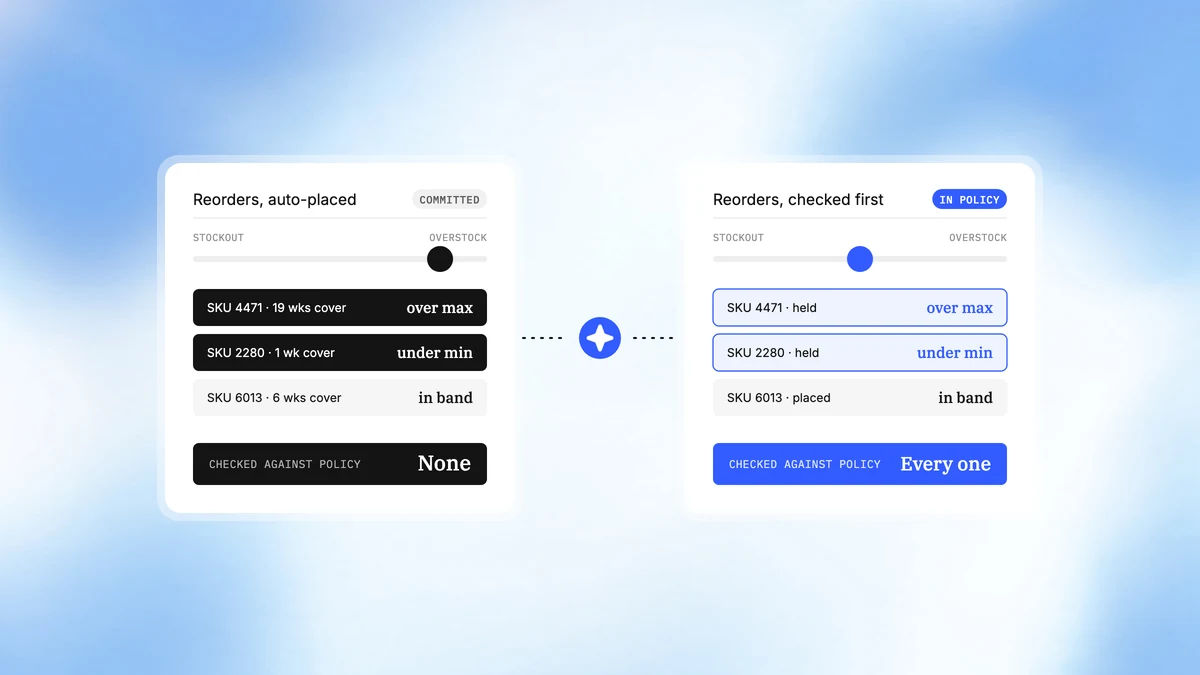
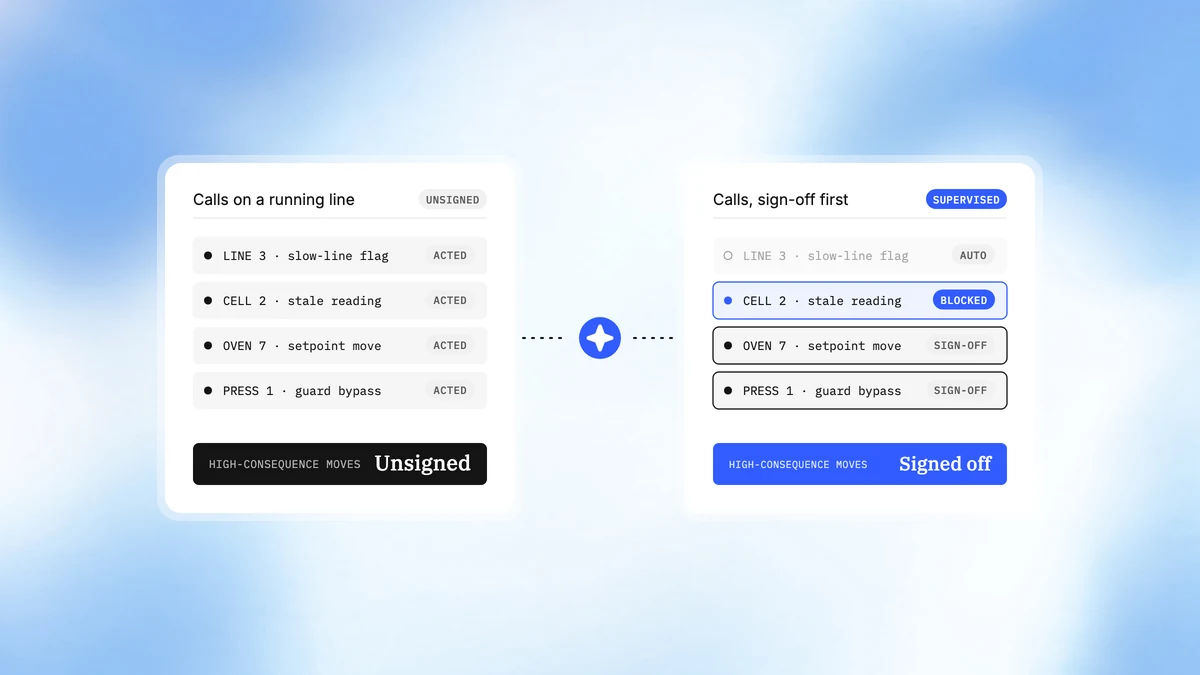
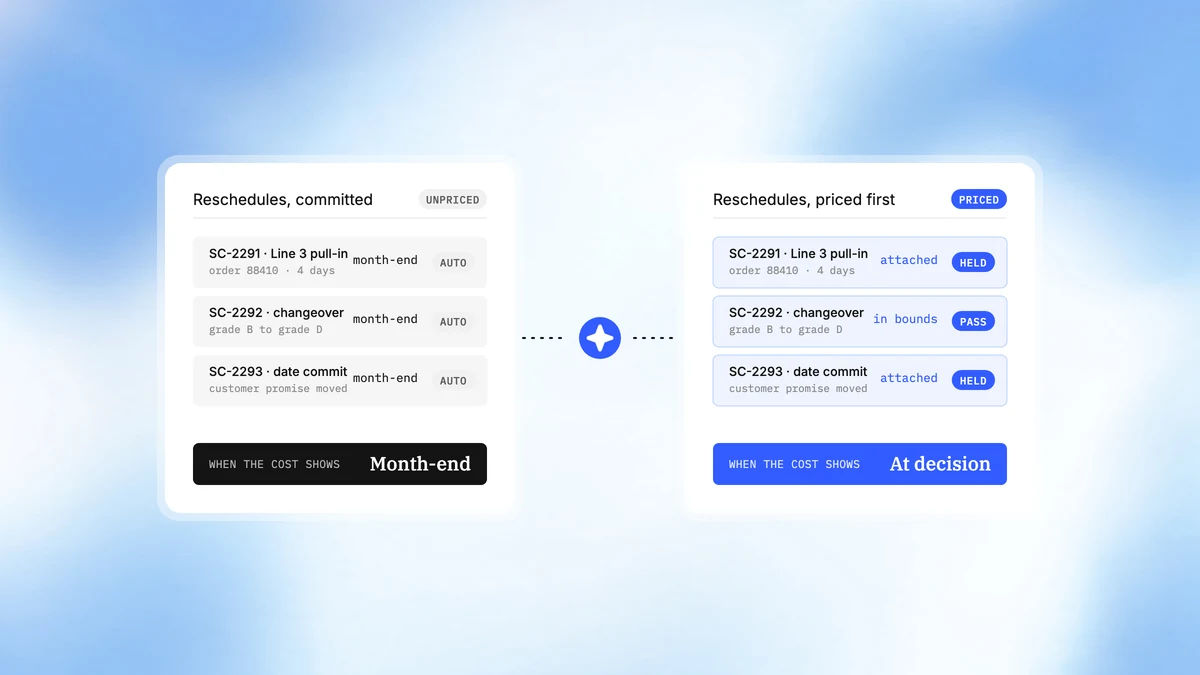
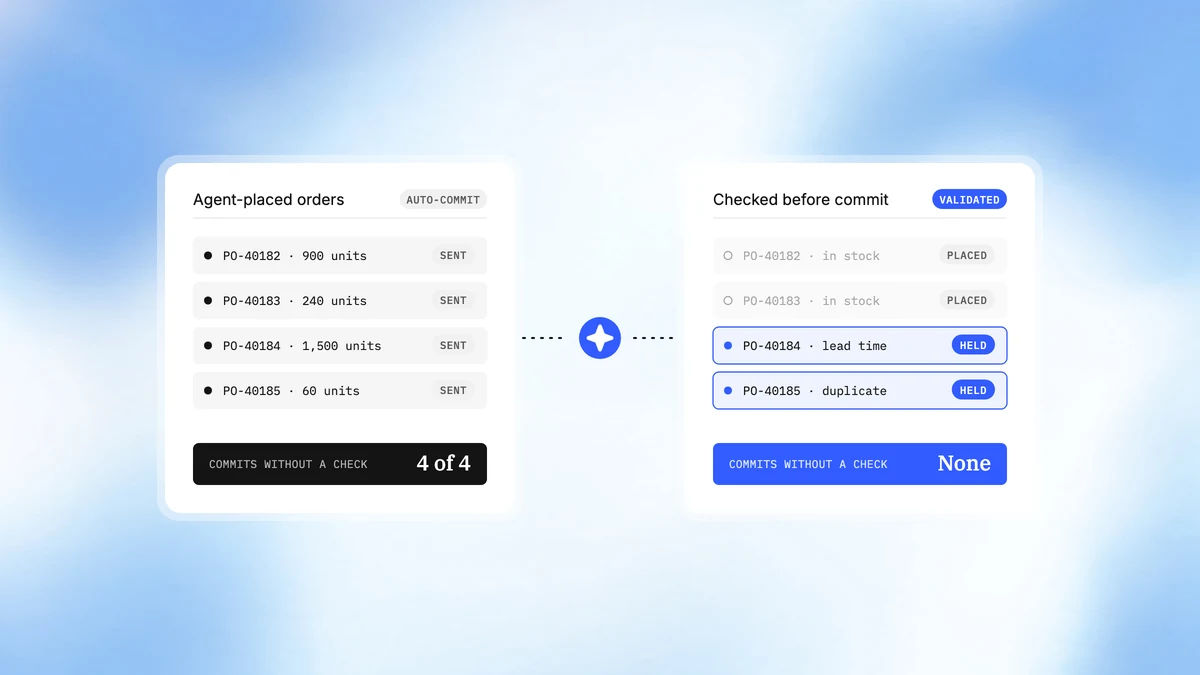
Planning and procurement tools now cut real purchase orders, move real inventory, and rewrite production orders on their own. When one gets it wrong, someone pays the expedite freight to unscramble it, or a customer ship date is missed.
- The action is real, not a recommendation. An agent that writes to ERP has already committed the company by the time a human sees it.
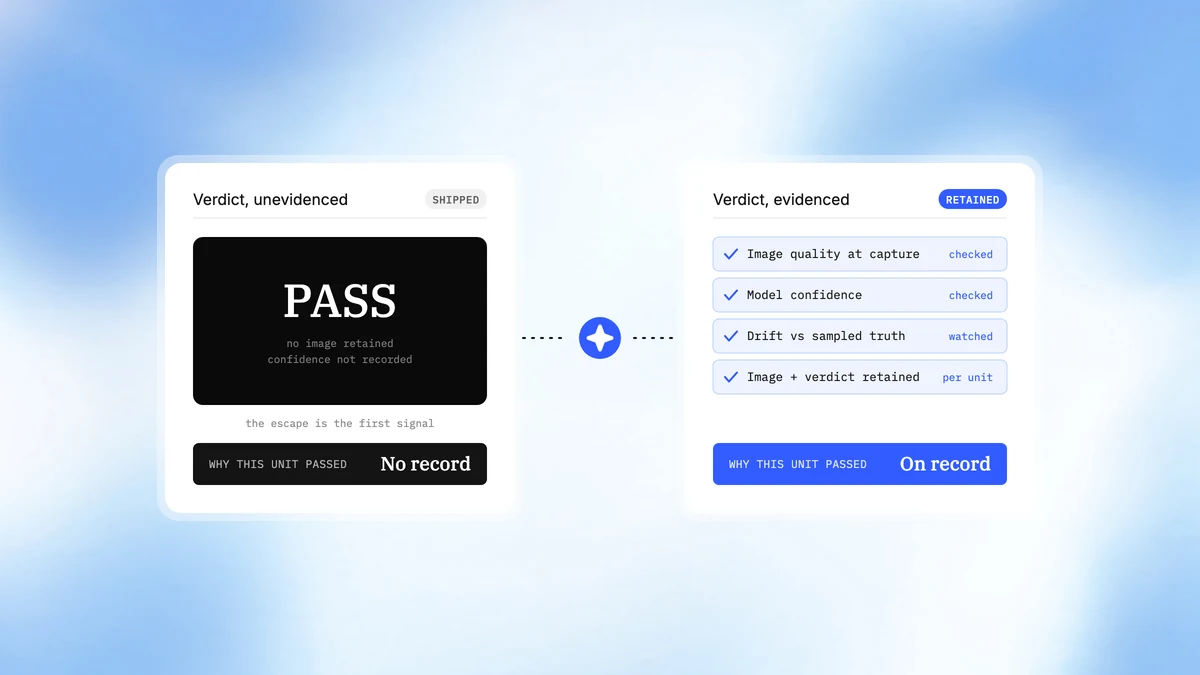
- Most of these tools never reach production. McKinsey's 2025 State of AI survey found most organisations still have AI in experimentation or pilot rather than in production. Our own reading of manufacturing is narrower: the floor cannot check a call it cannot see.
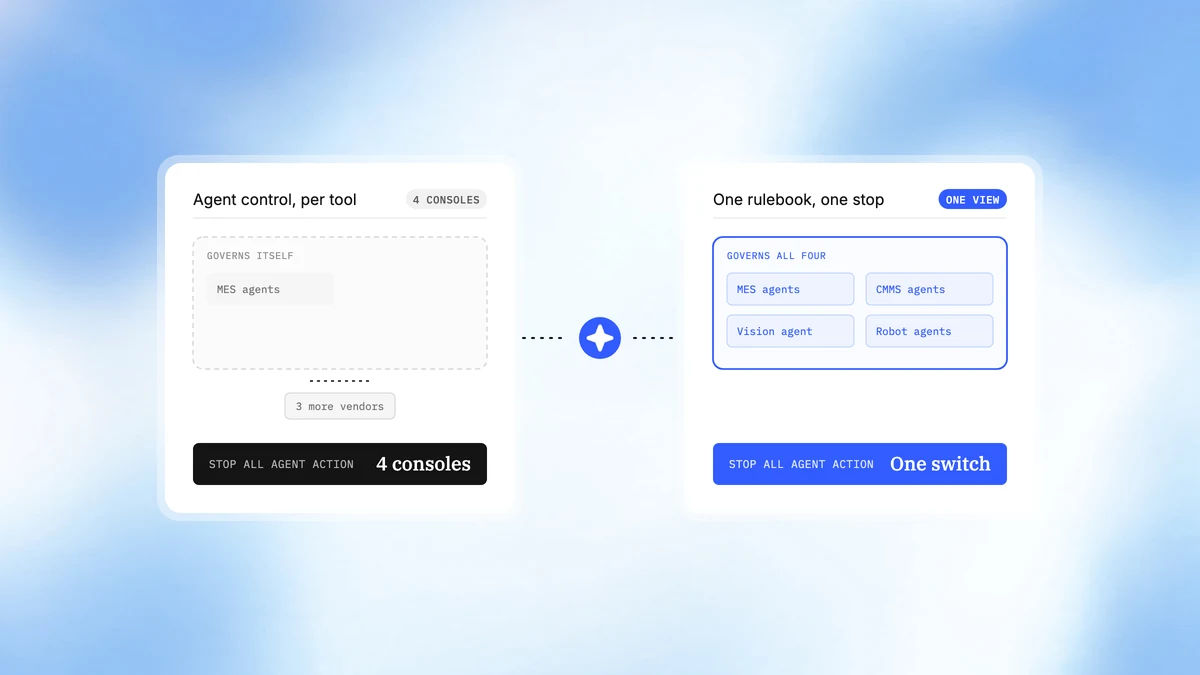
- No vendor ships the layer underneath. Every tool governs its own actions. Nothing governs actions across the tools an operation actually runs.
One order, at the moment it commits
- 01
The agent proposes an order
Reads A plan that may be minutes old
Emits A purchase order, inventory move or production order
- 02
Live state is read again
Reads On-hand and in-transit stock, supplier standing, current lead time
Held A pass, or the reason it failed
- 03
The operation's own thresholds apply
Reads Value bands, supplier status and exception types set locally
Held Wrong quantity and wrong timing stop here
- 04
Write, or ask the buyer who owns it
Reads A held order, routed to the named category buyer rather than a queue
Emits The order unchanged once cleared. Nothing outside its scope, ever.
Solution
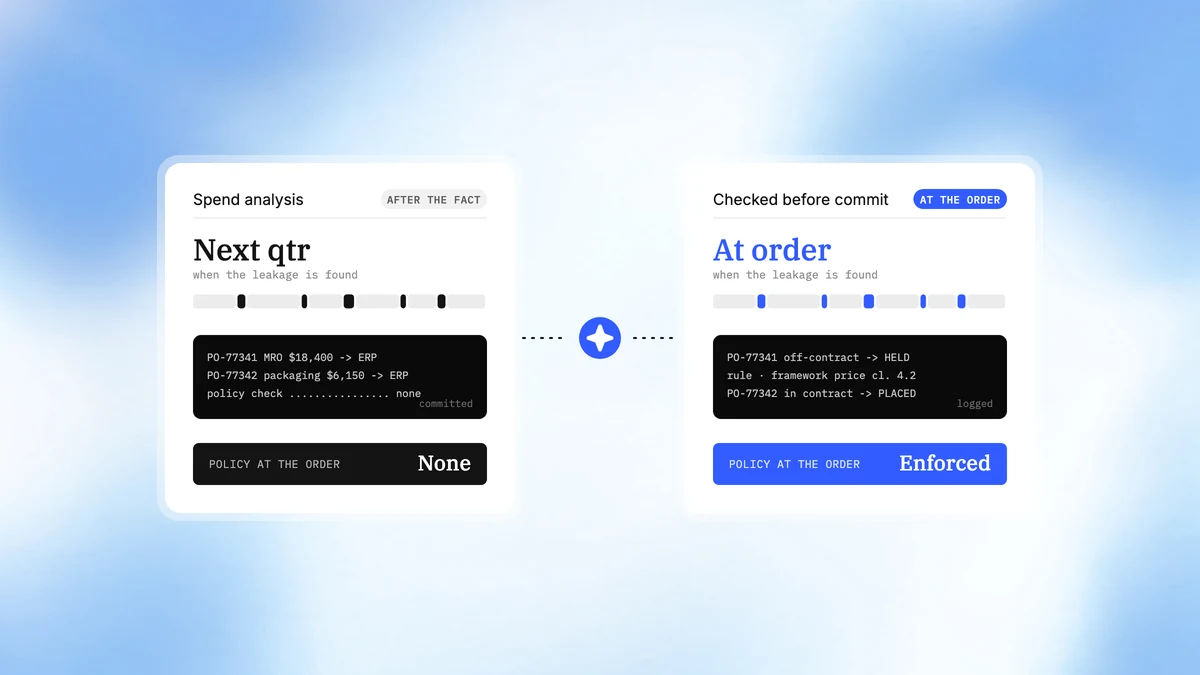
The order still gets placed. It stops for a moment at the point of write, where the state it assumed can still be checked.
- Re-read at the moment of write. The plan the agent acted on may be minutes old, so stock, lead time and open commitments are read again before the order is allowed through.
- Wrong quantity and wrong timing stop here. The failure this catches is an order that is operationally wrong: too much, too early, or against a supplier who cannot deliver it.
- Your thresholds, enforced not requested. Value bands, supplier status and exception types decide what passes and what waits for a buyer.
- A plain-language record of every call. What the agent proposed, what was checked, what happened, and who approved it.
What the Check Reads, and What It May Write
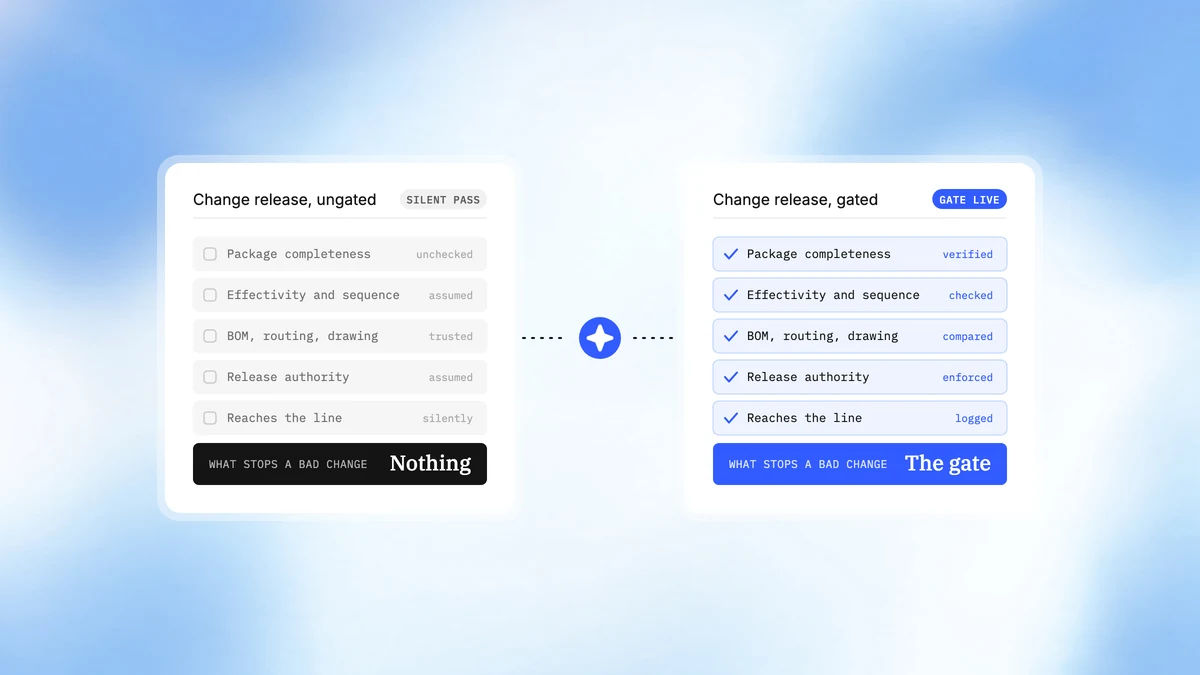
The checkpoint is not a review queue bolted to the end of the process. It sits on the write path, between the tool that decided and the system that would have recorded the decision as a fact.
- What it reads. On-hand and in-transit stock for the part, the supplier's current standing on the approved list, the lead time actually being quoted, and every open order or reservation already against the same demand. Read at the moment of write, not inherited from the plan run.
- What it writes. The purchase order, inventory move or production order, unchanged, once it passes. A clean order is not rewritten or improved. It is allowed through as proposed or it is stopped.
- What it is never allowed to write. Anything outside the workflow it was scoped to. It has no write path to master data, supplier records or contract pricing, so the rule cannot be widened by the thing the rule governs.
- Who gets asked. The buyer who owns the category, not a shared queue. The hold arrives with the order, the rule that stopped it, the live position that failed, and an approve or reject that takes one action.
- What is kept. What was proposed, which rules cleared, which check failed, who decided, and when. Held orders are retained as carefully as released ones, because the prevented order is where the saving is evidenced.
The tool that placed the order is the tool grading it.
A checkpoint is worth something only when it has no stake in the order going through.
What Happens When the Check Itself Is Wrong
Two failure modes matter more than the ones a demo shows. The first is a checkpoint that reads stale data and blesses a bad order. The second is a checkpoint that holds a good order and nobody is there to release it.
When the ERP is behind reality
- The read is timestamped. A position older than the freshness threshold set for that data fails the check rather than passing it. A stale read holds the order instead of clearing it.
- Silence is not agreement. If a source system does not answer, the order does not proceed on the assumption that nothing changed since the plan ran.
- The plant is often ahead of the record. A goods receipt not yet booked is a known gap. The rule set names the fields where physical truth leads the system and treats them as unknown rather than as zero.
When nobody responds
- A hold has an owner and a clock. Every held order names one approver and an escalation after a defined wait, agreed before go-live rather than during the first backlog.
- The default is not release. An unanswered hold stays held. An operation that quietly releases on timeout has a checkpoint in name only.
- Backlog is reported, not buried. The count of waiting orders is part of the weekly readout, because a control nobody can staff is a control that gets switched off.
Outcome Derived
This is a 60 to 90 day pilot on a single line, cell, category or product family. The figures below are what the pilot measures against a baseline captured in its first two weeks. They are targets and instrumentation, not results already delivered.
- Expedite spend avoided. Counted against the baseline measured in weeks 1-2, on the single line or value stream chosen for the pilot.
- Orders stopped before commit. Every held order is logged with the rule that held it, so the number is auditable rather than asserted.
- A decision record for each action. Designed to give the buyer and the auditor the same view of why an order was placed or blocked.
Highlights
- The checkpoint owns the moment an order becomes real. Planning stays where it is and no tool is replaced.
- Stock, lead time, supplier status and open commitments are read again at the point of write, because the plan the agent acted on may be minutes old.
- Value bands, approved-supplier status and exception types are enforced beneath the agent rather than requested of it.
- Runs inside the manufacturer's own environment, including at the plant, so demand, supplier and cost data has no route out.
- Every order carries its own record: what was proposed, what was checked, which rule decided, and who approved it.
Frequently asked questions
Do we have to replace our planning or procurement system?
No. The tools that plan keep planning. The checkpoint sits on the path an order takes to become real, so a purchase order, inventory move or production order clears your rules and a live read of stock, lead time and open commitments before it commits. Nothing is ripped out and no planner learns a new system.
What actually stops an order?
A rule you set, or a fact that changed since the plan ran. An order fails when it duplicates a commitment already open, names a supplier no longer in good standing, breaches a value band, or assumes stock or a lead time the live read does not support. It is handed back with the reason before it becomes committed.
Will this slow down the orders that are fine?
Routine orders inside your thresholds pass without waiting for anyone. Only the ones above the bands you set stop for a buyer, and they arrive with the rule, the live position and a single approve or reject. Judgment gets spent where it changes an outcome, not on every line.
Does our supplier and cost data leave our environment?
No. The control plane and storage run inside the manufacturer's own environment, including at the plant. Each run is isolated in its own guest kernel and outbound paths are allowlisted in the kernel, so demand, supplier and cost data has no route out rather than a policy saying it will not be sent.
What does the pilot actually prove?
One number, agreed before week one, on one line, category or value stream. Weeks one and two capture the baseline. Weeks three to six score every agent action with nothing blocked. Enforcement follows, and the readout compares held orders and expedite spend against that baseline. It is instrumentation, not a delivered result.